Vibhishana warned Ravana to return Sita, but was exiled. A story of choosing dharma over family loyalty, and Rama who welcomed the defector. A Ramayana tale of difficult choices
14 July 2026 · 4 min read
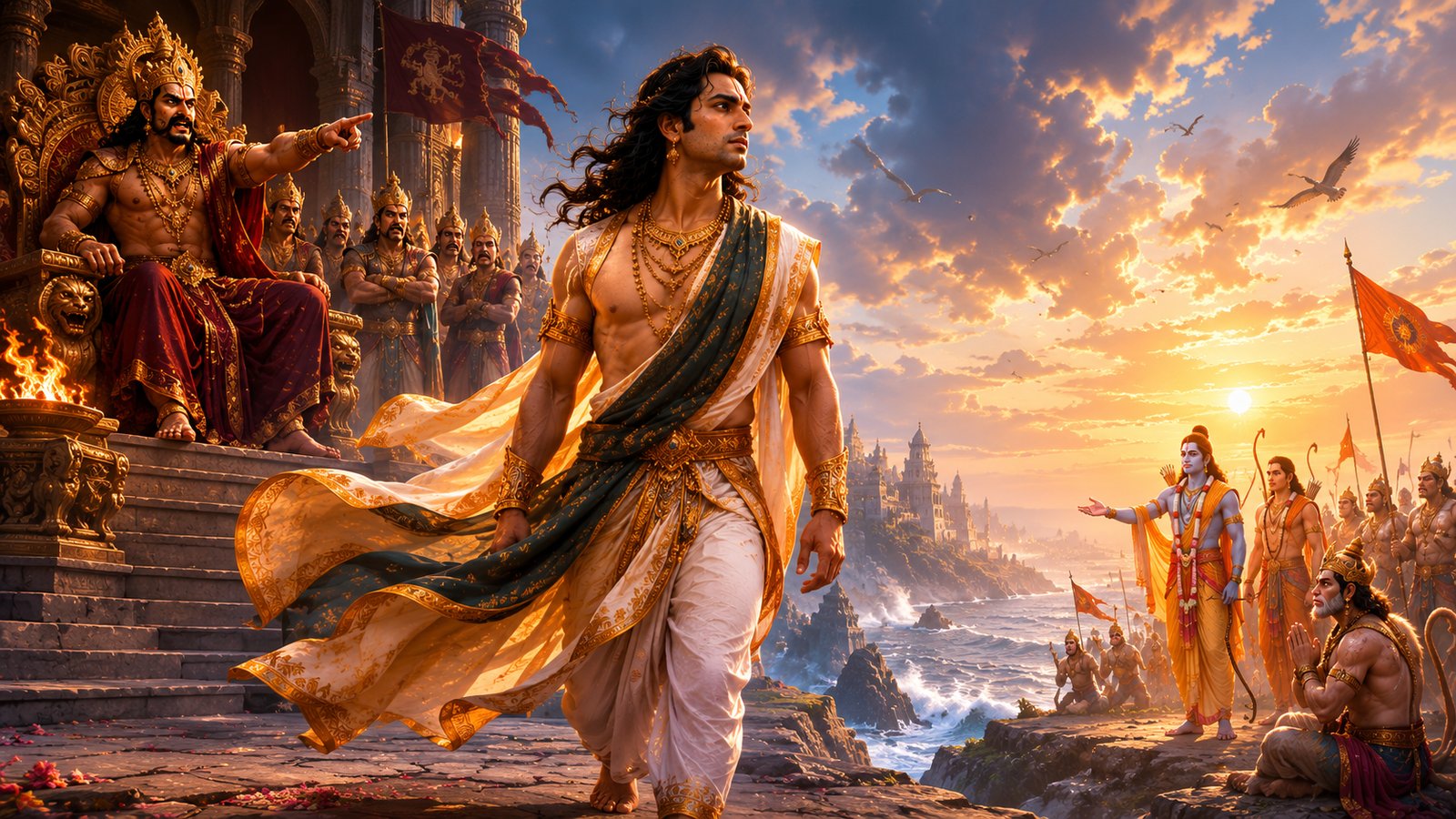
Every family has one member who says the thing no one else wants to say out loud. In the Ramayana, that person was Vibhishana youngest brother of Ravana, king of Lanka and the thing he said out loud cost him his home, his title, and his place in his own family.
By the time Rama's army had crossed the ocean and laid siege to Lanka, Ravana still had one option left that didn't involve war: return Sita, apologize, and let the whole conflict end before it truly began. He called his council of ministers and brothers to weigh it. Most told him what he wanted to hear that Lanka's armies were unmatched, that no one could breach its gates, that surrender was beneath a king of his stature.
Vibhishana stood up and told him something else entirely. Taking another man's wife by force was not a small transgression to be defended with military strength, he said it was adharma, plain and simple, and no fortress or army could make it otherwise. He urged Ravana to return Sita to Rama, make peace, and spare Lanka a war it did not need to fight.
Ravana did not receive this well. To a king already committed to his position, surrounded by advisors telling him he couldn't lose, his own brother's warning didn't sound like loyalty it sounded like betrayal, or worse, cowardice dressed up as wisdom. Ravana insulted him in front of the entire court and, in most tellings, kicked him out of the palace outright.
Vibhishana was left with two impossible choices. He could stay silent and watch his brother lead their entire kingdom into a war built on a wrong he believed in his bones was indefensible. Or he could leave the only home and family he had ever known, and go stand with the army about to besiege it.
He chose to leave.
Vibhishana flew to Rama's camp and offered his loyalty not out of hatred for his brother or his homeland, but because he believed Rama's cause was the just one, and Ravana's was not. This was not a small thing to offer or to accept. Rama's own commanders were wary. Sugriva, in particular, argued that a king's brother arriving unannounced from the enemy camp was far more likely to be a spy than a genuine ally, and urged Rama to imprison or kill him before he could do any damage.
Rama chose differently. He said that anyone who came seeking refuge, even once, deserved protection that turning away a person who asked for shelter was not something he was willing to do, regardless of who that person's brother happened to be. He welcomed Vibhishana, and in time, crowned him king of Lanka in place of Ravana even before the war had been won — a declaration of trust extended to a man everyone else in the room still suspected.
Vibhishana went on to serve as a guide through the war that followed, offering Rama's side knowledge no outsider could have had Lanka's weaknesses, Ravana's secrets, even the location of the sacrificial rite Ravana's son Indrajit used to make himself briefly invincible. Whatever the cost of his choice, Vibhishana did not make it half-heartedly.
It would be easy to call this a simple story about good triumphing over evil, with the brother who chose good rewarded for it in the end. But the discomfort in Vibhishana's story doesn't come from the ending it comes from the moment of the choice itself, when the outcome was not yet known and both directions came at a real cost.
Vibhishana did not leave Lanka because he stopped loving his brother, or because he was certain Rama would win. He left because he could not make himself believe that loyalty to family required agreeing with what that family was doing. The Ramayana doesn't soften how much that choice cost him banishment, the label of traitor that followed him even in later retellings, a war fought against people he had grown up with.
Most of us will never face a decision with the scale of Vibhishana's. But almost everyone, eventually, faces a smaller version of the same fork: a moment where staying loyal to a person and staying loyal to what you believe is right stop being the same thing. The Ramayana doesn't pretend that's an easy fork to stand at. It just shows you, unflinchingly, what one person chose and lets you decide what you would have said in that council room.
Mythological
29 June 2026 · 12 min read
Mythological
29 June 2026 · 10 min read
Mythological
25 June 2026 · 6 min read
Mythological
26 June 2026 · 12 min read
Mythological
25 June 2026 · 4 min read
Mythological
25 June 2026 · 12 min read