Ahalya was not turned to stone in Valmiki's Ramayana. She was made invisible, forgotten, erased. Explore her isolation, the burden of judgment, and her restoration by Rama.
29 June 2026 · 10 min read
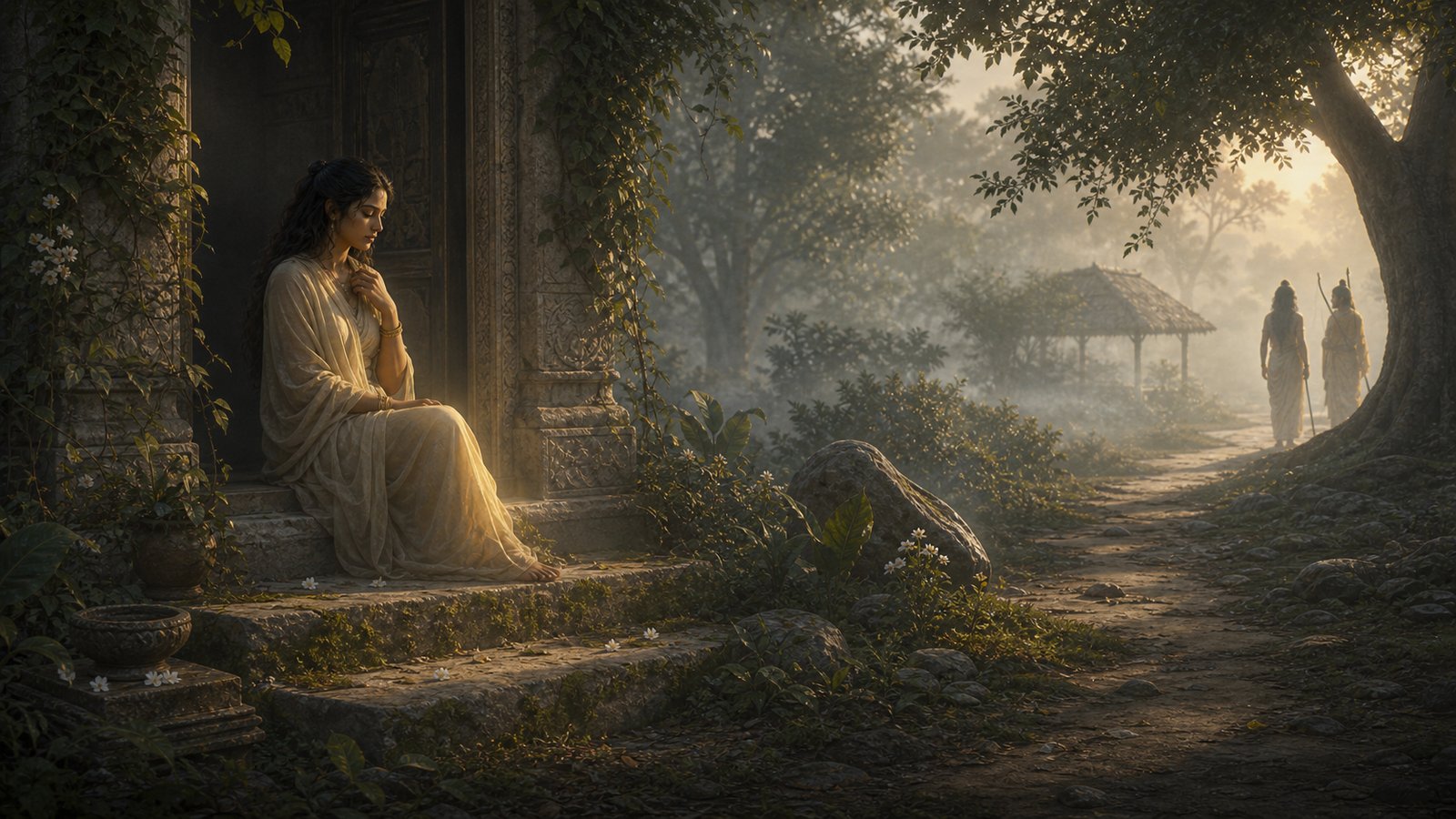
The dust of the forest road clings to the skin, but the silence of the abandoned hermitage is what truly suffocates. Ahalya stands in the threshold of a home that has become a ghost, her breath shallow, her eyes scanning a horizon that no longer recognizes her. The emotional core of her existence is not the shock of betrayal or the thunder of the curse, but the crushing weight of invisibility. She is a woman suspended between a crime she may have consented to and a punishment that seeks to erase her very presence from the living world.
The air in the hermitage is thick with the scent of old incense and stagnant time. For centuries, she has existed in the margins of the physical world, a shadow dwelling in a space where the wind forgets to blow. She is not a statue, though later poets would find it easier to imagine her as a cold, unfeeling rock than as a breathing woman enduring the agony of isolation. In the baseline of the Valmiki Ramayana, her torment is more intimate: she is unseen, inaccessible, living on air and ashes, a living ghost in a house of memories.
The tragedy began not with a mistake, but with a divine obsession. Indra, the King of the Gods, had long coveted Ahalya, whose beauty was a beacon of grace and intellect. He did not approach her with honesty, for honesty is rarely the tool of the desperate. Instead, he donned the guise of her husband, the sage Gautama. He mirrored the walk, the voice, and the aura of the man she revered. When Indra entered the sanctuary of their home, he did not just mimic a husband; he hijacked a trust.
The debate that has echoed through millennia centers on a single moment of recognition. In the Valmiki account, Ahalya recognized that the man before her was not Gautama, yet she consented. This detail is the pivot upon which all ethical interpretations turn. Was it a moment of weakness, a curiosity sparked by the divine, or a quiet rebellion against a life of rigid austerity? To judge her is easy, for the world loves to weigh a woman's morality against a god's deception. The power imbalance is staggering: a mortal woman facing the King of Heaven in the skin of her spouse. She was caught in a vortex where the divine will collided with human vulnerability, leaving her to navigate a choice that would eventually define her entire existence in the eyes of history.
When Gautama returned, the truth did not arrive as a whisper but as a storm. The sage, possessing the clarity of a seer, saw through the illusion immediately. The betrayal was twofold: the violation of the marital bond and the mockery of his spiritual standing. In a flash of divine rage, Gautama unleashed his curse. He did not merely cast her out; he stripped her of her visibility. He commanded that she remain in the hermitage, forgotten by the world, stripped of the luxury of being seen or heard. He spoke words that acted as a wall, sealing her away from the sight of men and gods alike, ensuring that her presence would be as absent as a dream upon waking.
Indra, too, was cursed, his divinity scarred by his transgression. But for Ahalya, the punishment was a slow erosion of the self. To be invisible is to be dead while the heart still beats. She remained in the abandoned hermitage, a silent witness to the passage of seasons. She did not eat the fruits of the forest or drink from the streams; she survived on the thin air of penance and the grey ashes of her former life. This was the true nature of her austerity not a quest for enlightenment, but a desperate attempt to maintain a shred of dignity in a void of absolute loneliness.
The danger of Ahalya's story lies in how we remember her. For generations, the narrative shifted, turning her into a stone. The stone motif is a powerful metaphor for the way society views the "fallen" woman: she is rendered immobile, silent, and devoid of agency. A stone cannot argue, cannot explain, and cannot feel. By turning her into rock, later traditions sanitized her suffering, making her a prop in a miracle story rather than a human being grappling with guilt and isolation. But the original silence was far more piercing than the hardness of granite. To be a rock is to be numb; to be an invisible woman is to feel every single nerve ending screaming for a witness.
In the silent hermitage, Ahalya became a scholar of her own solitude. She learned the rhythm of the wind and the language of the void. She lived in the tension between the woman she was the beloved of a sage and the ghost she had become. The responsibility for the act was shared between the deceiver and the deceived, yet the burden of the shame was placed solely upon her shoulders.
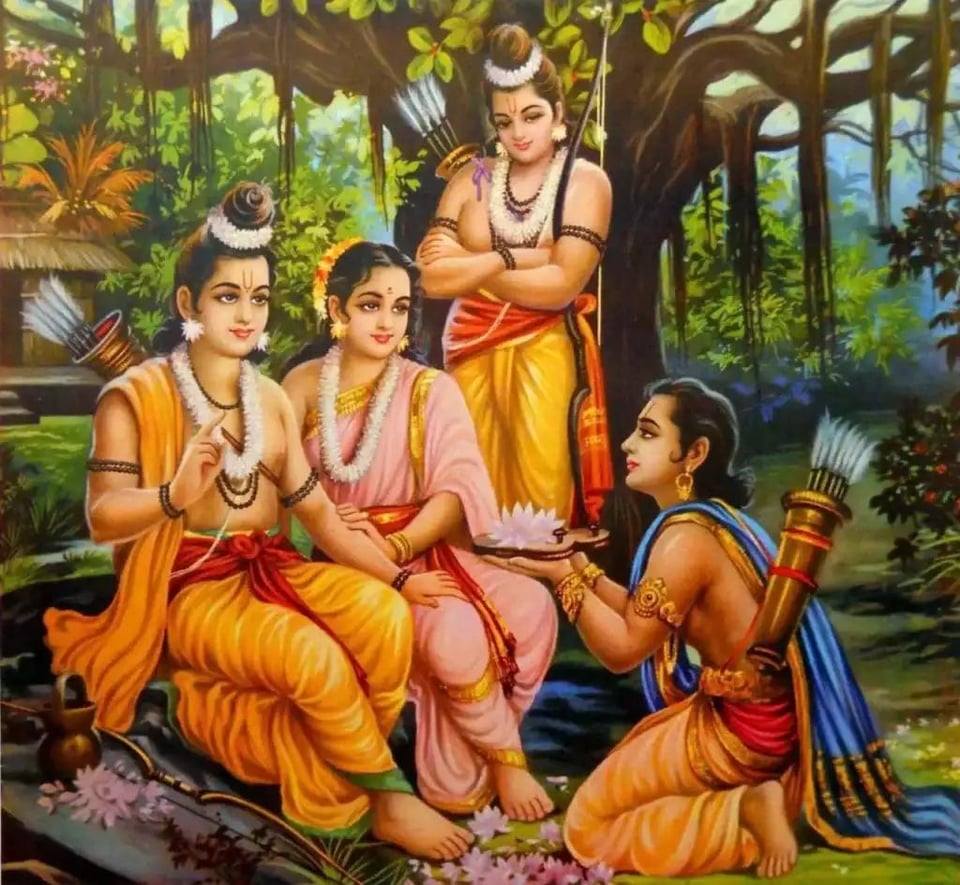
Years bled into centuries. The forest grew thick around the hermitage, reclaiming the walls and the courtyards. The world forgot that a woman lived there, breathing the dust of a broken promise. Then came the sound of footsteps not the heavy, rhythmic tread of a sage, but the light, purposeful stride of youth. Rama and Lakshmana, guided by the wisdom of Vishvamitra, entered the clearing. The air seemed to shimmer as they approached the site of the forgotten woman.
Rama did not come with a judgment or a lecture on morality. He came with the simple, transformative power of recognition. In the Valmiki tradition, the act of Rama's arrival is the catalyst for her restoration. He saw her not as a sinner to be cleansed, but as a soul to be acknowledged. When his gaze fell upon her, the veil of invisibility that Gautama had woven finally tore. The world rushed back in the colors of the forest, the warmth of the sun, the sound of her own voice returning to her throat. It was a sensory explosion, a sudden flood of existence that nearly overwhelmed her, as the grey world of ashes was replaced by the vibrant green of the living earth.
The hospitality Ahalya offered the brothers was not merely a social grace; it was the first act of a reclaimed life. After centuries of living on ashes, the act of providing water and shelter was a reclamation of her role as a mistress of her own home. She was no longer a shadow; she was a host. In this exchange, Rama validated her existence. He did not ask for a confession or a plea for forgiveness; he simply acknowledged her presence, and in doing so, he dismantled the prison of her isolation.
The restoration was completed when Gautama returned. The curse had a terminus, a point where the penance was deemed sufficient. The sage, having moved past the white heat of his anger, accepted Ahalya back into his life. This reunion is often read as a happy ending, but it carries a quiet, lingering tension. Can a relationship truly recover from a curse that lasted centuries? The text suggests a restoration of order, but the emotional scars remain etched in the silence that followed their reunion.
We must ask ourselves why the stone image persists in our collective memory. It is because the idea of a woman turning to stone is more comfortable than the idea of a woman being systematically erased by the judgments of men. A stone is a curiosity; a forgotten woman is a mirror reflecting our own capacity for cruelty. Ahalya's true journey was not from rock to flesh, but from invisibility to visibility. She moved from the periphery of existence back to the center, not through her own power, but through the grace of someone who looked at her and saw a human being.
The ethical debate regarding her consent remains a thorn in the narrative. Some argue she was a victim of divine trickery; others suggest she was an accomplice in her own downfall. However, the most vital question is not whether she was "right" or "wrong," but why the punishment for a perceived moral lapse was the total erasure of her identity. By making her invisible, Gautama controlled who she was and how she was perceived. He turned her into a non-entity, a cautionary tale without a voice.
Ahalya's silence in the hermitage is a testament to the endurance of the human spirit. To live for ages without a single voice to answer yours is a psychological torture that transcends physical pain. Yet, she did not succumb to madness. She maintained her austerity, her focus, and her essence. She waited in the grey space between existence and non-existence, holding onto the memory of her own name until the world finally called it back.
When we look at the ruins of the silent hermitage, we see more than an ancient story of a curse and a blessing. We see the blueprint of how society treats those who deviate from the prescribed path of purity. The "fall" of Ahalya is a recurring motif in human history the moment a woman is branded and subsequently cast into a social invisibility that is as restrictive as any stone wall. Her restoration by Rama is a reminder that the only cure for such isolation is a witness who refuses to judge.
The cinematic quality of her return the sudden burst of light, the shedding of the ash-covered robes, the first sip of water serves as a visceral release of tension. It is the moment the breath returns to the lungs after a long dive into dark water. The relief is not just hers, but the reader's. We want her to be seen. We want the world to acknowledge that she survived the void.
In the end, Ahalya is not a cautionary tale about the dangers of desire or the power of a sage's anger. She is a story about the danger of remembering a woman only through the judgments of the men in her life. She was the wife of a sage and the target of a god, but in the silence of the hermitage, she was simply Ahalya. She was the one who endured. She was the one who waited. She is the embodiment of the quiet strength that persists when all external validation is stripped away.
The memory of Ahalya should not be a memory of a stone, but a memory of a heartbeat persisting in a vacuum. The act of seeing is the highest form of redemption. It is the bridge that connects the isolated soul back to the community of the living, transforming a ghost back into a human being.
As the sun sets over the forest of the Bala Kanda, the hermitage is no longer silent. There is the sound of conversation, the rustle of leaves, and the quiet peace of a woman who has returned from the edge of nothingness. The ashes have been swept away, and the air is once again sweet with the scent of blooming jasmine. Ahalya stands once more in the light, not as a miracle of alchemy, but as a survivor of the most profound loneliness.
The legacy of this narrative is found in the space between the versions. Between the woman who consented and the woman who was deceived, between the ghost and the stone, there is a human being. That human being is the core of the Ahalya story. Her story is a timeless reminder that the human spirit is more durable than the hardest rock and more persistent than the longest silence.
The silence of the hermitage was not a void, but a cocoon. In that stillness, Ahalya stripped away everything that was not essential. She became the essence of patience. When Rama arrived, he did not just break a curse; he recognized a strength that had been forged in the fire of absolute solitude. This is the true miracle of her story: not that she became human again, but that she remained human while the world tried to turn her into something else.
Valmiki Ramayana, Bala Kanda 48–49, for Indra, Gautama's curse, Ahalya's seclusion, Rama's arrival, hospitality, and restoration.
IIT Kanpur/ValmikiRamayan.net verse and prose editions for passage cross-checking.
The stone transformation is identified as a later popular/textual development, not stated explicitly in Valmiki's baseline episode.
Mythological
14 July 2026 · 4 min read
Mythological
29 June 2026 · 12 min read
Mythological
25 June 2026 · 6 min read
Mythological
26 June 2026 · 12 min read
Mythological
25 June 2026 · 4 min read
Mythological
25 June 2026 · 12 min read