Jatayu knew he was old and Ravana was powerful. He fought anyway, turning a failed rescue into one of the Ramayana's deepest acts of courage and kinship.
25 June 2026 · 12 min read
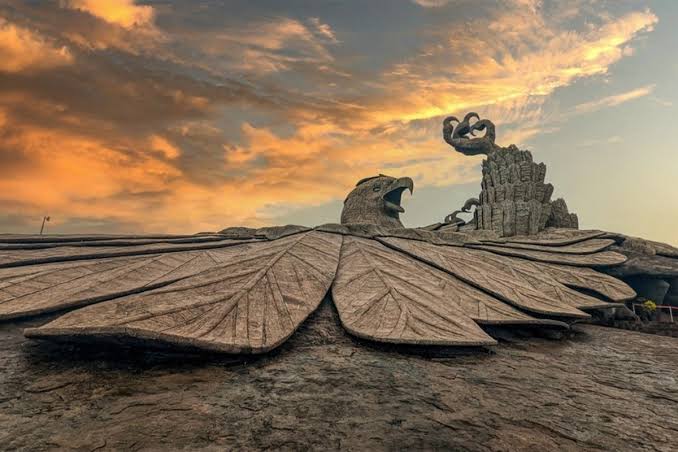
Sita saw the old vulture on a tree while Ravana's chariot was carrying her away.
She did not ask him to defeat the king of Lanka. She knew the difference between them. Ravana was armed, armored, young enough for battle, and driving a celestial chariot. Jatayu was old. In Valmiki's telling, he himself says age has worn him down.
Sita asked him to tell Rama.
Jatayu could have survived by becoming a witness. Instead, he opened his wings.
He did not save Sita that day. Ravana cut him from the sky. Yet his failed rescue became one of the Ramayana's clearest answers to a difficult question: what is courage worth when victory is unlikely?
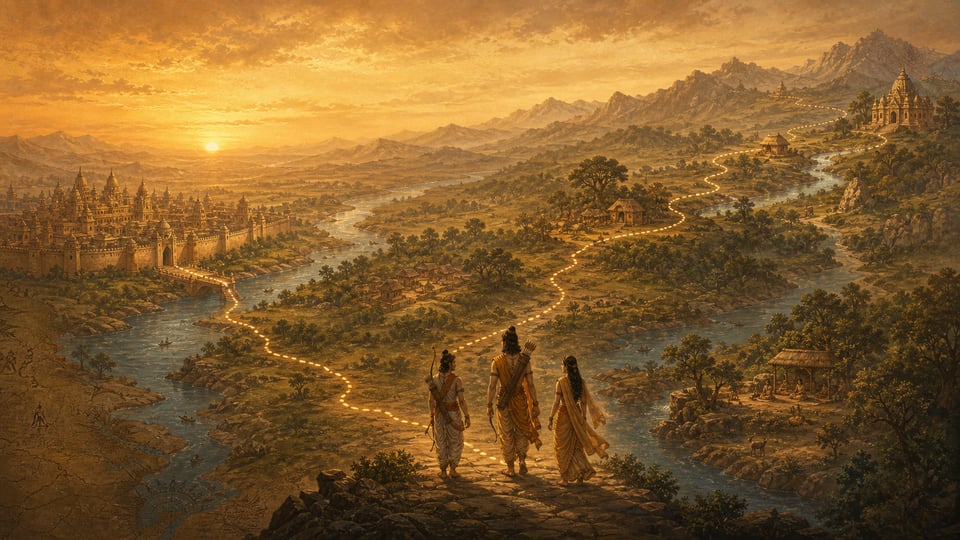
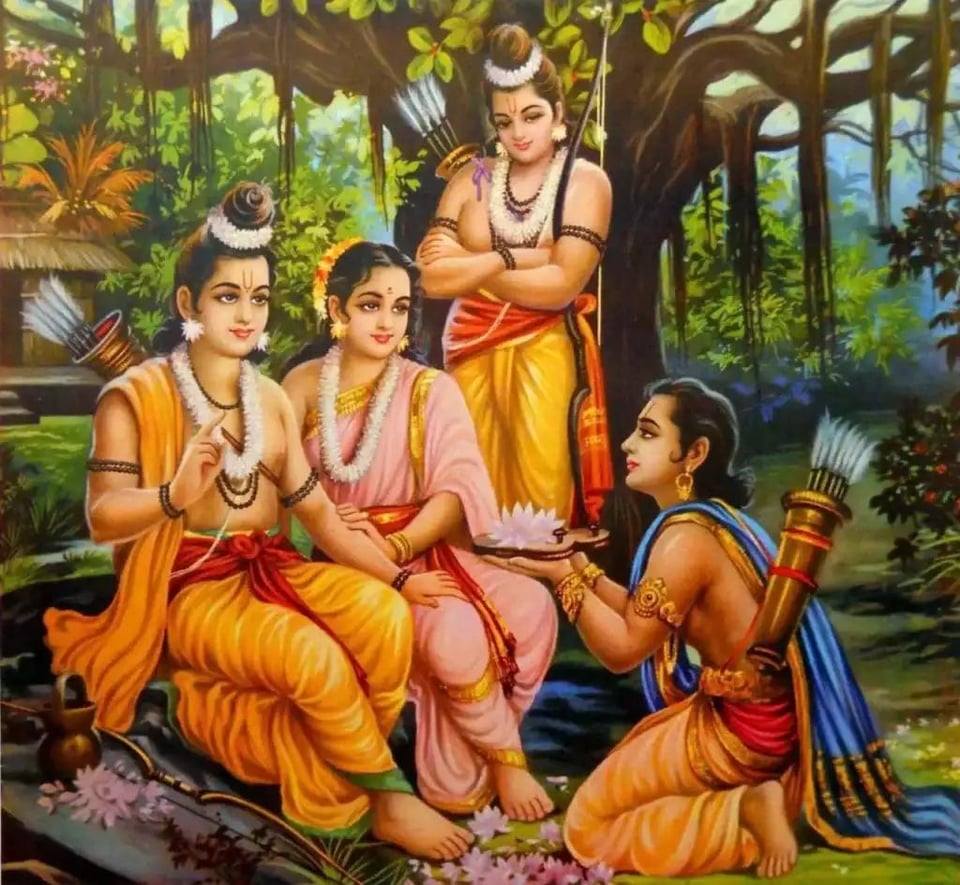
Rama, Sita, and Lakshmana had met Jatayu earlier while moving through the Dandaka forest. At first, the enormous bird startled them. Jatayu introduced himself and explained his ancestry among the great birds. More importantly, he named his human bond: he had been a friend of King Dasharatha.
Dasharatha was already behind them in Ayodhya, and his sons did not yet know that grief had taken his life. In the forest, Jatayu became a living thread to the father Rama had left.
He offered help. While Rama and Lakshmana were away, he would guard Sita.
The offer was not grand strategy. He had no army, palace, or network of scouts. He gave what he had: his presence, his age-earned judgment, and the loyalty he still felt toward a dead friend's family.
That makes his later choice more than a spontaneous heroic impulse. When Sita's cry reached him, an old promise suddenly demanded a price.
He could have reasoned that guarding Sita was no longer possible. Ravana had already seized her and risen into the air. Rama and Lakshmana were absent. The enemy possessed weapons and supernatural strength. No one would reasonably accuse an aged bird of cowardice for carrying the news instead.
Indeed, that was what Sita initially asked of him: remain alive, remember, tell Rama.
But Jatayu understood friendship as something more demanding than delivering information after the danger had passed. Dasharatha was not present to protect his daughter-in-law. Rama was not present to protect his wife. Jatayu was.
For one moment, the whole duty of the absent household rested upon a pair of old wings.
Ravana had taken advantage of separation. Maricha, disguised as the golden deer, drew Rama away. His false cry in Rama's voice helped pull Lakshmana from the hermitage. Ravana then approached Sita in disguise, revealed himself, seized her, and carried her into the sky.
Sita called to Rama and Lakshmana. She appealed to the Godavari, the trees, forest deities, animals, and birds to carry news of her abduction. Her speech transformed the landscape into a field of witnesses.
Then she saw Jatayu.
Her words to him contain fear and realism together. She identifies Ravana's violence and asks Jatayu to report the event from beginning to end. She also warns that the armed king of the rakshasas is too powerful for him.
Sita is not a silent object passed between men. Even while being abducted, she observes, identifies allies, calls for testimony, predicts Ravana's destruction, and tries to protect the old bird from a battle he may not survive.
Jatayu wakes and sees the scene. He does not immediately strike. He speaks.
He tells Ravana who he is. He names Rama as Dasharatha's son and Sita as Rama's wife. He appeals to the responsibilities of a king: a ruler charged with protecting others cannot steal another man's wife through deception. He warns that a deed bringing only disgrace and destruction is not heroism.
The old bird offers Ravana a last door.
Release Sita. Turn back. Do not carry a serpent around your neck and call it a prize. Do not mistake Rama's absence for safety.
Ravana refuses.
Only then does Jatayu turn warning into battle.
Jatayu tells Ravana that he is old. Some translations preserve an immense conventional number for his age; the dramatic point is plain even without making that number biological history. His youth is gone. Ravana is equipped for war.
Jatayu names the imbalance and fights anyway.
This is different from pretending weakness does not exist. He does not boast that age has left him untouched. He knows his endurance is limited. Courage begins after that knowledge, not before it.
Valmiki's episode does not make moral purity physical invincibility. Jatayu's fatigue and the duration of the fight matter. Ravana eventually sees that age has exhausted him and renews the attack.
Yet age is not presented as uselessness.
Jatayu recognizes the scale of Ravana's mistake, understands royal responsibility, and can speak with authority before using force. His body is diminished; his moral perception is not.
Families can treat elders only as people to protect, forgetting their capacity to recognize danger, remember promises, and make consequential choices.
Jatayu complicates that image. He needs no one to pretend he is young. His heroism comes from using what remains.
Beak. Talons. Wings. Memory. Friendship. One final decision.
He cannot choose the body he had decades earlier. He can choose what the body he has will do now.
The battle is not a symbolic gesture in which Jatayu falls after one brave attempt. He damages Ravana severely.
Ravana showers him with arrows and weapons. Jatayu endures the attack and tears at him with his talons. He breaks Ravana's bow. When Ravana takes another, Jatayu breaks that too. The wind of his wings scatters arrows. He shatters Ravana's armor and destroys the chariot's equipment.
He kills or brings down the creatures drawing the chariot. He breaks the vehicle. He strikes the charioteer with his beak. Ravana falls to the earth while still holding Sita.
For a moment, the impossible rescue seems near.
The forest's creatures praise Jatayu. Ravana has lost his bow, chariot, driver, and much of the protection surrounding his power. The old bird has forced the king who carried Sita through the sky to stand exposed upon the ground.
But courage does not guarantee the ending it deserves.
Ravana rises again. Jatayu is exhausted. Still he attacks. He lands upon Ravana's back, tears him with beak and claws, and continues to denounce the act that will destroy Lanka. The episode gives him no confusion about the stakes: Ravana is not merely committing one crime; he is drawing relatives, soldiers, servants, and an entire kingdom toward ruin.
At last Ravana uses his sword.
He cuts Jatayu's wings, legs, and sides. The bird who chose the sky crashes onto the earth, his body covered in blood.
Sita runs toward him and embraces the fallen defender. She grieves that the bird who came from compassion now lies destroyed because of her misfortune.
Ravana seizes her again.
Jatayu has lost the battle. Yet the broken chariot, dead driver, scattered weapons, and wounded king remain behind. His resistance has written the truth of the abduction into the forest.
Ravana can carry Sita farther. He cannot make the crime invisible.
It is tempting to judge action only by immediate outcome. Sita was still taken to Lanka. Jatayu was mortally wounded. Ravana continued south.
By that measure, the fight failed.
But failure in the Ramayana is not always fruitlessness.
Jatayu delayed Ravana and forced him into combat. He showed Sita that her cry had reached someone who would risk everything for her. He left physical evidence of the struggle. Most importantly, he remained alive long enough to tell Rama who had taken her and in which direction.
Without testimony, Rama and Lakshmana were searching a vast forest under unbearable uncertainty. They did not know whether Sita had been killed, devoured, hidden, or carried away. Grief made Rama question trees, rivers, mountains, and animals. His anger expanded toward the whole world.
Jatayu gave grief a name and direction.
Ravana.
South.
Those fragments were enough to turn wandering anguish into pursuit.
The story therefore separates two kinds of success. Jatayu could not complete the rescue, but he protected the possibility of rescue. He could not stop the crime, but he ensured that the victim's account would reach the people searching for her.
Many acts of courage work this way. A witness cannot undo violence but preserves truth. A person may stand between harm and another human being for only a few minutes, yet those minutes change what becomes possible next.
Its power lies in Jatayu's free choice. He saw a wrong occurring before him and decided that survival without response was not the life he wished to preserve.
When Rama and Lakshmana found the devastation, they followed signs through the forest: broken weapons, damaged ornaments, blood, fragments of a chariot, and marks of struggle.
Then they saw the enormous bird lying near death.
Rama's first interpretation was wrong. Overwhelmed by grief, he thought the vulture might have killed and eaten Sita. He raised his bow to strike.
The moment is painfully fitting. Jatayu had risked his life because Rama was absent. Rama returned and almost killed him because sorrow made the evidence look like guilt.
Jatayu spoke through blood and failing breath. Ravana had taken both Sita and, effectively, Jatayu's life. He described the battle: the broken bows, shattered chariot, fallen driver, and the sword that cut his wings.
Rama lowered his weapon and embraced him.
The scene asks the hero to change instantly from suspicion to tenderness. There is no time for dignity or distance. Rama falls upon the ground beside the bird and laments with Lakshmana. He calls Jatayu his father's friend and touches him with paternal affection.
Jatayu, who had stood in Dasharatha's place for Sita, now receives from Dasharatha's son the love due to a father.
This reversal is central to the episode's emotional force. Kinship does not move in only one biological direction. An old friend protects a friend's child. That child later performs the final duties of a son.
Blood did not create the bond at the battlefield.
Action revealed it.
Rama asks questions quickly because Jatayu's breath is fading. How was Sita taken? What did she say? What did Ravana look like? Where does he live?
Jatayu gives what he can.
He identifies Ravana, speaks of the illusion and violence surrounding the abduction, and says that he traveled south. He also offers hope: the moment of seizure will ultimately prove destructive to the taker, and Rama will recover Sita after defeating him.
The dying bird's vision blurs. In the old translation, he describes strange golden trees before his eyes. Flesh and blood rise into his mouth. Still he retains awareness long enough to add Ravana's lineage: son of Vishrava, brother of Vaishravana.
Then his life leaves.
Rama keeps urging him to speak, but the witness has given his final testimony.
Jatayu's last words are not a speech about his own bravery. He does not ask for a monument, recount his wounds for praise, or complain that Rama arrived late.
He points toward Sita.
That ending protects the moral center of the fight. Jatayu did not battle to become a hero in someone else's story. He battled because a woman was being carried away and because loyalty demanded that her path not disappear.
His body falls silent after making the next action possible.
The story leaves us with a difficult contrast. Ravana possesses a magnificent kingdom, weapons, supernatural power, and a chariot. Jatayu ends with no wings and only a few breaths.
Yet the dying bird knows where the story is going. Ravana's power has begun to collapse. Jatayu's apparent defeat has already joined the chain leading Rama south.
Rama's grief for Jatayu is not a short pause before the "main" quest resumes.
He tells Lakshmana that the bird died for his sake and in the attempt to rescue Sita. He says that courage, righteousness, honesty, and the giving of refuge are found in every form of life, even among birds. He compares Jatayu's worthiness of honor to Dasharatha.
Then Rama performs the funeral.
He and Lakshmana gather wood and build the pyre. Rama cremates Jatayu as his own kinsman. They make offerings suited to the bird, go to the Godavari, offer water, and perform the rites with reverence.
The act matters because it refuses to let usefulness end with death. Jatayu has delivered information. Rama could rush south. Instead, he stops and recognizes the person who gave everything.
In doing so, the prince expands the meaning of family.
Jatayu is not human. He is not born into the Ikshvaku line. He is not related to Sita through marriage or blood. Yet Rama treats his body with the duty and tenderness of a son.
The epic does not make kinship sentimental. It gives it work: gathering wood, lighting fire, offering water, mourning, and delaying one urgent journey to honor another life.
The bond is not proclaimed first and proved later.
It is proved first. Rama then names it.
Jatayu could not fly again. He could not see Sita rescued. He could not accompany Rama toward Lanka.
What remained?
A broken chariot in the forest. Ravana's blood. A direction. A name. Sita's memory of someone answering her cry. Rama's memory of his father's friend dying in his arms. Funeral smoke rising over the trees.
That is not a small legacy.
Some epic heroes never reach the final battlefield. They appear for one decision and spend everything upon it. Their importance lies in what becomes impossible to forget after them.
Jatayu also protects the story from a shallow worship of victory. If only winners are honorable, his sacrifice becomes meaningless. Valmiki gives him a different triumph: Ravana can cut his wings, but cannot turn him into a bystander.
The scene does not ask whether Jatayu believed he would win. It asks what he believed his life was for when another person's freedom passed within reach.
Families carry quieter versions of such courage. A neighbor who sheltered children during a crisis. A teacher who defended a student when relatives would not. A friend who sat through the night at a hospital. An elder who spent social standing to speak against an injustice inside the family. Such people may never appear on the main branch of ancestry, yet the family's later life may depend upon them.
If their names vanish because they were "not relatives," the memory becomes poorer than the relationship.
Jatayu's last flight says that protection can create kinship. Rama's funeral says gratitude must give that kinship a place.
Preserve the story of someone who protected your family without sharing its blood through Bamsawali—especially the choice they made when walking away would have been easier and safer.
Valmiki Ramayana, Aranya Kanda 14, for Jatayu's introduction, ancestry, friendship with Dasharatha, and offer to protect Sita.
Valmiki Ramayana, Aranya Kanda 49–51, for Sita's appeals to the forest, Jatayu's warning to Ravana, and their battle.
Valmiki Ramayana, Aranya Kanda 67–68, for Jatayu's final message, death, and the funeral rites performed by Rama and Lakshmana.
Mythological
14 July 2026 · 4 min read
Mythological
29 June 2026 · 12 min read
Mythological
29 June 2026 · 10 min read
Mythological
26 June 2026 · 12 min read
Mythological
25 June 2026 · 4 min read
Mythological
25 June 2026 · 6 min read