Shabari waited a lifetime for Rama in the Dandakaranya forest. Her story is not about miracles, it is about patience, faith, and the quiet strength of humble devotion.
29 June 2026 · 12 min read
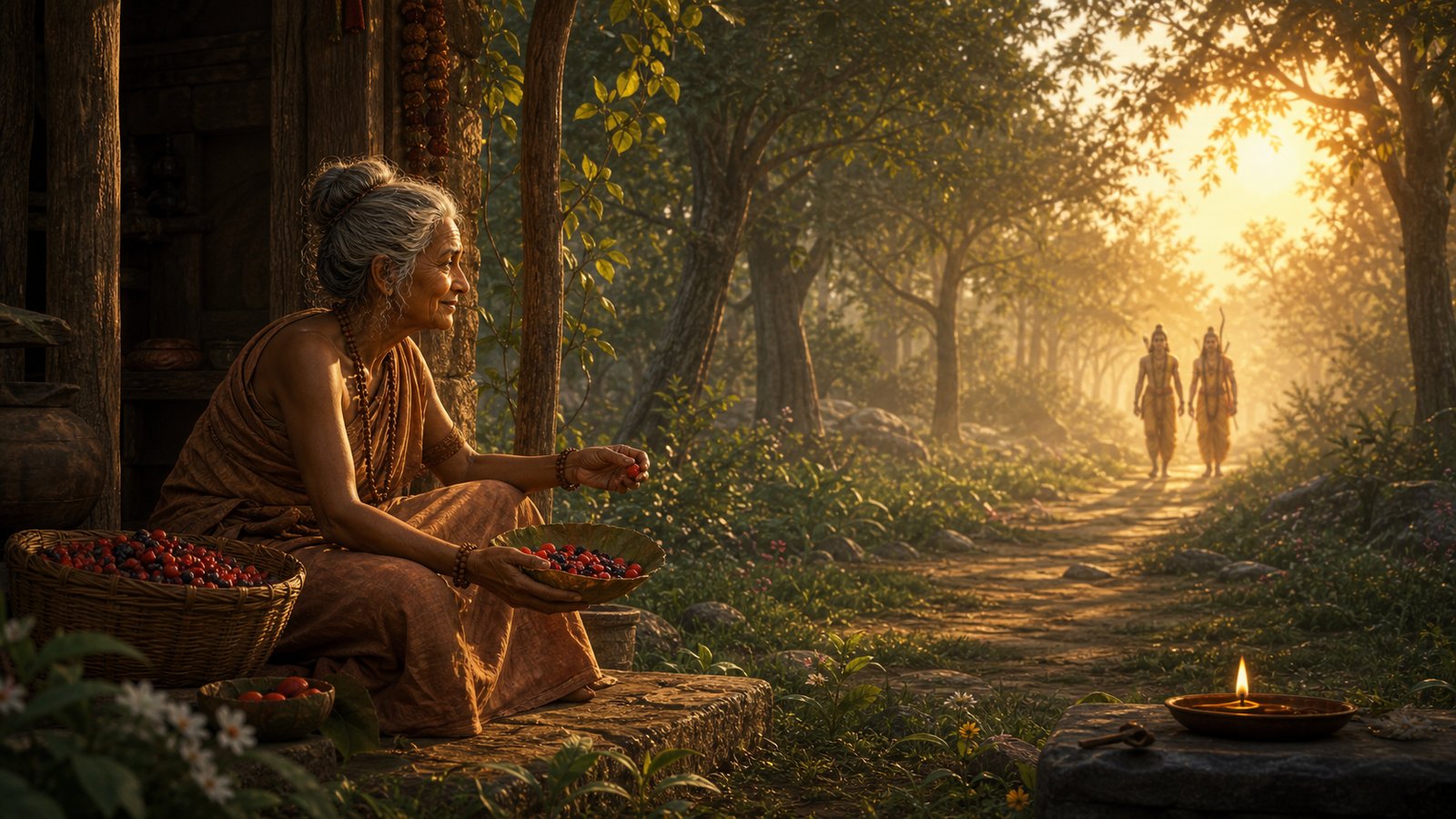
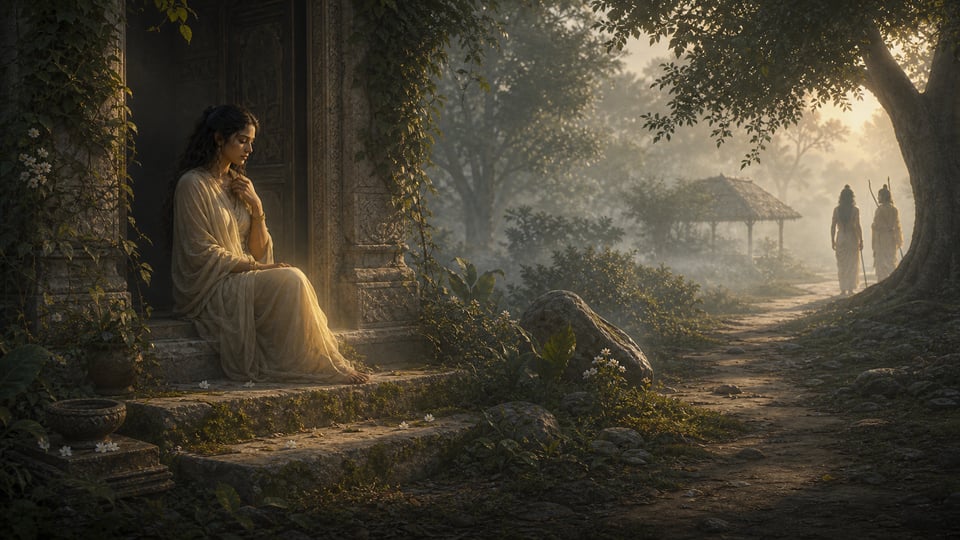
The forest of the Dandakaranya is a place of suffocating density and unpredictable shadows, where the air tastes of damp earth and ancient silence. In the heart of this wilderness, an elderly woman stands by the edge of a small clearing, her eyes clouded by the cataracts of age but her gaze fixed firmly on the horizon. She does not look for a miracle; she looks for a person. For decades, she has lived in the echo of a promise, and the emotional weight of her existence is defined by a single, unwavering certainty: the guest she was told would come is finally within reach.
The arrival of Rama and Lakshmana is not a sudden explosion of divine light, but a quiet intersection of two paths. After the encounter with the demon Kabandha, who directed them toward the hermitage of the sage Matanga, the two brothers find themselves in a landscape that feels both welcoming and haunted. They enter a space where the rhythm of life has been slowed to the pace of a single heartbeat, a place where one woman has spent the better part of her life preparing for a visit that the rest of the world had likely forgotten.
To understand the woman waiting in the clearing, one must understand the silence that preceded her. Years prior, this forest had been the domain of the great ascetic Matanga. Shabari had been his disciple, not through the study of complex scriptures or the mastery of ritual fire, but through the humble, repetitive labor of service. She had spent her youth gathering fuel, cleaning the dwelling, and tending to the needs of her teacher. Her spirituality was not found in the heights of philosophical debate, but in the lowliness of the dust and the steady rhythm of a broom.
Before Matanga Rishi departed the earthly plane, he left Shabari with a directive that would become the scaffolding of her entire existence. He told her that a great soul, the prince Rama, would one day seek her out and visit this very hermitage. He did not give her a date, a month, or a specific season. He gave her a promise. For most, such a vague prophecy would be a source of frustration or a forgotten detail of a dying man's last words. For Shabari, it became a divine appointment.
The tragedy and the triumph of her life lay in the interval. She remained in the hermitage long after her teacher had gone, long after the other ascetics had vanished into the mists of the mountains. She lived in a state of perpetual readiness. Every morning was a rehearsal for the arrival. Every evening was a prayer for the dawn. She did not seek to leave the forest or find a more comfortable life in the cities of the plains. To leave the hermitage would be to risk missing the moment the guest stepped across her threshold. Her faith was not a spectacle of loud proclamations; it was the quiet, stubborn act of staying put.
Imagine the psychological toll of such a wait. As the years turned into decades, the physical world around her began to decay. The walls of the hermitage weathered, the paths grew over with wild vines, and her own body surrendered to the inevitable erosion of time. Her skin became like parchment, and her movements slowed to a fragile shuffle. Yet, inside her, the anticipation remained as fresh as the first day Matanga had spoken.
This kind of waiting is a form of asceticism that is rarely discussed. It is the discipline of hope. Most people view waiting as a void, a gap between the present and the desired future. For Shabari, the waiting was the practice itself. The act of preparing the space, cleaning the area, and keeping the memory of the promised guest alive was her meditation. She was not merely waiting for a person; she was cultivating a state of readiness.
The isolation of the Dandakaranya often breaks the spirit, but for her, the solitude was a shield. She spent her hours sweeping the dirt paths and arranging the wild flowers, treating the forest floor as if it were the marble hallway of a palace. Each fallen leaf was cleared with intention; each stone was placed with a sense of purpose. She existed in a liminal space, caught between the memory of her master and the promise of the prince.
When Rama and Lakshmana finally appeared, they did not find a woman broken by loneliness. They found a woman who had been sustained by the sheer force of her expectation. The tension of her long wait broke not with a scream or a collapse, but with the simple, profound recognition of a face she had only known through the descriptions of her teacher. The encounter was the resolution of a lifelong chord that had been stretched to its absolute limit.
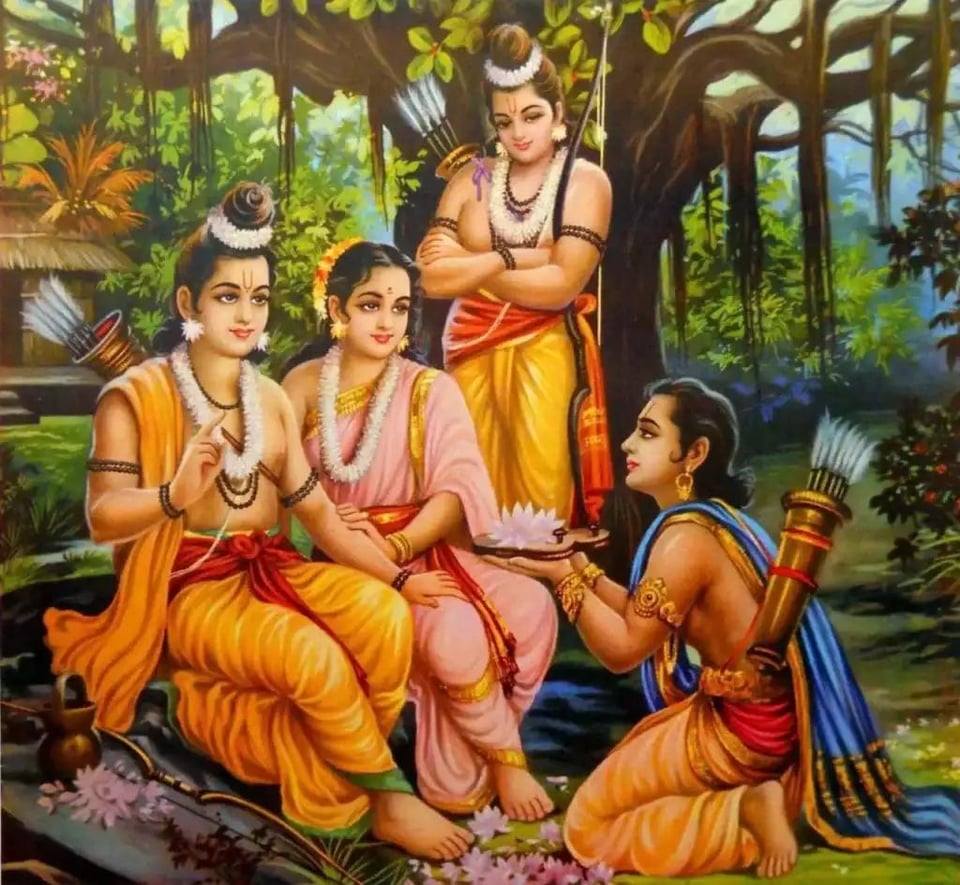
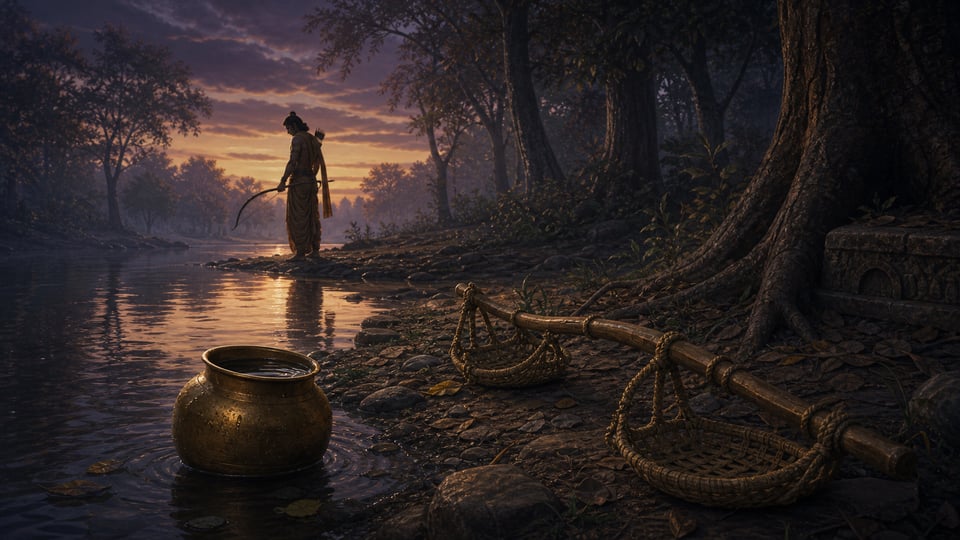
The reception Rama received was devoid of the royal pomp he had known in Ayodhya or the formal rituals of the high priesthood. Instead, he was met with the raw, unfiltered hospitality of a woman who had nothing to offer but her total devotion. Shabari welcomed the brothers with water to wash their feet, a gesture of respect and purification that transcends social standing. In this moment, the boundaries of the world—the distinctions between prince and forest-dweller, between the powerful and the powerless—dissolved into the simple act of a host serving a guest.
She provided them with the foods she had gathered, the simple fruits of the forest. There is a pervasive tradition in later devotional stories that describes Shabari tasting every single berry to ensure it was sweet before offering it to Rama. However, in the original account of the Valmiki Ramayana, the focus is not on the tasting of the fruit, but on the purity of the offering and the warmth of the welcome. The essence of the scene is not a curiosity about sweetness, but the profound sincerity of a woman giving everything she has, regardless of its perceived value.
Rama accepted her hospitality without hesitation. He did not look at the simplicity of the meal or the age of the woman with pity; he looked at her with the recognition of a soul who had mastered the art of patience. For Rama, the meal was not about the nutrition of the fruit, but the nutrition of the love that accompanied it. The hospitality of Shabari was a mirror reflecting the divine quality of a heart that asks for nothing and gives everything.
The interaction was marked by a rare intimacy. This moment of shared humanity highlighted the core of Rama's character—his ability to see the divine spark in the most overlooked corners of the world.
After the meal, Shabari did not simply let the guests depart. She took Rama and Lakshmana on a tour of the hermitage and the surrounding sacred sites. This was not a tour of sightseeing, but a sharing of a spiritual map.
By showing Rama these places, she was connecting her past with his present. She was proving that the space she had guarded for so long was not a wasteland, but a sanctuary. The forest, which to an outsider might seem like a chaotic tangle of greenery, was to her a curated gallery of holiness. Every tree and every stream had a story, and every story led back to the promise of Rama's arrival.
She spoke of the specific groves where the air felt lighter and the streams that had carried the chants of the rishis for generations. As she walked, her frail steps were guided by a memory that was more vivid than the physical landscape. She was not merely showing Rama the land; she was introducing him to the spiritual legacy of her master, ensuring that the continuity of the lineage was honored.
This act of guidance reveals the depth of her role. She was not just a devotee; she was the keeper of the flame. She had maintained the sanctity of the hermitage in the absence of the master, ensuring that when the promised guest arrived, he would find a place that was still vibrating with the energy of truth. Her service to Matanga had extended beyond his life, transforming into a stewardship of the land itself.
The interaction between Rama and Shabari serves as a powerful commentary on the nature of faith. In a world that prizes speed, efficiency, and immediate results, Shabari's life is an anomaly. She represents the slow path. Her life was not defined by achievements, titles, or the accumulation of knowledge, but by the singular act of believing in a word spoken years ago.
There is a profound dignity in her age. She did not seek a cure for her frailty or a way to regain her youth. She accepted the decline of her body because her spirit was anchored in something timeless. The promise of Rama's visit was the only thing that mattered; the physical decay of the world was merely a backdrop to the unfolding of a divine appointment.
The psychological strength required to maintain such a vigil is immense. For years, she must have faced the doubts of the wind and the mockery of the silence. There were likely nights when the forest felt too vast and her hope too small. Yet, she chose to believe that the word of her teacher was more real than the emptiness of the horizon. This choice was not a passive act of waiting, but an active commitment to a truth that the rest of the world had discarded.
When we reflect on her story, we see the intersection of human vulnerability and spiritual strength. Shabari was an old woman in a dangerous forest, yet she was the most secure person in that landscape. Her security did not come from walls or weapons, but from the knowledge that she was exactly where she was supposed to be. She had played her part in the cosmic drama by simply waiting.
The climax of Shabari's journey is not the arrival of Rama, but the departure from the world. Having received the guest she had waited for, the purpose of her earthly existence was complete. The tension that had held her together for decades the "not yet" that had driven her to wake up every morning had finally been resolved into a "now."
She did not wish to linger in a world where her primary mission had been accomplished. With a heart full of peace, she asked Rama for his consent to leave her physical form. This request is not born of despair or a desire to escape suffering, but from the fulfillment of a cycle. She had served her teacher, she had guarded the hermitage, and she had finally welcomed the Lord. There was nothing left to achieve.
The request for permission is a poignant detail. It shows that even in her final moments, she remained a disciple, seeking the guidance of the divine before stepping into the unknown. She did not simply vanish; she sought the blessing that would transform her death into a liberation.
Rama, recognizing the purity of her intent and the completion of her journey, gave her his blessing. In a scene of quiet transcendence, Shabari entered the fire—a traditional Vedic symbol of purification and liberation. She did not leave as a lonely old woman of the forest, but as a liberated soul ascending to the realm of her teachers. The fire did not consume her; it released her.
As the flames subsided and the presence of Shabari vanished from the physical plane, a heavy silence returned to the hermitage. Rama and Lakshmana stood in the clearing, the remnants of the forest meal still present, the echoes of her voice still lingering in the air. The departure was not a tragedy, but a homecoming.
The story leaves us with a haunting image of the forest. The hermitage of Matanga once again became a place of solitude, but it was no longer a place of waiting. The void that had defined Shabari's life for so many years had been filled. The circle had closed. The guest had come, the host had served, and the soul had flown.
The brothers lingered for a moment, perhaps reflecting on the sheer magnitude of a life spent in anticipation. The forest seemed different now; the shadows were less oppressive, and the silence felt less like an absence and more like a presence. The memory of the woman who had swept the paths for a ghost of a promise now inhabited the very air they breathed.
In the larger narrative of the Ramayana, this episode is a brief pause in the frantic search for Sita. Yet, it is one of the most emotionally resonant moments in the epic.
The story of Shabari challenges the modern notion of success. We are taught to pursue, to capture, and to accelerate. Shabari teaches the art of receiving. She demonstrates that there is a specific kind of power in stillness and a specific kind of holiness in the act of waiting. Her life was a testament to the idea that the arrival of the goal is less important than the quality of the anticipation.
She did not demand a sign or a miracle to sustain her faith. She did not ask for a map or a timeline. She simply trusted the word of her teacher. This trust was her armor and her sanctuary. It allowed her to transform a lonely existence into a sacred vigil.
When we look at the distinction between the Valmiki account and later traditions, we see how the human heart seeks to add "sweetness" to the story. The addition of the tasted berries in later versions is a beautiful expression of love, but the original story is more profound in its austerity. It tells us that the simple act of welcoming, the basic gesture of offering water and food, and the courage to wait for a lifetime are enough. The raw, unadorned faith of Shabari is the most powerful force in the forest.
As the brothers moved forward from the hermitage, leaving the ashes of the fire behind, they carried with them the memory of a woman who had defined devotion not by what she did, but by how she waited. Her legacy is a reminder that no one who waits with a pure heart is ever truly forgotten. The guest always arrives, even if the arrival takes a lifetime.
Valmiki Ramayana, Aranya Kanda 73–74, for Kabandha's direction, Shabari's reception of Rama, Matanga hermitage, and her departure.
IIT Kanpur/ValmikiRamayan.net prose and verse editions for passage cross-checking.
The tasted-berries episode is treated as a later popular devotional tradition, not an explicit detail in Valmiki's Sarga 74.
Mythological
14 July 2026 · 4 min read
Mythological
29 June 2026 · 10 min read
Mythological
25 June 2026 · 6 min read
Mythological
26 June 2026 · 12 min read
Mythological
25 June 2026 · 4 min read
Mythological
25 June 2026 · 12 min read