Before Rama's exile, Dasharatha told of killing an unnamed ascetic youth who cared for blind parents. Later tradition calls him Shravan Kumar.
26 June 2026 · 12 min read
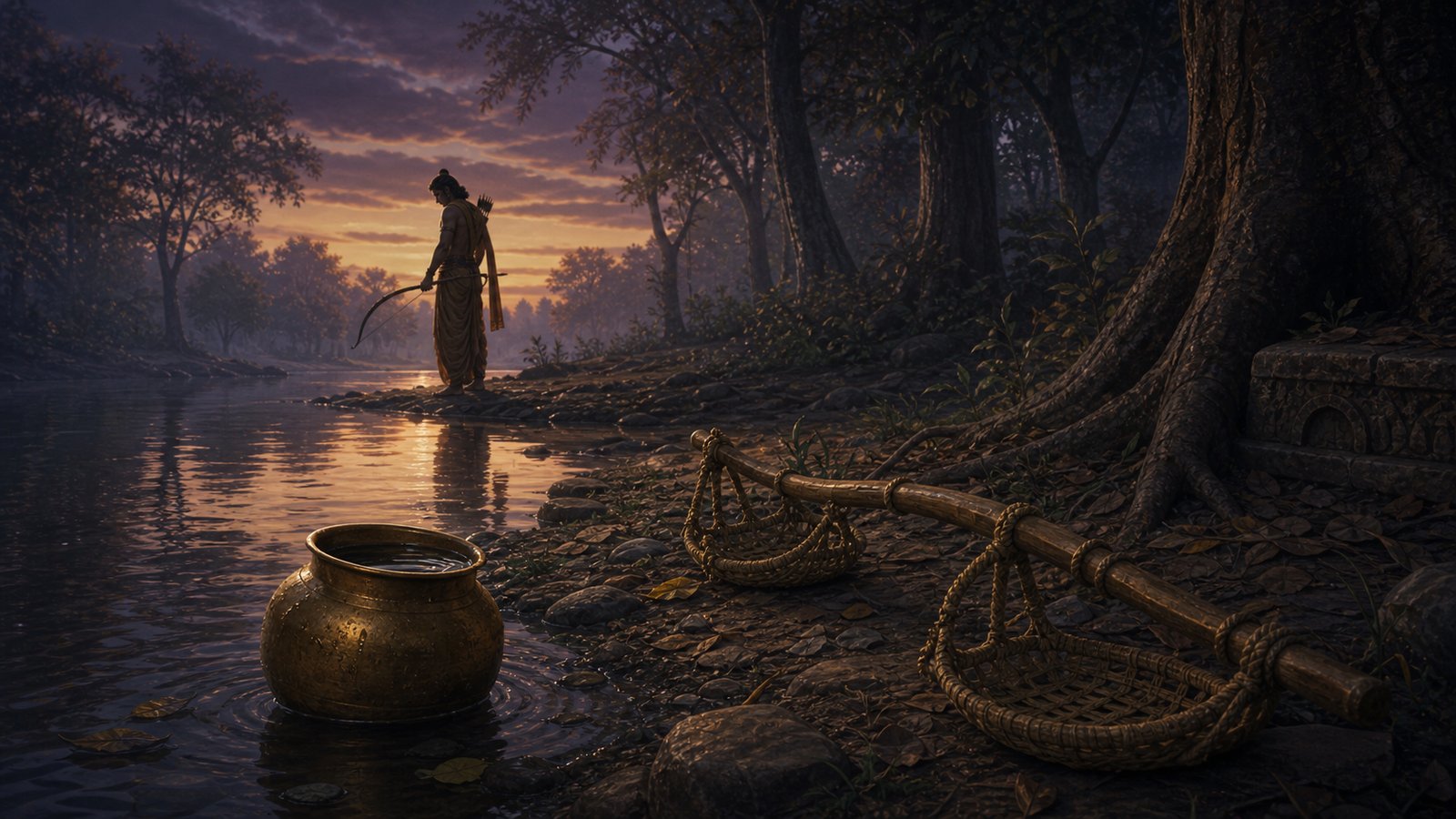
The sound came from the dark riverbank: a vessel sinking into water, a hollow rush like an animal drinking.
Young Dasharatha did not wait to see. Proud of his skill at striking by sound, he drew the bow and released.
The cry that followed was human.
Years later, while Rama was far from Ayodhya and Dasharatha lay dying of separation, the king remembered that arrow. He had once carried news of a son's death to two blind parents. They had cursed him to die from the grief of losing his own son.
Popular tradition gives the youth a beloved name—Shravan Kumar. Valmiki's Ramayana leaves him unnamed. The absence makes his final concern more piercing: not "Remember my fame," but "Who will care for my parents now?"
Dasharatha tells the story to Kausalya in Ayodhya Kanda 63–64 after Rama's exile has broken him. He recalls his youth, before maturity had disciplined pride.
During the rainy season he went hunting near the Sarayu. He possessed the skill of shabdavedhi—striking a target by sound. In royal and martial imagination, such ability is impressive. It suggests concentration so refined that sight is unnecessary.
But skill without verification becomes danger.
Dasharatha hears the sound of a pot being filled and mistakes it for an elephant drinking. He shoots into darkness. The arrow reaches its target exactly. The judgment behind it is wrong.
This distinction is central to the tragedy. He does not miss. He succeeds at the physical act he intended and fails at the human act of knowing what stood before him.
When the wounded cry rises, triumph collapses. Dasharatha follows the sound and finds a young ascetic, not an animal. The youth has come to fetch water for his aged, blind parents waiting in the forest.
The king's identity, weapon, and expertise cannot reverse the shot.
Many disasters begin this way: confidence moves faster than knowledge. A rumor sounds familiar, a shadow resembles a threat, an old conflict shapes a new interpretation. Action arrives before the person is seen.
The Ramayana places that mistake inside the memory of a king celebrated for martial power. His finest skill becomes the instrument of the wound he can never forget.
The youth is in agony. He tells Dasharatha that he is not a dangerous enemy and asks why he has been struck. He describes his parents: old, blind, dependent upon him, waiting for water.
His concern moves beyond his own body. What will happen to them when he does not return?
In Valmiki's account, the youth is not named Shravan in this passage. Nor are the popular names of his parents part of the baseline episode. Later tradition has given him a name, images, pilgrimage routes, dramatic retellings, and a place as the exemplary devoted son. Those traditions are culturally powerful and deserve acknowledgment as later memory.
But the unnamed form has its own force. Without a famous identity, he could be any caregiver whose labor holds an unseen household together.
He asks Dasharatha to take the water to his parents and tell them what happened. He also asks the king to remove the arrow, knowing it may end his life but unable to bear the pain.
Dasharatha hesitates, fearing the consequence of removing it. The youth clarifies his parentage and the issue of ritual guilt in the terms of the epic's society. Then the arrow is withdrawn, and he dies.
The water pot remains.
That ordinary object now carries everything the parents do not yet know. They are thirsty. They hear footsteps and assume their son has returned. Dasharatha must lift the vessel and walk toward them.
The hardest part of the hunt begins after the arrow.
The blind parents recognize that the person approaching is silent. They speak affectionately to the son they expect.
Why has he taken so long? Are they being punished for something they said? They depend upon his voice, touch, and daily service. In the absence of sight, his footsteps are part of home.
Dasharatha stands before them unable to answer at first.
Then he identifies himself and confesses. He heard the sound of water, thought an animal was there, and shot. Their son is dead.
The scene reverses the earlier mistake. Dasharatha acted upon sound without seeing. The parents must now understand a world they cannot see through the sound of the killer's voice.
They ask to be taken to their son. Dasharatha leads them to the body.
Their grief is not abstract praise of filial duty. They speak to the young man who fetched their water, protected them, and made survival possible. The household has not only lost someone beloved. It has lost the person through whom food, movement, safety, and connection reached them.
The father performs or directs the final rites within the account's sacred frame. The parents, overwhelmed by grief, prepare to follow their son in death.
Before dying, the father speaks the curse.
Dasharatha too will die from the sorrow caused by separation from a son.
The punishment mirrors the wound, but not immediately. The young hunter must live long enough to become the father who understands.
Dasharatha returns to ordinary life carrying the event. He becomes king, marries, longs for children, and finally fathers Rama, Bharata, Lakshmana, and Shatrughna. Years gather over the riverbank.
Then Kaikeyi claims her boons. Rama leaves for fourteen years. Dasharatha cannot call him back without breaking the truth he has pledged. The palace fills with the same unbearable structure he once entered as a stranger: parents waiting for a son who will not return.
On his deathbed, memory joins the two scenes.
He tells Kausalya that actions bear fruit, comparing the relation of deed and consequence to a person receiving the result of what was done. The arrow released in youth has reached him in old age—not as a weapon, but as knowledge.
The curse should not be read as a mechanical explanation that every grieving parent caused someone else's grief. Sacred narratives use curses to bind moral time, not to provide a formula for suffering. The Ramayana does not authorize blaming bereaved families for hidden wrongdoing.
Within Dasharatha's story, the delayed consequence is specific. A young man acted before seeing and made dependent parents experience fatal separation. An old king later experiences separation from the son who structures his own life.
The parallel is not exact. Rama is alive and leaves to uphold a vow; the ascetic youth dies by an accidental arrow. Yet grief does not wait for symmetrical facts. Dasharatha knows only that his son is beyond reach and his own breath cannot continue beneath the absence.
The riverbank has entered the palace.
Across South Asia, the unnamed youth is widely known as Shravan Kumar. Children hear of him carrying blind parents on a shoulder-yoke, taking them on pilgrimage, and serving them with extraordinary devotion. Plays, films, school lessons, paintings, and oral tellings have made the name inseparable from filial care.
A source-aware retelling does not need to mock or erase that tradition. It needs to name the distinction.
Valmiki's Ayodhya Kanda 63–64 describes an ascetic youth fetching water for aged blind parents and does not call him Shravan in the passage. The portable yoke and elaborated pilgrimage details familiar today belong to later popular development unless tied to a named later text.
Both layers tell us something. The earlier episode centers Dasharatha's mistake, the youth's concern, the parents' dependency, and the curse of mirrored grief. The popular Shravan tradition expands the son into a cultural ideal of service.
Trouble begins when the ideal is used as a weapon. "Be like Shravan" can inspire tenderness, but it can also place all care upon one child, shame migrants, silence daughters-in-law doing invisible work, or treat an adult child's exhaustion as moral failure.
The original scene itself warns against such simplification. The parents' complete dependence on one son is precisely what makes his death catastrophic. Their love is profound; their lack of alternatives is also dangerous.
To honor the youth today is not merely to praise sacrifice. It is to ask why one person's absence could leave two elders without water.
The youth's final words reveal caregiving as practical work. His parents need water, food, guidance, and protection. Affection cannot be separated from tasks.
Modern elder care also includes tasks that disappear from family stories: arranging appointments, translating medical instructions, managing transport, cooking, cleaning, handling finances, answering calls, staying awake at night, and making decisions under uncertainty. Often one person becomes the default because they live nearby, are unmarried, are a daughter, are a daughter-in-law, or are assumed to have fewer important obligations.
Calling that person "our Shravan" may sound like praise while concealing overload.
The epic youth does not complain about caring for his parents, and we should not invent resentment for him. But his death exposes the household's fragility. Care built around one indispensable person has no room for illness, migration, accident, or exhaustion.
A humane response is shared responsibility. One sibling may provide daily physical care, another money, another transport, another regular respite, another legal or administrative help. Neighbors, community, and professional services may also be part of the circle. Love does not become less authentic when labor is distributed.
Nor should elders be remembered only as recipients. The blind parents have voices, grief, authority, and a relationship with their son. Their dependency does not erase their personhood. They deserve to be asked what kind of help they want, where they wish to live, which rituals matter, whom they trust, and what privacy they need.
The water pot is a reminder: care is concrete. Someone must notice before it is empty.
Dasharatha does not flee after discovering the youth. He removes the arrow at the youth's request, carries the water, confesses to the parents, leads them to the body, and receives their curse.
These actions matter. He tells the truth even though the truth will destroy strangers and may bring punishment. Yet honesty after harm is not the same as preventing harm.
The parents' son remains dead.
Modern storytelling sometimes rushes to redeem the powerful person who feels remorse. Dasharatha's grief is real, but the episode keeps the harmed family at the center long enough to resist easy absolution. The king's confession cannot become the most important suffering in the scene.
The youth's parents also do not offer comforting forgiveness. Their curse speaks from unbearable loss. Whether a reader approves of the curse is less important than recognizing that the story allows the powerless to name a consequence for a king.
Dasharatha must carry the truth without controlling how the injured respond.
That is part of accountability. An apology can be necessary and still not restore trust. Compensation can help and still not replace a person. Confession may prevent a second lie but cannot make the first act unhappen.
When Dasharatha later remembers the event, he does not describe himself as the hidden victim of an unfortunate misunderstanding. He knows the arrow was his.
The skill, darkness, and accident explain. They do not erase responsibility.
Dasharatha tells the story during Rama's exile, so readers naturally connect the curse to the king's death. But the old river scene also changes how we view everyone around the exile.
Kausalya loses daily contact with her son. Sita chooses to accompany Rama and leaves her natal and marital homes behind. Lakshmana leaves Urmila and his parents. Bharata returns to a dead father and an absent brother. The people of Ayodhya follow the departing chariot until they cannot.
Separation radiates.
The ascetic youth's death radiated too. His body received the arrow; his parents' lives collapsed around it. The person harmed directly and the people dependent upon that person may suffer different but connected losses.
This does not make royal exile equivalent to death, disability, labor migration, or modern caregiving separation. Analogies have limits. What the paired scenes reveal is relational consequence: no one departs alone when lives are interdependent.
Families often narrate migration through the person who left—his courage, her salary, their struggle abroad. The people who remained become background. Or care is narrated through the elder's illness while the caregiver's altered life disappears. A fuller story follows the separation in both directions.
Who waited? Who carried new duties? Who stopped sleeping? Who became less visible because another person's crisis took the whole frame?
The Ramayana's curse crosses decades because grief also crosses relationships.
The story's sharpest question is not whether every child should imitate an idealized Shravan. It is whether a family knows what will happen if the person carrying the water cannot return.
That question should be asked before crisis.
Elders can speak about where they wish to live, which relatives or friends should be called, what spiritual practices comfort them, what level of privacy they want, and how responsibilities can be shared. Caregivers can name limits without being accused of insufficient love. Siblings can recognize labor that money alone does not measure.
Private medical details do not belong in a public family story without consent. A family archive is not a substitute for a clinical plan, legal document, or emergency contact system. But memories, preferences, trusted relationships, and the elder's own voice can be preserved respectfully.
Dasharatha heard a pot and imagined an animal. The mistake began because he acted before knowing.
Care decisions can repeat that pattern in quieter ways. A son assumes his mother wants to leave the village. A daughter assumes her father refuses outside help. Relatives assume the nearby sibling is "managing." Everyone acts upon a sound shaped by expectation.
Ask before releasing the arrow.
The youth at the river had no time to create another arrangement. His last thoughts traveled toward two people waiting in darkness. Their first words to Dasharatha were meant for the son they believed had brought water.
That mistaken welcome is the story's lingering wound.
Years later, Dasharatha waits for Rama with the same impossible hope: perhaps the footsteps will return, perhaps the separation can be undone. They do not return in time for him.
Valmiki Ramayana, Ayodhya Kanda 63–64, for Dasharatha's account of the unnamed ascetic youth and his blind parents.
IIT Kanpur's Valmiki Ramayana edition/translation for passage cross-checking.
"Shravan Kumar," the carrying-yoke image, and named-parent details are identified as later popular tradition unless separately sourced.
Mythological
14 July 2026 · 4 min read
Mythological
29 June 2026 · 12 min read
Mythological
29 June 2026 · 10 min read
Mythological
25 June 2026 · 4 min read
Mythological
25 June 2026 · 6 min read
Mythological
25 June 2026 · 12 min read