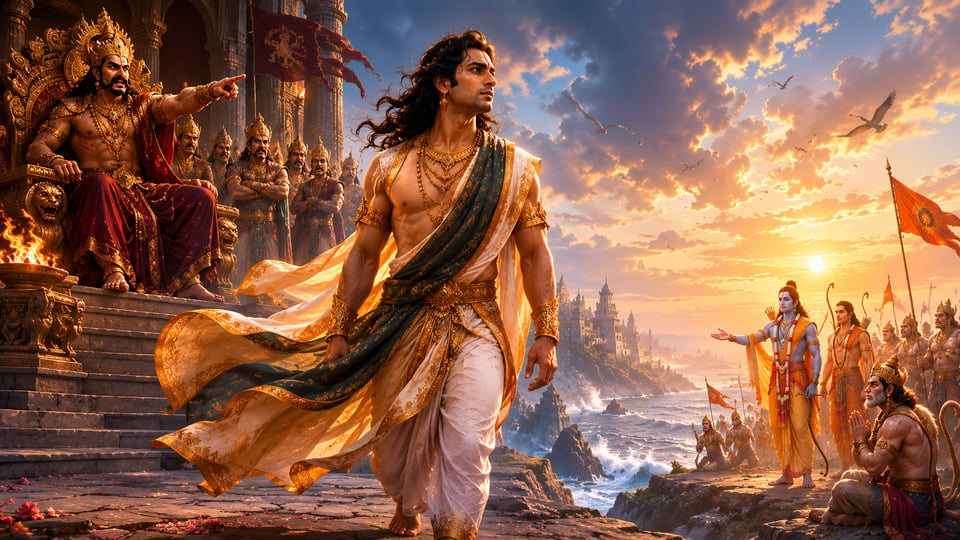
Bharata rejected a kingdom gained through Kaikeyi's demand, yet governed until Rama returned. What does that reveal about power, legitimacy, and family stewardship?
25 June 2026 · 6 min read
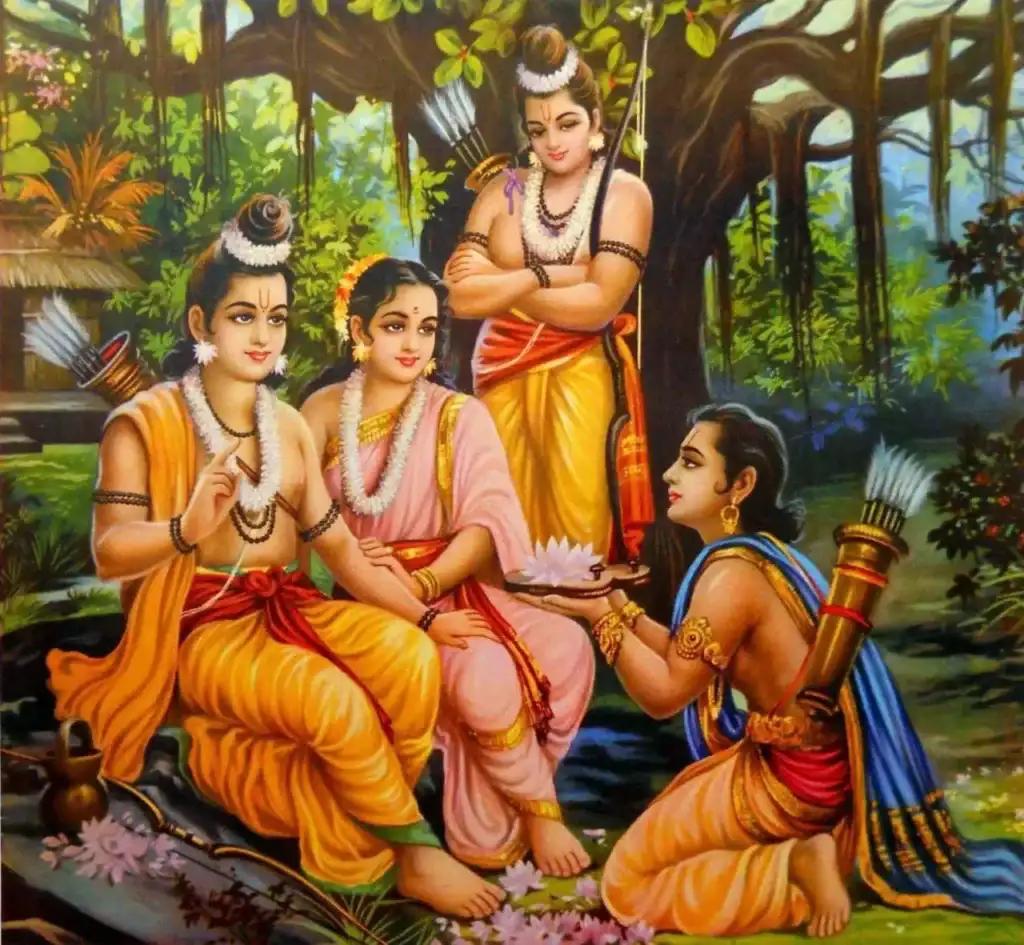
Bharata returns to Ayodhya to find a kingdom prepared for him, a father dead, and an elder brother exiled through his mother's demand.
He rejects the benefit. But he does not simply walk away from responsibility. He seeks Rama, challenges the legitimacy of what happened, asks him to return, and when Rama keeps the exile governs in his name. Bharata's lesson is not merely "refuse power." It is: do not claim authority produced by wrongdoing, but do not abandon the people who still need responsible administration.
That distinction matters in families, community groups, trusts, and businesses where ownership, seniority, office, and moral legitimacy are often confused.
Bharata does not campaign for kingship. He is away when Kaikeyi invokes Dasharatha's old promises, secures Rama's exile, and demands the throne for her son.
By the time Bharata returns, the political result is ready. If he thought only in terms of personal advantage, the path would be easy: accept the coronation, describe it as his father's command, and let the court normalize what happened.
Instead, the kingdom arrives as evidence of a broken household.
His father's grief and death, Rama's exile, Kaushalya's suffering, and the suspicion that Bharata may have desired the outcome all stand behind the crown. The office cannot be separated from the process that produced it.
This is the first part of Bharata's moral clarity. A legal-looking decision can still be illegitimate in spirit. A promise may have been invoked, but the benefit was created through manipulation, secrecy, and harm.
Modern succession disputes often contain the same category error. Someone says:
"The papers put me in charge."
"Father told me once that I would inherit."
"I am the eldest."
"Our branch has always led."
"The committee voted when the others were absent."
Each statement may contain relevant information. None automatically settles whether the process was fair, informed, and accepted.
Bharata refuses to treat possession as proof of legitimacy.
That refusal also protects him. If he accepts the outcome without challenge, every future decision remains shadowed by the suspicion that he benefited from or quietly approved the plot. By confronting the process publicly, he separates his own intention from Kaikeyi's act.
Families often underestimate this need. A person who receives property, office, or access through a disputed decision may say, "I did not ask for it." That may be true, but silence can still make the benefit appear accepted. A transparent response may require disclosing the decision, inviting affected people, pausing irreversible action, and asking whether the mandate should be confirmed.
Refusal, then, is not only about personal innocence. It is about preventing an institution from treating a contested event as settled precedent.
It is easy to tell Bharata's story as a single dramatic gesture: the good brother refuses the throne.
The fuller story is harder. A kingdom still needs decisions. Officials, households, roads, security, ritual obligations, disputes, and ordinary people cannot wait fourteen years for a moral symbol.
Bharata therefore does more than say no. He confronts Kaikeyi, performs duties after Dasharatha's death, gathers the court and citizens, travels to find Rama, and argues that Rama should return. He does not hide behind private purity while leaving everyone else inside the consequences.
This changes the meaning of refusal.
A person can decline personal ownership and still accept custodial responsibility. A trustee manages property without pretending it belongs to them. An acting chair keeps an organization functioning without rewriting the succession rules. An older sibling may coordinate care for parents without becoming the owner of every family decision.
The ethical question is not only, "Will I take the title?" It is also, "What will happen to everyone affected if I refuse every duty attached to the crisis?"
Bharata's answer combines protest with administration.
Bharata's journey to Rama is not a ceremonial visit. It is an attempt to repair legitimacy.
He brings family members, priests, ministers, and citizens. The presence of this wider group matters. The dispute has injured more than two brothers, so its resolution cannot remain a private conversation alone.
Bharata argues from seniority, royal custom, family duty, and the welfare of the kingdom. Rama answers from Dasharatha's command, truthfulness, and the obligation to complete the exile. The brothers agree about affection and public duty but disagree about which obligation must control the moment.
This is one reason the episode remains compelling: the conflict is not between simple greed and simple goodness. Bharata is right to question an unjust benefit. Rama is committed to completing a promise he understands as binding.
The disagreement also shows why succession systems need more than affection. Loving relatives can interpret duty differently. If authority, temporary delegation, emergency procedure, and dispute resolution are never documented, a family may discover its rules only after a crisis.
Bharata does not solve the problem by declaring his own moral superiority. He asks the recognized heir to resume the role.
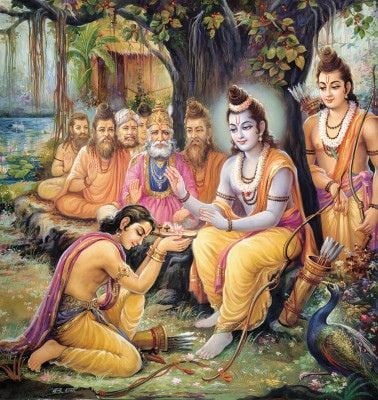
When Rama will not return before the fourteen years end, the sandals become the episode's most memorable object.
In the familiar Valmiki tradition, Bharata receives Rama's sandals, places them as the symbol of sovereignty, and governs from Nandigrama while awaiting Rama's return. The act is devotional, political, and administrative at once.
The sandals create a visible limit around Bharata's power.
He is governing, but not claiming that the disputed transfer made him the rightful king. He is making decisions, but under an acknowledged source of authority. His role has an ending condition: Rama's return after the exile.
Problems arise when the temporary role is not marked. A caretaker begins to act like an owner. An administrator treats access to records as personal control. A relative managing land for absent siblings transfers it without transparent consent. A temporary committee postpones elections indefinitely.
The sandals are powerful because they keep the difference visible. The symbol says, "Responsibility is here; ultimate claim is elsewhere."
Symbols are effective only when practice follows them. If Bharata had displayed the sandals but behaved as an unrestricted sovereign, the gesture would have become theatre. The traditional narrative instead emphasizes his restraint and his orientation toward Rama's return.
Bharata refused the crown's wrongful benefit, not the people's need.
He rejected kingship gained through Kaikeyi's demand and asked Rama to return. When Rama maintained the exile, Bharata accepted a delegated caretaker role and administered the kingdom while recognizing Rama's sovereignty.
Why did Bharata place Rama's sandals on the throne?
The sandals symbolized Rama's authority and the limited nature of Bharata's rule. They made his claim of stewardship visible while he awaited Rama's return.
Bharata held responsibility without claiming Rama's place.
Leadership is the responsibility to coordinate decisions and serve a group. Ownership is a legal or accepted claim over property or shares. A person may lead or administer something without owning it.
How does Bharata's story connect to a family memory?
It shows why kinship, succession, office, and delegated responsibility should be recorded separately. Being the eldest or closest relative does not automatically define every administrative role.
Valmiki Ramayana, Ayodhya Kanda 82 and 98–112, for Bharata's return, appeal to Rama, and the resolution of delegated rule.
Valmiki Ramayana, Ayodhya Kanda, sandals and Nandigrama passages in the selected translation.
knowledge-base-ai-ingest/plain-text/028_ramayana_dutt_1892_text.txt, including later references to Bharata's austerity and administration.
knowledge-base-ai-ingest/plain-text/024_agni_puranam_vol_1_dutt_1903_text.txt for a Puranic synopsis, used only as secondary comparison.
Mythological
14 July 2026 · 4 min read
Mythological
29 June 2026 · 12 min read
Mythological
29 June 2026 · 10 min read
Mythological
26 June 2026 · 12 min read
Mythological
25 June 2026 · 4 min read
Mythological
25 June 2026 · 12 min read