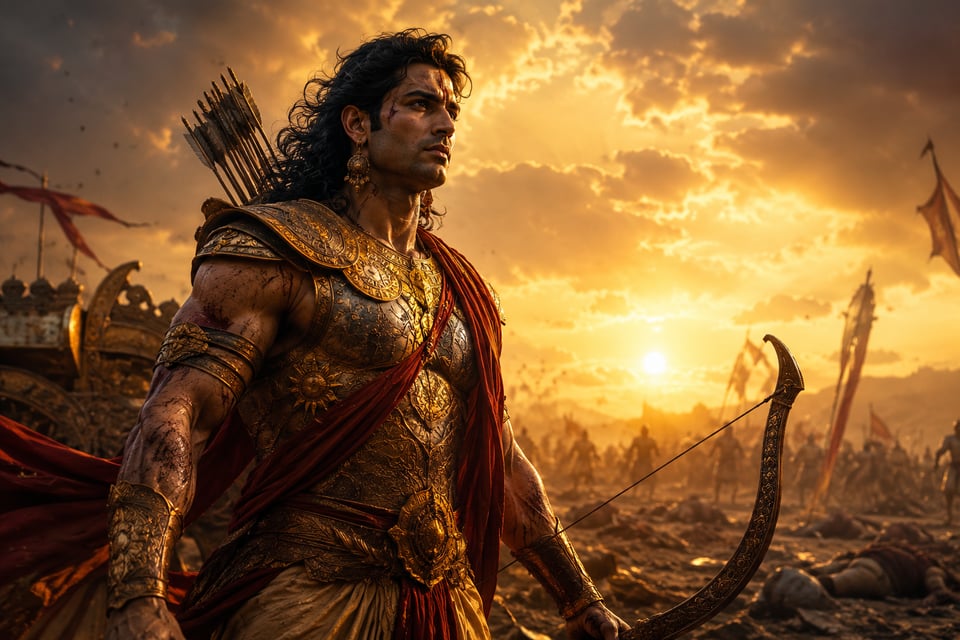
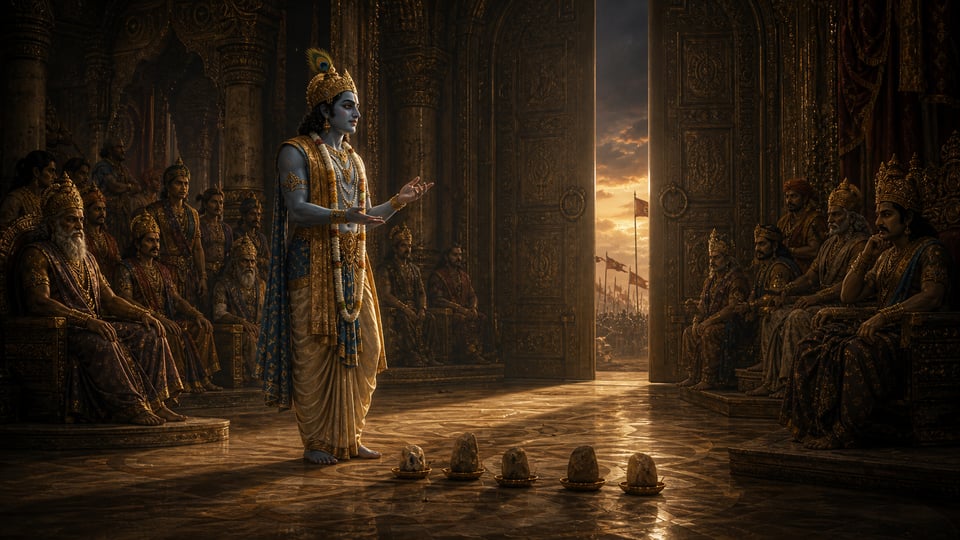
Savitri chose Satyavan knowing he would die within a year. When Yama took him, she followed not with force, but with courage, reasoning, and carefully chosen words.
26 June 2026 · 11 min read
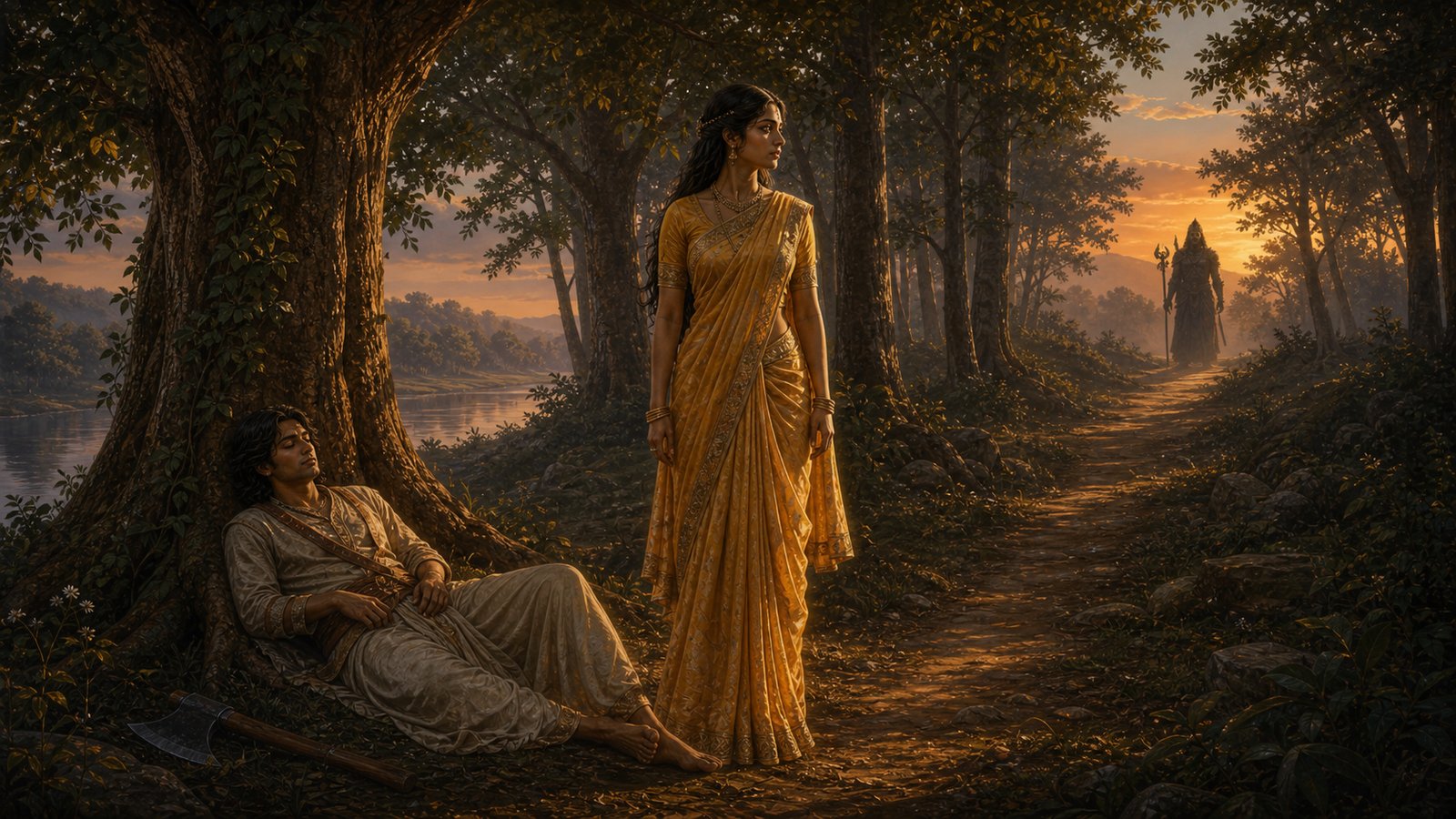
Satyavan's head rested in Savitri's lap when the forest changed.
Moments earlier he had been cutting wood. Then pain struck his head, his limbs weakened, and he asked to lie down. Savitri had counted toward this day for a year. She knew the prophecy. She knew why the breath leaving her husband did not feel like an ordinary faint.
When Yama appeared and drew Satyavan's life away, Savitri rose.
She could not overpower Death. She did something more difficult: she followed him far enough, spoke wisely enough, and chose each request carefully enough that the road meant to end one life turned back toward the forest.
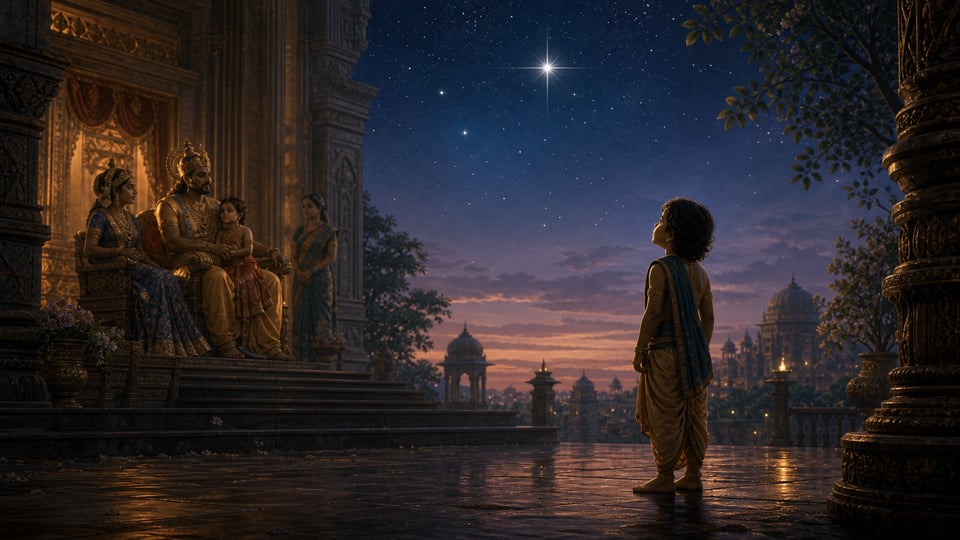
The story appears in the Mahabharata's Vana Parva, told to Yudhishthira during exile. It begins before Satyavan, with King Ashvapati of Madra longing for a child. Through long discipline and devotion, he receives a daughter and names her Savitri.
She grows with such radiance and strength that potential suitors hesitate. The court's admiration becomes distance. Rather than wait for a marriage to be arranged around other people's fear, her father sends her to choose.
Savitri travels through forests and hermitages, observing households removed from palace splendor. There she sees Satyavan, son of the exiled and blind King Dyumatsena. His family has lost its kingdom and lives in the forest. Satyavan possesses no court to offer her, but his character fixes her choice.
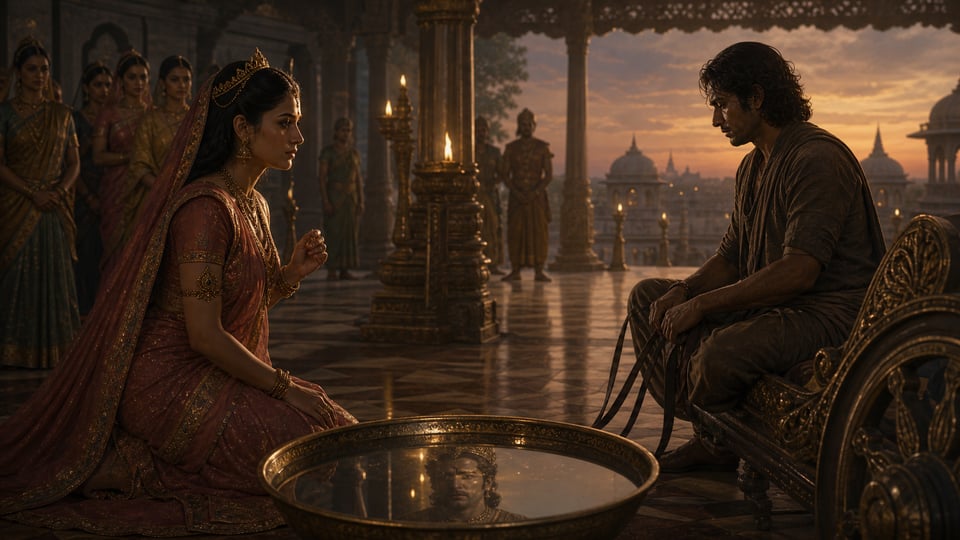
When she returns, the sage Narada is present. Ashvapati asks whom she has chosen. Savitri names Satyavan.
Narada praises him, then delivers the sentence around which the whole story tightens: Satyavan has every virtue, but only one year remains before his death.
The room changes. A father who had sent his daughter to choose now wants her to choose again.
Ashvapati does not oppose Satyavan because he is poor or displaced. The prophecy frightens him. He asks Savitri to find another husband, someone equally worthy without the approaching death.
Her answer is calm. A portion may be divided once. A daughter may be given once. A choice of husband, she says in the logic of the text, is made once. Whether Satyavan lives long or briefly, whether he possesses virtues or lacks them, she has chosen.
This is not ignorance dressed as devotion. Savitri hears the warning clearly. No one hides the risk. She does not assume love will magically cancel prophecy. She decides with the knowledge everyone believes final.
That distinction matters. Later summaries often make her an emblem of the obedient wife, but the first defining action in the story is not obedience to father or sage. Both advise her to reverse course. She refuses respectfully.
Her father eventually accepts the decision. Savitri marries Satyavan and leaves royal life for the forest household of Dyumatsena. She exchanges fine clothing for bark garments and serves her new family with attention. Yet the story does not say that becoming devoted requires losing thought. She carries Narada's date inside her.
Every sunrise subtracts from the year.
Satyavan does not appear to know the prophecy. Savitri does.
That difference creates the story's quietest tension. She lives beside him, speaks with her blind parents-in-law, performs daily work, and watches the promised day approach. The Mahabharata does not fill the year with invented scenes. Its restraint lets us imagine the burden without pretending to know every conversation.
Three days before the appointed date, Savitri begins a severe fast and vigil. Dyumatsena worries about the austerity, but she completes her vow. She is not bargaining with the universe at the last second. She prepares her body and mind before entering the day she cannot avoid.
On the morning marked by the prophecy, Satyavan takes his axe and goes to gather fruit and wood. Savitri asks to accompany him. Her parents-in-law hesitate; fasting has weakened her. She insists gently, saying she has not visited the flowering forest with him and wishes to go.
Only she and the listener know the full reason.
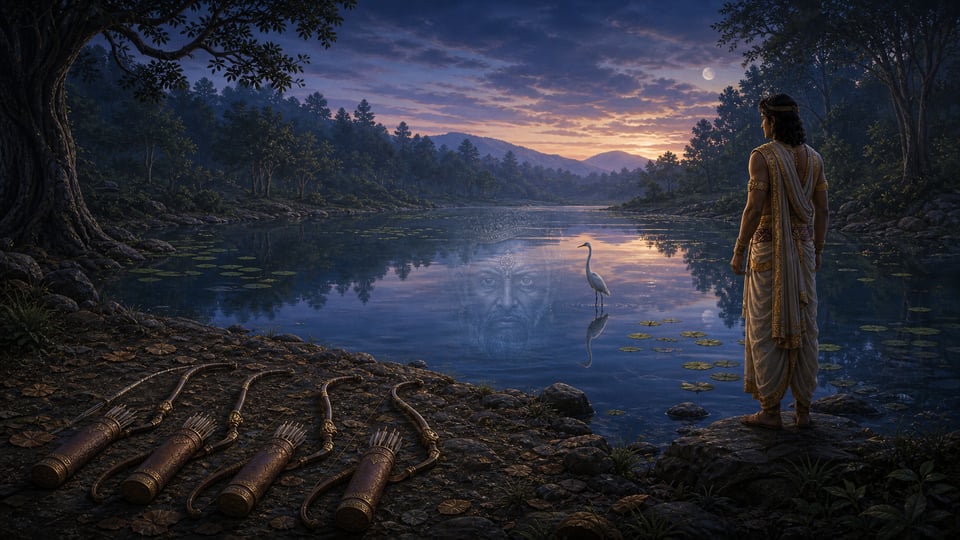
The path is beautiful. Birds call. Trees hold fruit. Satyavan points out the forest's richness. Savitri sees the same world under a different light. Beauty does not soothe the countdown; it makes the possible lastness of each detail more intense.
She does not warn him that every step may be final. She walks beside him.
Satyavan works until sweat covers him. Then a sharp pain enters his head. He tells Savitri his body feels pierced, that he cannot remain standing, and asks to rest.
She sits upon the ground and places his head in her lap.
This is the objectless center of the story: no army, throne, curse spoken in anger, or miracle yet. A wife sits beneath trees holding the weight of the person she chose. She knows exactly what the moment may mean and can do nothing to stop his breath by ordinary strength.
Then she sees a majestic, dark, radiant being with a noose. She places Satyavan down, joins her hands, and asks who he is.
He identifies himself as Yama, lord of justice and death. Because Satyavan is righteous, Yama has come personally to take him. He draws out a subtle being from Satyavan's body and turns south.
Savitri rises and follows.
Yama tells her to return. She has fulfilled her duty; funeral rites remain. The road he travels is not for the living.
But she continues, answering that where her husband is taken, there she must go as far as she can. Her speech is not a scream against mortality. She speaks of companionship, righteous conduct, the goodness of association, and the trust created by walking even a few steps together.
Yama listens.
Pleased by her words, Yama offers a boon anything except Satyavan's life.
Savitri does not spend the first request on herself. She asks that Dyumatsena, her blind father-in-law, regain his sight and strength.
Yama grants it and again tells her to return. She continues.
The sequence matters. Savitri does not repeat "Give him back" until Death surrenders. She understands the boundary Yama has stated and works within it. Her first request restores perception and dignity to a displaced elder. It addresses the household Satyavan would leave behind.
As they walk, she speaks again: of dharma, compassion toward all beings, and the conduct of the good. Her praise is not empty flattery. Each speech establishes shared moral ground. Yama is not a demon to be tricked but the guardian of an order Savitri invokes with discipline.
He offers another boon, still excluding Satyavan's life.
She asks that Dyumatsena regain his lost kingdom.
Yama grants it. Sight and sovereignty, both taken from Satyavan's father, are now promised back. Savitri's requests are expanding the future around a man who, at this moment, lies dead beneath a tree.
Again Yama tells her she has walked far enough.
Again she does not stop.
For the next boon, Savitri turns toward her natal family. Her father Ashvapati has no sons. She asks that he receive a hundred sons to continue his line.
Yama grants the request.
The choice reveals that marriage has not erased her first home. Even while following her husband's soul, she remembers the father who raised her and accepted her difficult decision. Her loyalty runs in more than one direction.
Yama offers yet another boon. Savitri asks that she herself have a hundred sons born of Satyavan.
He grants it.
Only after the words are given does their structure close around the impossible condition. Savitri cannot bear sons by Satyavan if Satyavan remains dead. She has not directly violated Yama's restriction. She has asked for a future whose fulfillment requires the life he has taken.
Some tellings emphasize this as clever argument, almost a verbal trap. Cleverness is present, but the scene is larger. Savitri has led Yama through a complete restoration: sight, kingdom, natal lineage, marital lineage. Each boon repairs a relationship damaged or threatened by loss. The last promise reveals the missing person without whom the restored future cannot exist.
Yama recognizes the force of her fidelity and speech. He releases Satyavan and grants him a long life.
Savitri turns back along the road she had been told no living person should travel.
This time she is not following Death.
Savitri returns to Satyavan's body and places his head upon her lap again. He wakes as if from deep sleep and asks why she did not rouse him, and who the dark figure was.
Night has fallen.
She does not pour the entire cosmic encounter into the first breath. She tells him they should return and that she will explain. Satyavan worries about his blind parents, who will be terrified by their absence. His first concern after returning to life is the household waiting for him.
They make their way through the dark forest.
At the hermitage, Dyumatsena's sight has returned. The exiled king and his wife have spent the night searching in anguish. Sages reassure them, reading signs of Satyavan's survival. When the couple finally arrives, private restoration becomes communal wonder.
Savitri tells what happened.
Soon messengers bring news that Dyumatsena's enemy has fallen and his people seek his return. The boons unfold not as isolated prizes but as a household rebuilt across generations. Ashvapati too receives the promised sons. Savitri and Satyavan later have descendants.
The story's movement is therefore not merely dead man, clever wife, resurrection. It begins with several threatened futures: a blind king without a throne, a father without sons, a princess choosing a doomed man, and a marriage with no tomorrow. Savitri's walk gathers each broken future and carries it into her requests.
When Satyavan wakes, the victory is quiet. His head is where it was before—on her lap. The world has changed around that repeated image.
Savitri is rightly honored for devotion, but devotion becomes distorted when used to demand that women endure every danger or erase themselves for a husband.
She does not remain in a harmful marriage because society commands it. She chooses Satyavan before marriage, with full warning. She prepares deliberately. She speaks throughout the crisis. She protects her in-laws, remembers her natal father, negotiates her own future, and refuses to turn back when an authority tells her the conversation is over.
Nothing in the story should be used to tell a woman to tolerate abuse, refuse medical care, or prove love through dangerous sacrifice. Mythic confrontation with Yama is not a household rule. The narrative's emotional force comes from agency joined to commitment, not from suffering made compulsory.
Satyavan, meanwhile, is not saved because Savitri is more useful than he is. His character is what first draws her choice and what brings Yama personally. Yet the decisive actions belong to her. The story allows a wife to be the person whose judgment changes the family's fate.
The frame in which the Mahabharata tells the story adds another layer. Yudhishthira, living in exile and grieving Draupadi's suffering, asks whether any woman has shown devotion equal to hers. Markandeya answers with Savitri. This does not make the two women identical. Draupadi's crisis arises from public injustice and failed kings; Savitri's from foretold death. Yet both stories refuse to treat a wife as a silent ornament around a husband's destiny. Each woman speaks into a situation powerful men cannot solve.
Savitri's preparation also complicates sudden heroism. The famous walk lasts a short time, but it rests on a year of carrying knowledge without surrendering daily life, three nights of austerity, attention to both households, and speech held steady under grief. The decisive moment grows from habits formed before it.
Her boons reveal those habits. She remembers what each person lacks. Dyumatsena needs sight and a home. Ashvapati needs descendants. Her marriage needs a future. The requests form a map of relationships she has kept present even while one relationship is being torn away.
That breadth prevents devotion from becoming possession. Savitri does not say only her private happiness matters. Satyavan returns into a restored network of parents, kingdom, natal kin, and unborn children. Love succeeds by rebuilding a world, not by isolating the couple.
Later Hindu ritual traditions often emphasize fasting and marital auspiciousness. Those practices carry living religious meaning, but they should not replace the Vana Parva's dramatic intelligence. Savitri's fast belongs beside her choice, speech, memory, and refusal to stop walking.
It also refuses a shallow opposition between love and intelligence. Savitri does not love less because she reasons carefully. Her discipline makes love effective. She listens to Yama's condition, remembers every relationship, sequences her requests, and leaves him no righteous way to honor his promise without restoring Satyavan.
Her words do not decorate devotion. They are how devotion acts.
The most memorable part of Savitri's story may not be the final boon. It is the sound implied before every boon: Yama walking, Savitri still behind him.
He tells her to return. Footsteps.
He grants sight and tells her to return. Footsteps.
He restores a kingdom and tells her to return. Footsteps.
He gives descendants to her father and tells her to return. Footsteps.
Her persistence is not noisy. She does not deny that death exists. She refuses to abandon the relationship while speech, thought, and moral appeal remain possible.
Modern readers sometimes look for a single lesson—choose bravely, argue cleverly, remain devoted. The story resists being reduced. Savitri's strength lies in the combination: she chooses, prepares, accompanies, listens, reasons, remembers both families, and asks for a future larger than private desire.
When she returns, she does not return alone. Behind her come restored sight, recovered home, remembered parents, unborn children, and the husband whose brief life had seemed fixed by prophecy.
That is why the old story continues to breathe. It does not imagine love as a feeling that waits beside the body. It imagines love standing up and walking after the impossible.
Mahabharata, Vana Parva, Pativrata-mahatmya 291–297, in the K. M. Ganguli translation.
Matsya Purana traditions are later/parallel variants and should not be silently merged with the Vana Parva account.
Mythological
15 July 2026 · 6 min read
Mythological
13 July 2026 · 6 min read
Mythological
1 July 2026 · 12 min read
Mythological
30 June 2026 · 12 min read
Mythological
30 June 2026 · 12 min read
Mythological
26 June 2026 · 12 min read