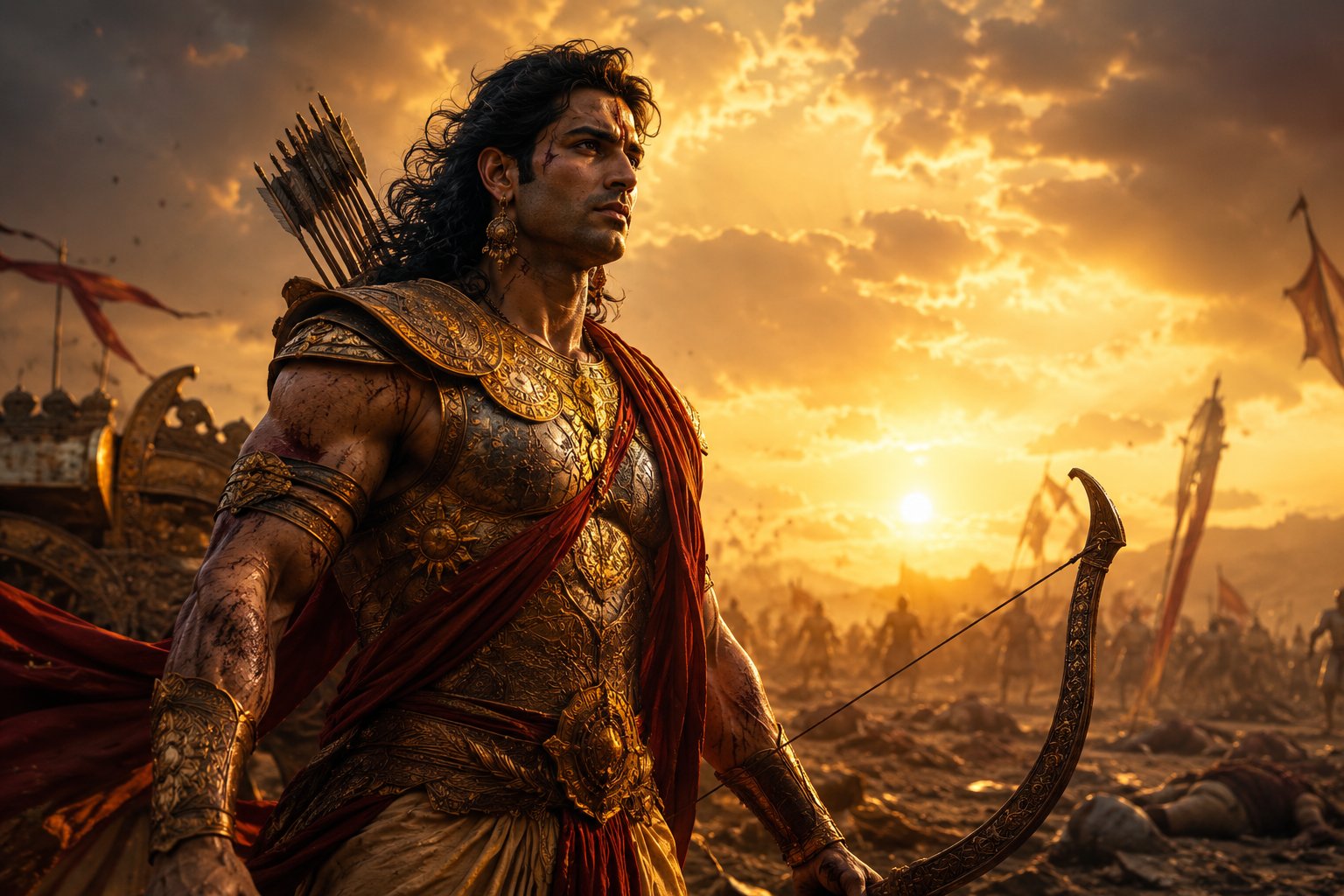
Karna's chariot wheel sank at Kurukshetra, bringing old curses to bear. Discover the epic story of Karna's death.
13 July 2026 · 6 min read
Can a rule we ignore when it hurts others still protect us when we need it most?
Can a family's hidden secrets and selective standards survive the test of time?
In the final moments of the Mahabharata’s seventeenth day of war, these questions ceased to be philosophical debates. They became a matter of life and death for its most tragic hero, Karna.
Karna’s death is often retold as a simple tale of fate and magical curses. But beneath the dramatic clash of bows and divine weapons lies a deeper conflict about integrity, the price of hidden identity, and the danger of calling upon rules we only honor when they serve us. It is a story that holds profound lessons for how we document our own histories, families, and lineages in modern genealogy.
By the afternoon of the seventeenth day at Kurukshetra, Karna stood as the commander-in-chief and the final hope of the Kaurava army. The great patriarch Bhishma lay on a bed of arrows. The master tactician Drona had fallen. Duryodhana had nothing left but Karna the warrior raised by a charioteer who had spent his life fighting to prove he belonged among kings.
Karna and Arjuna finally faced each other, chariot to chariot, the two greatest archers of their era. Arrows filled the sky, blocking the sun. For hours, neither could gain a clear advantage. But two old debts represented by two specific curses were riding with Karna that day, waiting for their moment to be paid.
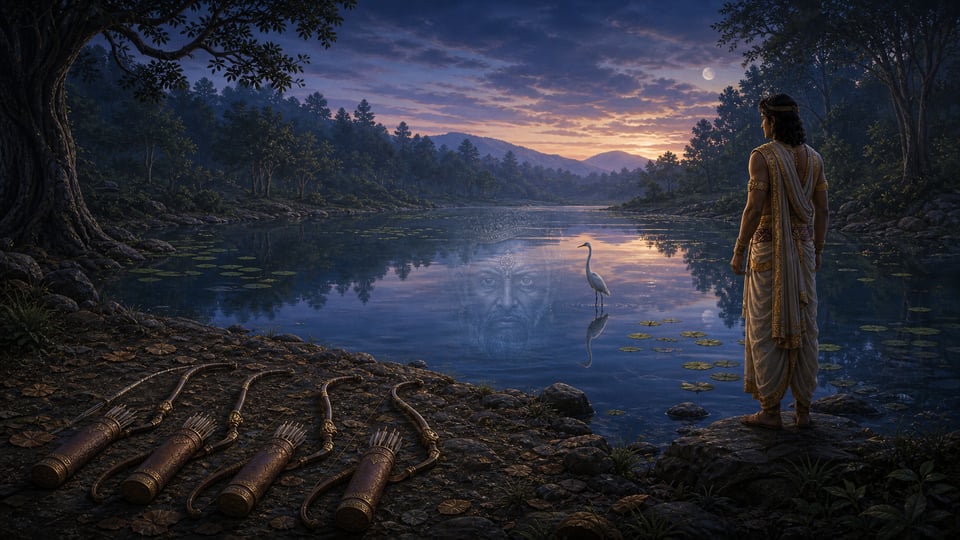
Years earlier, desperate to learn the highest arts of weaponry which Drona had refused to teach a suta (charioteer’s) son, Karna had lied about his birth. He traveled to the hermitage of Sage Parashurama, claiming to be a Brahmin. Parashurama, who had vowed never to teach Kshatriyas, accepted him.
One afternoon, while Parashurama slept with his head in Karna’s lap, a stinging insect bored into Karna’s thigh. The pain was excruciating, and blood flowed freely, but Karna remained absolutely still so as not to wake his teacher. When Parashurama woke and saw the blood, he knew immediately: no Brahmin could bear such physical pain without moving. Only a warrior-spirit could.
Furious at the deception, Parashurama cursed him: the knowledge of the ultimate weapon (the Brahmastra) would desert Karna at the exact moment he needed it most.
Around the same time, while practicing archery, Karna had accidentally killed a cow belonging to a local Brahmin. Despite Karna’s pleas and offers of compensation, the grieving Brahmin cursed him: in his final, most critical battle, the earth would seize and swallow his chariot wheel, leaving him helpless before his enemy.
These curses were not random occurrences. They were the accumulated consequences of Karna's choices—his lies about his identity and the accidental harm he had caused. They lay dormant, waiting for the afternoon when the soil of Kurukshetra would turn to soft mud under the weight of war.
During the duel, the Brahmin’s curse struck. The left wheel of Karna’s chariot sank deep into the mud. The chariot tilted, and Karna found himself unable to aim his weapons. In panic, he tried to recall the mantras for the Brahmastra to counter Arjuna’s assault, but Parashurama’s curse activated—the sacred words vanished from his memory.
Helpless and dismounted, Karna did something few warriors on either side had done in seventeen days of brutal warfare: he stopped fighting and appealed to the code of dharmayuddha (the laws of righteous combat). He called on Arjuna to hold his fire, quoting the ancient rules:
"A warrior does not strike an opponent who is unarmed, dismounted, whose armor is broken, or who is currently struggling to defend himself."
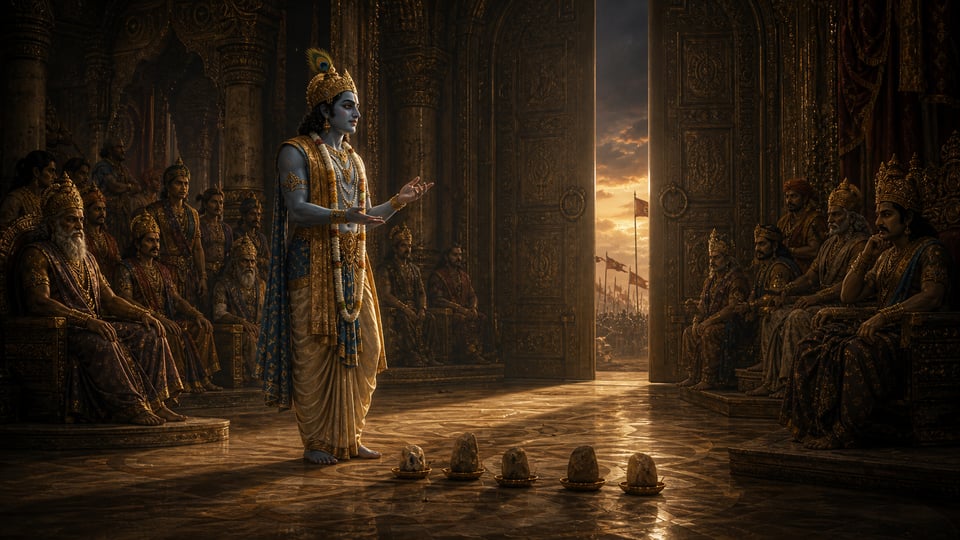
It was a fair request under the code both sides had sworn to uphold. But it was Krishna, standing beside Arjuna as his charioteer, who answered:
"Where was your dharma, Karna, when the young boy Abhimanyu was surrounded by six maharathis, his bow broken, and slaughtered while he stood unarmed on the ground? Where was your dharma when Draupadi was dragged into the assembly hall by her hair and disrobed before the elders? Where was your dharma when the house of lac was set on fire to burn the Pandavas alive?"
Krishna’s reply exposed the central moral conflict of the scene. Karna was invoking a rule to protect his life, having activey participated in breaking that very same rule when it was convenient for his faction. He demanded the protection of a code he had helped dismantle.
With no answer left, Karna turned to lift his wheel from the mud. On Krishna's command, Arjuna released the Anjalika arrow. Karna died on the ground of the war he had spent his life trying to prove himself worthy of.
Karna's tragic end is not just a mythological lesson in karma. It mirrors the structural problems we encounter when researching and writing family histories today.
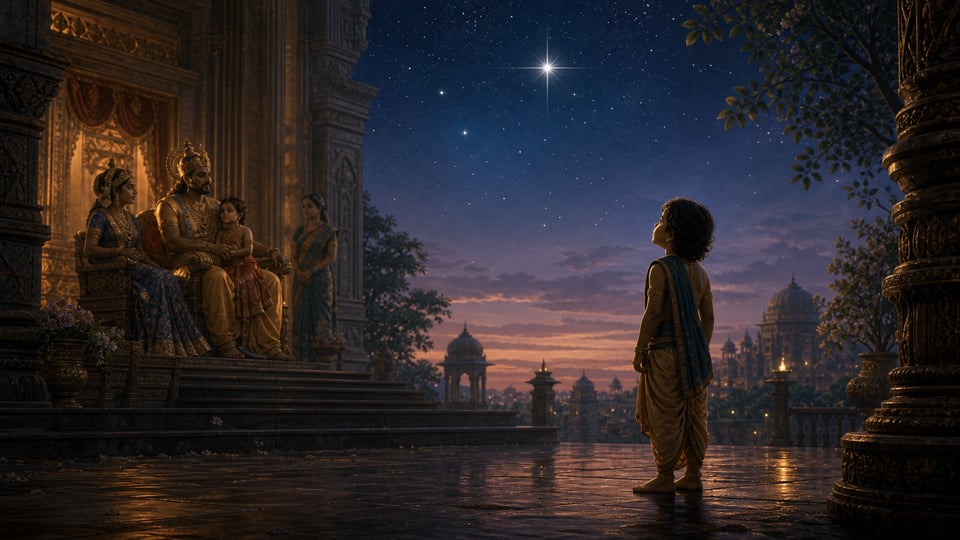
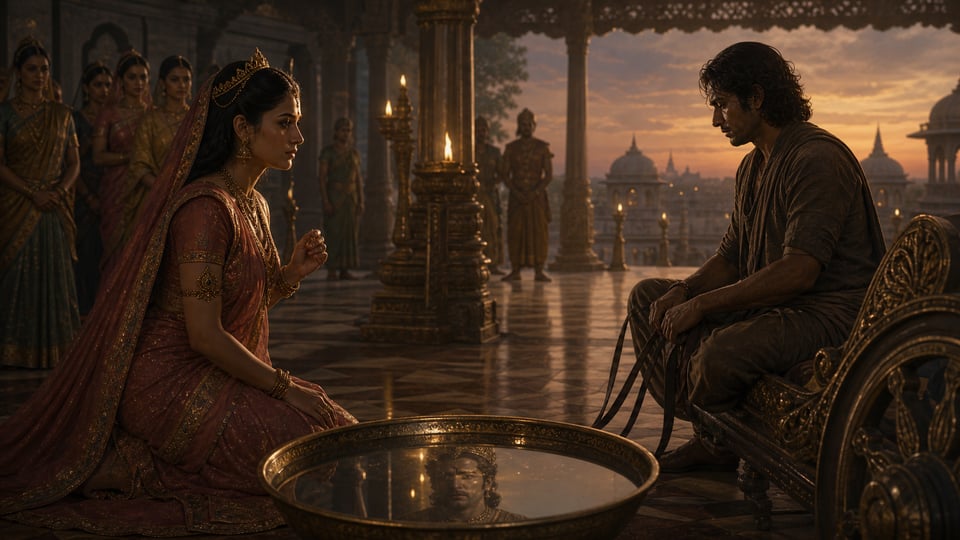
Karna’s entire life was defined by the secrecy surrounding his birth. He was the firstborn son of Kunti, abandoned as an infant to protect her social standing. Because his royal lineage was hidden, he was branded a sutaputra, facing constant stigma and exclusion.
It was this very exclusion that drove him to lie to Parashurama to acquire an education. His hidden birth was the root cause of the curses that eventually killed him.
In genealogy, when families hide branches, cover up marriages, or erase individuals due to social stigma, they create "historical debts." These secrets do not disappear; they form gaps that confuse future generations and distort the family's true legacy.
Karna’s appeal to dharma represents the trap of selective rules. He wanted the rules applied strictly to save him, but he had ignored them when they applied to Abhimanyu.
Parashurama had sworn to teach weapon skills only to Brahmins. Karna, desperate for education, lied about his birth and claimed to be a Brahmin. When Parashurama discovered the lie through Karna’s high pain tolerance (a trait associated with Kshatriyas), he cursed Karna that his weapon knowledge would fail him when he needed it most.
Karna accidentally shot and killed a cow belonging to a Brahmin while practicing his archery. The grieving Brahmin refused any compensation and cursed Karna, saying that in his hour of greatest danger, the earth would swallow his chariot wheel, just as the earth had swallowed the blood of the cow.
Technically, yes. Striking a dismounted, unarmed warrior violated the code of dharmayuddha. However, Krishna argued that the Kauravas, including Karna, had already destroyed the moral authority of those rules by repeatedly violating them first, most notably during the killing of Arjuna's unarmed son, Abhimanyu.
Karna’s life shows that hidden identities and family secrets (such as his abandonment by Kunti) lead to long-term conflict and tragedy. It teaches modern genealogists to document family lines completely, including adoptive relationships and difficult histories, without applying selective rules to make the family history look more prestigious.
Mahabharata, Karna Parva, Sections 89–91 (K. M. Ganguli translation), for the detailed account of the final duel, the chariot wheel sinking, the curses coming due, and the dialogue between Karna and Krishna.
Mahabharata, Adi Parva, Sections 137–139, for Karna's early life, his rejection at the tournament, and his training under Parashurama.
Madhusudan Subedi, "Caste System: Theories and Practices in Nepal," for analysis on how occupational labels were historically institutionalized:
knowledge-base-ai-ingest/markdown/014_caste_system_theories_practices_nepal_subedi_2011.md
Bamsawali evidence and copywriting guidelines:
planning-and-strategy/bamsawali-copywriting-master-prompt.md
Mythological
15 July 2026 · 6 min read
Mythological
1 July 2026 · 12 min read
Mythological
30 June 2026 · 12 min read
Mythological
30 June 2026 · 12 min read
Mythological
26 June 2026 · 11 min read
Mythological
26 June 2026 · 12 min read