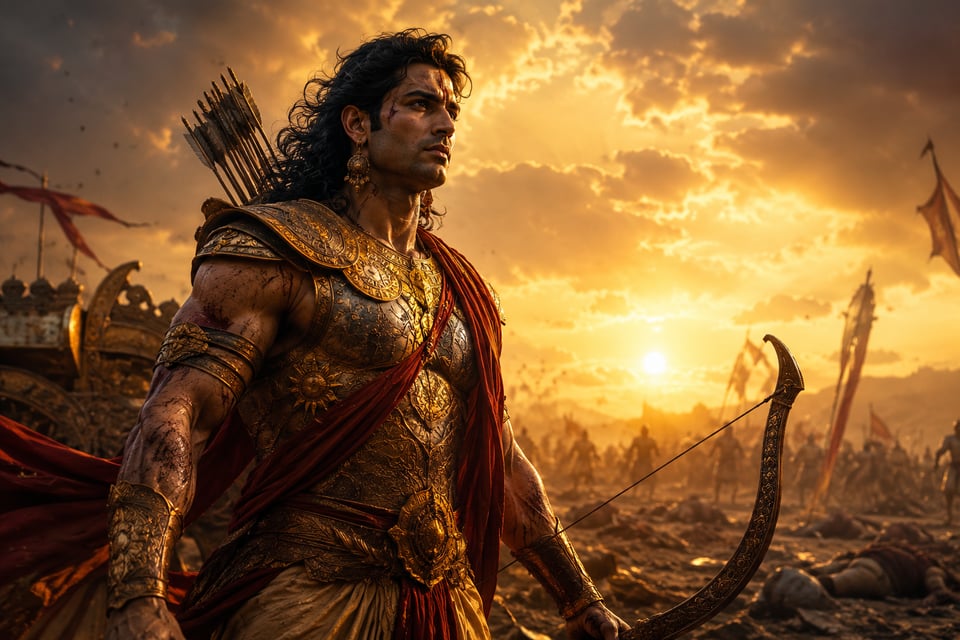
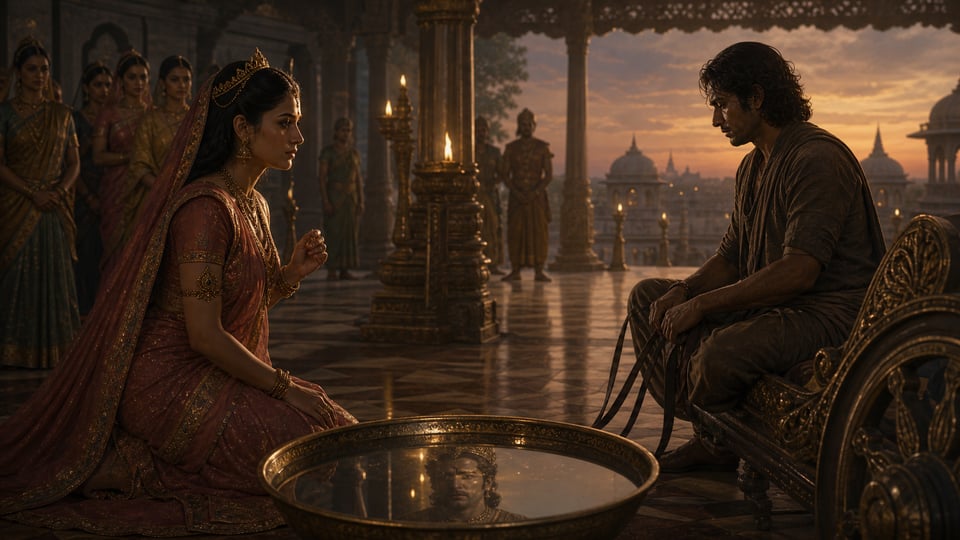
Before Kurukshetra, Krishna entered Hastinapura with one last chance for peace. The mission failed not because no compromise existed, but because pride rejected it.
26 June 2026 · 12 min read
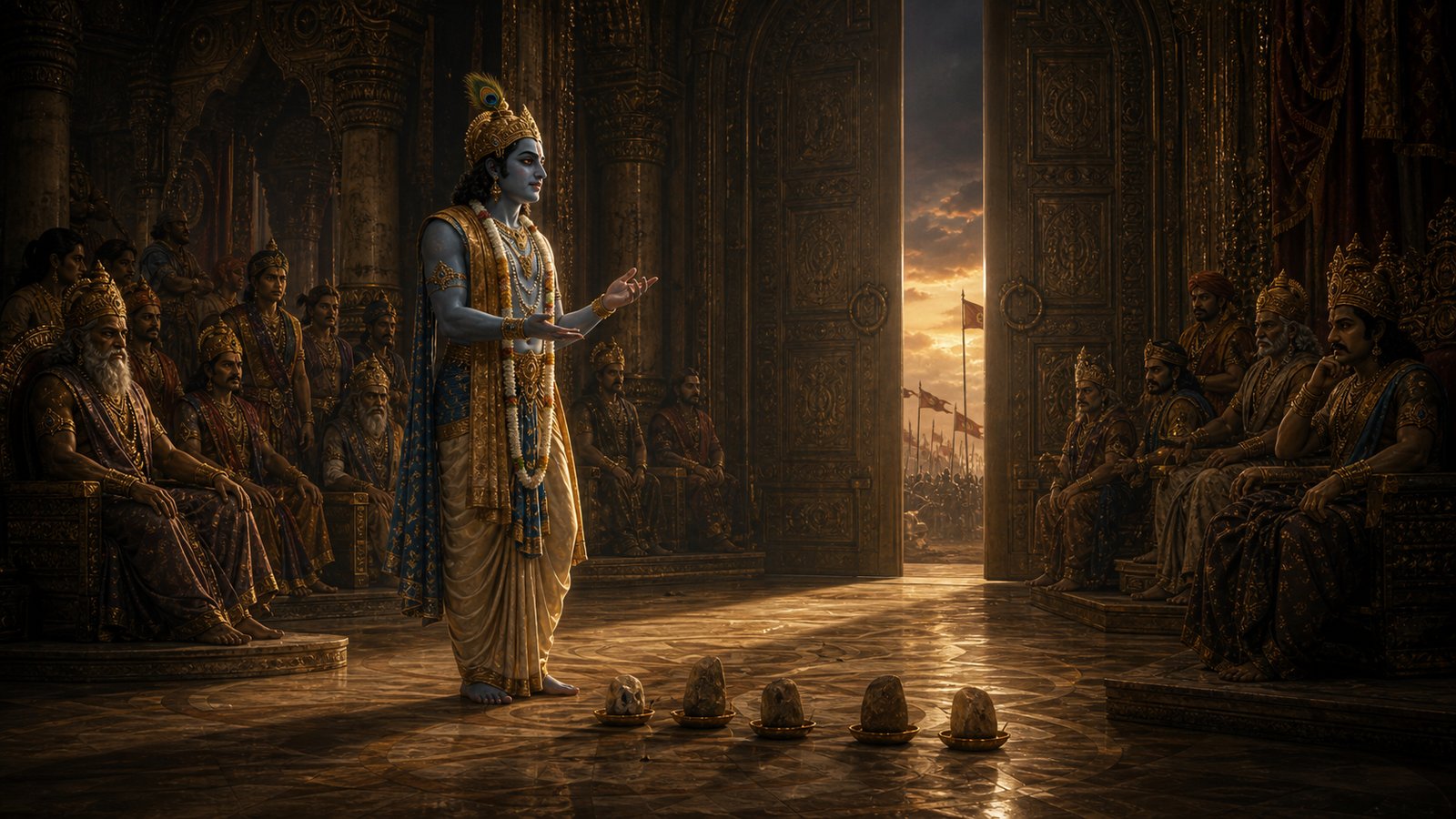
Before conches sounded at Kurukshetra, Krishna walked into Hastinapura without an army and asked a family to step back from destruction.
The Pandavas had completed exile. Their kingdom had not been returned. Armies were gathering, yet a settlement still existed: restore a just share, or at least enough ground for them to live without submission. Krishna came as envoy because war was not yet inevitable.
His mission failed. Not because no one understood the cost, and not because compromise was impossible. It failed because Duryodhana preferred a ruin he could command to a peace in which he would have to yield.
The Udyoga Parva is filled with movement before battle. Messengers cross between camps. Kings choose sides. Weapons, loyalties, memories, and old injuries are counted. Each party speaks of justice while preparing for the possibility that words will fail.
The Pandavas have reasons to demand more than compromise. They built Indraprastha, lost it through a deceitful dice game, endured Draupadi's humiliation, and completed the years of forest exile and concealment imposed upon them. Yudhishthira's claim is not a sudden appetite for land. It is tied to sovereignty already exercised and a settlement already violated.
Yet he does not begin by asking Krishna to threaten annihilation. Across the peace discussions, the Pandava position is repeatedly narrowed in the hope of avoiding war. The famous memory of "five villages" captures that narrowing: give the brothers even a small, viable share rather than force them to live under Duryodhana's domination. Editions and section numbering present the negotiations through several speeches, but the moral movement is clear. A large claim is reduced; the refusal remains absolute.
Krishna knows compromise can look like weakness to those already mobilizing. He also knows victory will not restore the dead. The warriors being assembled are related by blood, marriage, teaching, friendship, and hospitality. Bhishma blessed both branches. Drona trained both. Kripa stands within the same court. Kunti's sons will fight the sons of the household in which they grew.
Peace is therefore not sentimental avoidance. It is the last practical attempt to prevent kinship from becoming a list of targets.
Krishna accepts the role of envoy with danger already visible. He will carry words into a court whose prince has built his identity around never conceding to the Pandavas.
Hastinapura prepares for Krishna's arrival with ceremony. Duryodhana arranges luxurious hospitality. A royal guest, especially an envoy of Krishna's stature, can be surrounded by honor until the honor itself becomes a claim: you ate at my table, accepted my gifts, entered my favor.
Krishna declines.
In the Udyoga Parva's exchange, he distinguishes food offered from love from food accepted in necessity. He has neither reason to treat Duryodhana's invitation as affection nor need to depend upon it. He stays with Vidura, whose welcome is sincere and whose warnings have long opposed the Kuru court's descent.
The choice is not a rejection of hospitality as sacred practice. It protects the embassy from theatrical generosity. Duryodhana cannot use a banquet to create the appearance of intimacy while refusing the substance of justice.
At Vidura's house, the story's scale changes. The envoy who can command armies sits with the man whose counsel has repeatedly been ignored. Vidura understands the court. He knows Bhishma's grief, Dhritarashtra's weakness, Duryodhana's pride, and the way each warning has been absorbed without changing policy.
Krishna also meets Kunti. She has lived in Hastinapura separated from the sons for whom he now negotiates. Her grief carries years: widowhood, danger, exile, public insult, and uncertainty. The coming war is political on the maps, but maternal in her room. Every possible outcome contains sons killing relatives.
These meetings keep the mission from becoming an abstract debate about territory. Behind every demand stand people who will receive news after the battlefield.
Krishna enters the Kuru assembly before kings, elders, teachers, and counselors. He does not reveal a hidden legal trick. The facts are known.
The Pandavas are members of the Kuru house. They survived attempts against them. They accepted partition, built a kingdom, were dispossessed through dice, fulfilled exile, and now seek restoration. War will consume both sides. A just settlement can preserve Dhritarashtra's line and the wider world of allied rulers.
Krishna appeals to several kinds of responsibility at once. Dhritarashtra must act as king and father. The elders must use prestige before prestige becomes an ornament at a funeral. Duryodhana must understand that possession does not become righteousness merely because he has held it for years. The assembled rulers must imagine the consequences of joining a conflict that can still be prevented.
Voices in the court support peace. Bhishma, Drona, Vidura, and others urge Duryodhana to accept counsel. Dhritarashtra speaks the language of helplessness, as though his son's will were weather rather than a force he has repeatedly enabled.
This is one of the mission's bitter truths: the court does not lack wise people. It lacks a structure in which wisdom can overrule the person determined to reject it.
Duryodhana has heard every argument before. He interprets compromise as humiliation. Returning land would mean admitting that the dice victory did not settle moral legitimacy. It would place the Pandavas beside him as sovereign relatives rather than beneath him as defeated dependents.
For him, peace carries an intolerable witness: the world would see that he had yielded.
Later memory condenses Duryodhana's position into a hard image: he will not give the Pandavas land enough to fit the point of a needle. The exact wording varies across retellings and translations, but it faithfully reflects the absolutism of his refusal.
The image is small; its consequence is vast.
By this stage, the argument is no longer about whether the Pandavas' reduced request can be accommodated. A kingdom capable of sustaining enormous armies could survive a territorial settlement. The obstacle is Duryodhana's belief that any concession destroys him.
He presents himself as defending what he possesses. In reality, he is allowing possession to choose the fate of everyone around him. His brothers will fight. His grandfather will fight while grieving. His teacher will fight former pupils. Allied kings will die for a refusal they did not create. Parents, spouses, and children will inherit the cost.
This is how pride disguises itself as principle. It says, "If I give one step, I am nothing." It turns flexibility into shame, apology into defeat, and shared survival into loss of face.
Krishna's mission exposes that logic by making the alternative visible. Peace does not require Duryodhana to vanish. It requires him to live without total control.
The distinction matters because the Mahabharata does not portray war as arising from one disputed field alone. The road includes succession anxiety, attempted murder, competitive resentment, the burning of the lac house, the division of the kingdom, the splendor of Indraprastha, the dice game, Draupadi's humiliation, exile, vows, and failed mediation. Land is bound to dignity, legitimacy, and memory.
Yet at the final door, a concrete concession could still prevent battle. Duryodhana chooses the entire inheritance of hatred over the smallest admission that another branch also belongs.
Refusing the proposal is not enough for Duryodhana. He and his allies consider seizing Krishna.
The plan reveals how far the court's moral language has collapsed. An envoy traditionally carries protection because dialogue is impossible if the messenger can be imprisoned whenever the message displeases power. To seize Krishna would violate diplomatic duty and announce that Hastinapura has abandoned even the form of negotiation.
The elders are horrified. Vidura warns. Dhritarashtra protests his lack of consent. But the plot itself matters even when it fails: Duryodhana cannot answer Krishna's argument, so he imagines controlling Krishna's body.
Krishna cannot be contained. In the epic's theophanic scene, he reveals a cosmic form before the assembly. Deities, worlds, radiance, and terrifying power appear within him. The court that planned to bind one envoy confronts a being in whom the forces of the coming destruction are already visible.
Different readers approach this scene devotionally, philosophically, or poetically. Within the narrative, its dramatic meaning is unmistakable. Duryodhana has mistaken restraint for vulnerability. Krishna came without using force because he was offering a choice, not because force was unavailable.
The revelation does not compel peace. That is crucial. Overwhelming vision can astonish the court, but it cannot create consent inside a will committed to refusal. Duryodhana interprets, dismisses, or survives even this warning without yielding.
Miracle does not remove moral agency. Krishna can show what stands before them. He does not make Duryodhana choose differently.
The attempted seizure becomes the peace mission's darkest mirror: a man afraid of losing control tries to imprison the last person holding open the way out.
It is tempting to place the mission's failure entirely on Duryodhana. His refusal is decisive, but the court around him helped build the conditions in which refusal could rule.
Dhritarashtra repeatedly recognizes danger yet describes himself as unable to restrain his son. His blindness is physical; the epic's political tragedy lies in the habits of partiality surrounding it. He loves Duryodhana, fears losing him, benefits from the Pandavas' dispossession, and postpones confrontation until warnings have become armies.
Bhishma commands reverence but remains bound to the Kuru throne by the vow that once protected his father's desire. Drona carries obligation to the court. Kripa remains within its service. Their counsel is wise, but counsel without a line beyond which one refuses participation can become ceremonial dissent.
Gandhari condemns her son's obstinacy. Vidura has warned against injustice for years. Sanjaya has carried messages. Krishna now speaks with unmatched clarity. The failure is not silence in the literal sense. It is speech that power has learned it may ignore without consequence.
That pattern gives the mission emotional weight. Many families and institutions possess a respected elder who says the right thing after each escalation. Yet if the elder continues to bless every gathering, conceal every breach, and stand beside the aggressor when decisions are enforced, advice may preserve the adviser's innocence more than it protects the vulnerable.
The Mahabharata does not offer a simple escape for the elders. Their vows, debts, offices, and affections are real. So is the catastrophe they cannot prevent.
Krishna's embassy is the last audit of their influence. When the moment comes to convert moral prestige into a changed decision, the court discovers how little authority remains behind its wisdom.
The public mission has failed, but Krishna attempts one more intervention. He takes Karna aside and reveals that Kunti is his mother, making him the eldest Pandava by birth.
The conversation belongs to the peace mission because Karna is central to Duryodhana's confidence. If he crosses sides, the balance of loyalty and military strength changes. Krishna offers recognition, brotherhood, and kingship. He gives Karna a path out of the coming war.
Karna refuses. Radha and Adhiratha raised him. Duryodhana honored him. He will not abandon that friendship when danger arrives, even though he understands the likely destruction and asks that the birth secret remain hidden from Yudhishthira.
The exchange shows peace narrowing from kingdoms to one conscience. The court would not yield land. Now one warrior is asked to yield allegiance. He cannot.
Krishna does not pretend Karna's reasons are empty. Gratitude and lived parenthood matter. Yet noble feelings can bind a person to a ruinous cause. Karna's loyalty is among his most admirable qualities and one of the chains drawing him toward death.
Soon Kunti will make her own appeal and receive only a promise that four sons will be spared. Every negotiation now produces limits upon disaster rather than peace.
This sequence makes the failed embassy more than a diplomatic episode. Krishna tests every remaining door: royal duty, elder wisdom, pragmatic settlement, fear of consequence, sacred vision, hidden kinship, and personal loyalty. Each door opens just enough to show the path, then closes.
War becomes inevitable only after people repeatedly make it so.
Krishna departs Hastinapura without an agreement. The road behind his chariot is the last visible line between negotiation and war.
No one can later claim that battle came because alternatives were never spoken. The claims were named. The costs were described. Elders urged restraint. A smaller settlement was imaginable. The envoy was protected only because he could not be seized. Even the hidden brotherhood between Karna and the Pandavas was brought into the light.
The mission's failure therefore has a particular sorrow. Peace did not die from lack of intelligence. It died from identities built around not yielding.
Sanjaya and other messengers had already carried versions of the same warning between the families. Krishna's embassy was not the first conversation; it was the last gathering of arguments accumulating for years. Repetition makes the refusal more serious. Duryodhana cannot claim surprise, and the elders cannot say they lacked time to understand.
Duryodhana imagines that keeping every measure of land preserves his honor. Kurukshetra will leave him with no kingdom to enjoy. Dhritarashtra avoids the pain of restraining his son and receives the grief of losing sons. The elders avoid breaking their bonds to the throne and enter a war that breaks the dynasty.
The story should not be reduced to advice that every conflict has an easy compromise. Some demands are unjust; some settlements merely delay violence; people under threat are not obliged to surrender safety for the appearance of harmony. The Pandavas had already accepted repeated losses. Krishna's offer matters because it did not ask the wronged side to call injustice good. It asked the powerful side to return enough justice for coexistence.
The unanswered question is not "Why did no one think of peace?" Many did.
It is "What had Duryodhana become unable to imagine about himself if he shared?"
That question belongs beside every inherited conflict whose original facts have become wrapped in pride. Sometimes the last door is not locked by the size of the dispute. It is locked by the fear that opening it will change who gets to feel victorious.
Mahabharata, Udyoga Parva, especially the Bhagavat-yana sections covering Krishna's embassy to Hastinapura.
Mahabharata, Udyoga Parva, for the court speeches, Duryodhana's refusal, the plot to seize Krishna, and the cosmic manifestation.
Mahabharata, Udyoga Parva 140–145, for Krishna's private conversation with Karna after the mission.
Mythological
15 July 2026 · 6 min read
Mythological
13 July 2026 · 6 min read
Mythological
1 July 2026 · 12 min read
Mythological
30 June 2026 · 12 min read
Mythological
30 June 2026 · 12 min read
Mythological
26 June 2026 · 11 min read