Yudhishthira chose fairness over power at the Yaksha lake saving his brother Nakula instead of Bhima or Arjuna. A profound lesson in justice from the Mahabharata.
30 June 2026 · 12 min read
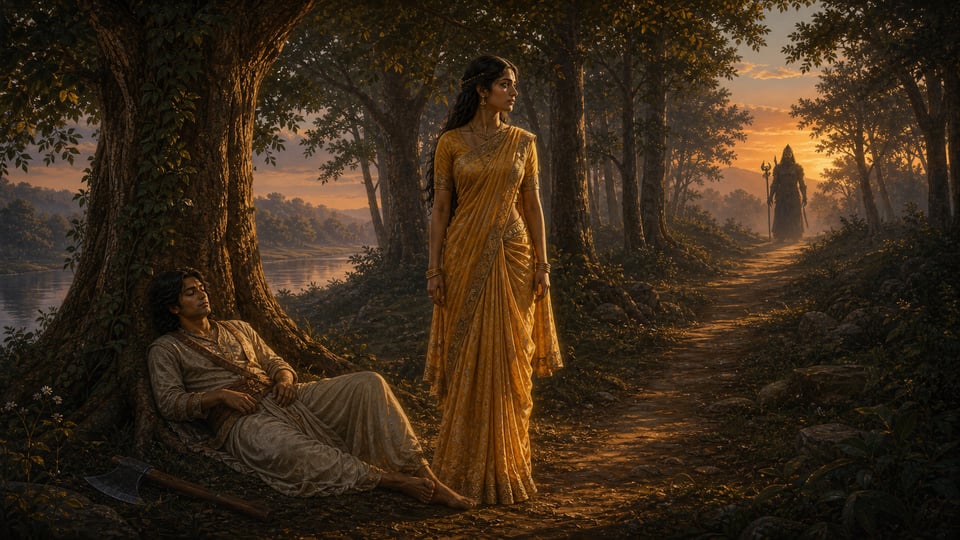
The heat of the forest was a physical weight, a shimmering haze that turned the horizon into a blur of gold and dust. Yudhishthira walked with a slow, measured gait, his throat feeling as though it had been scorched by embers. Around him, the silence of the wilderness was absolute, broken only by the rhythmic crunch of dry leaves underfoot. He was not alone in his exile, yet as he looked back, the trail of his brothers had vanished. The emotional weight of this moment was not merely the thirst of the body, but the sudden, suffocating fear of a leader who has lost his charges to an invisible enemy. He felt the crushing pressure of responsibility, knowing that in the depths of this forest, a single lapse in judgment could mean the end of their lineage. He paused, leaning against a gnarled tree, the rough bark scraping against his palm, wondering how a group of the world's most capable warriors could simply dissolve into the green maw of the woods.
The crisis had begun with a deceptively simple event. A Brahmin, fleeing through the woods, had lost his fire-sticks to a deer, and in the ensuing chaos and pursuit, the Pandavas had been scattered. Thirst, that most primal of human urges, had driven the brothers away from the safety of their collective strength. One by one, they had sought water, and one by one, they had encountered a mirror of their own desperation. The forest, usually a sanctuary of nature, had become a labyrinth of psychological traps, where the basic need for survival clashed with the invisible laws of a higher realm.
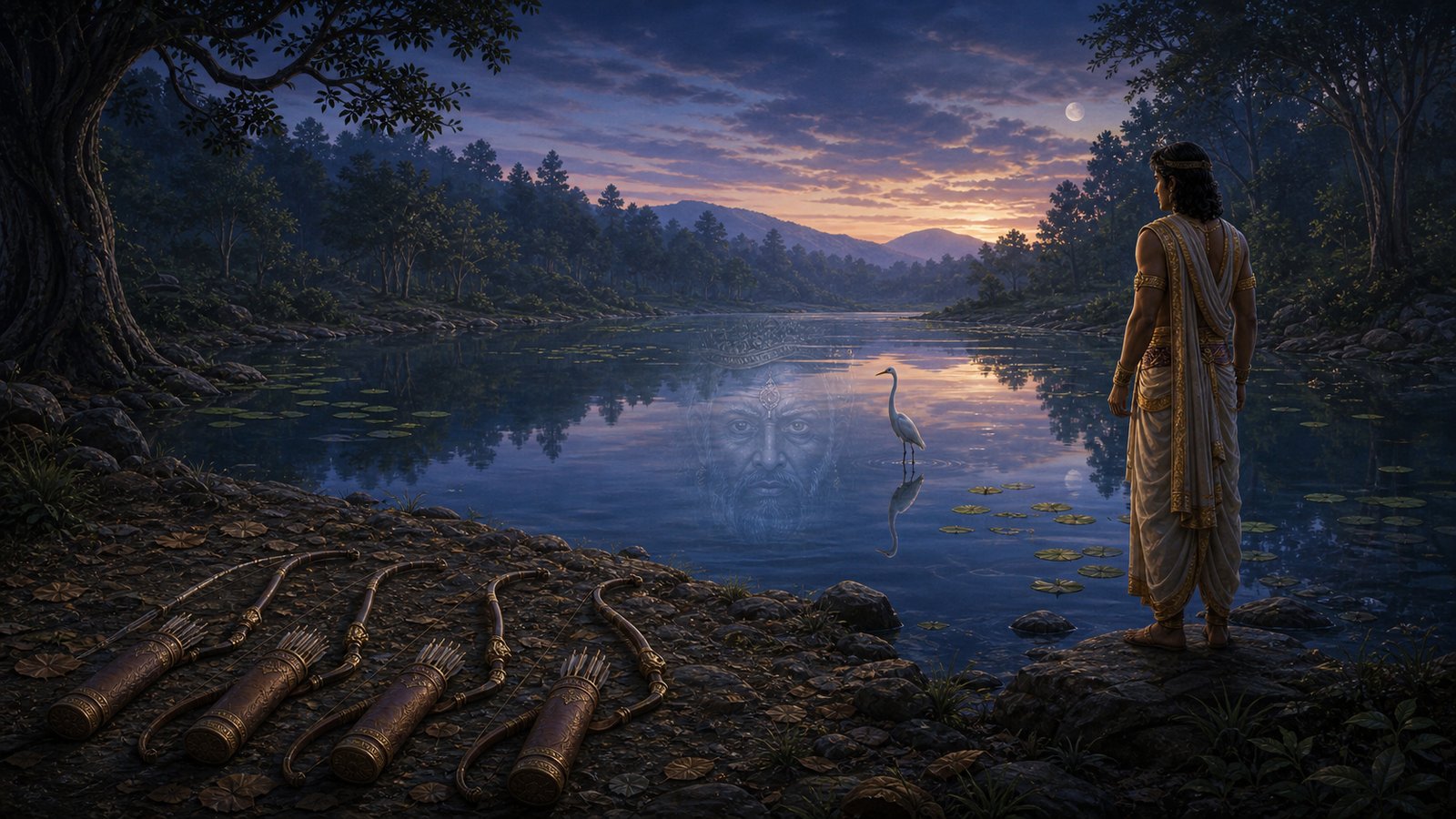
The lake was a jewel of sapphire blue set against the oppressive green of the Vana Parva. When Nakula first arrived at its banks, he saw the water as a salvation, a shimmering promise of relief. He did not see the entity that hovered in the air, an unseen voice that resonated not in the ears, but directly in the consciousness. The voice had been clear: answer the questions first, or suffer the consequence of the water. Driven by an agony of thirst that eclipsed all caution, Nakula ignored the warning. He felt the cool breeze of the lake on his skin, a cruel tease before the end. He knelt to drink, and as the water touched his lips, he collapsed, his life force extinguished in an instant, his body becoming a silent statue on the shoreline.
The tragedy repeated itself with a haunting precision. Sahadeva, then Arjuna, and finally the mighty Bhima arrived at the shore. Each saw their brother lying motionless on the sand, a sight that should have served as a warning. Yet, the desperation of the flesh is a powerful blindfold. Arjuna, the master of the bow, might have analyzed the scene with his keen eyes, but the fire in his throat drowned out the logic of his mind. Bhima, whose strength could shatter mountains, felt his knees weaken not from fatigue, but from the sheer, visceral need for a single drop of water. Each brother, consumed by the need to survive and the grief of seeing their sibling fallen, ignored the unseen command. They stepped into the water, and the silence of the lake claimed them all. By the time Yudhishthira reached the shore, the scene was a tableau of absolute devastation. Four of the strongest men in the world lay like fallen pillars, their breaths stilled, their strength useless against a foe that did not fight with weapons, but with rules.
Yudhishthira stood at the edge of the water, his heart hammering against his ribs. The sight of Bhima, the man who could move mountains, lying helpless, was a blow that nearly broke his resolve. He looked at the stillness of their chests, the unnatural peace on their faces, and felt a surge of helplessness that no amount of royal training could prepare him for. But the eldest Pandava was defined by a different kind of strength: the strength of restraint. He did not rush into the water in a panic, nor did he let the darkness of despair swallow his reason. He did not scream at the heavens. Instead, he looked at the bodies of his brothers and felt the cold wind of mortality. He realized that this was not a random accident, but a trial designed to test the very core of his being. The air shimmered, and the voice of the Yaksha returned, demanding that Yudhishthira, too, submit to the interrogation before he dared to touch the water.
The dialogue that followed is known to history as the Yaksha Prashna, a series of inquiries that stripped away the superficialities of existence to reach the marrow of truth. He questioned what is the fastest thing in the world, and what is the greatest wonder of all. Yudhishthira, though grieving and exhausted, did not let his emotions cloud his intellect. He stood his ground, his voice steady, answering with a clarity that mirrored the still surface of the lake. He understood that to answer incorrectly was not just to risk his own life, but to fail the legacy of his ancestors.
When asked what is the fastest thing in the world, Yudhishthira did not speak of the wind or the flight of an arrow. He spoke of the mind, which can travel to the furthest reaches of the universe in a single heartbeat, crossing oceans and mountains in a flicker of thought. He observed the irony of human nature: the desperate clinging to a temporary life while ignoring the eternal cycle of decay. These answers were not mere academic exercises; they were the reflections of a man who had lost everything and had therefore found the perspective of the eternal. He spoke not as a prince seeking a kingdom, but as a soul seeking the truth.
The tension of the scene shifted from an intellectual duel to a moral crucible. The Yaksha, satisfied with the wisdom of the answers, offered Yudhishthira a reward. He promised to bring one of his brothers back to life. For a moment, the forest seemed to hold its breath. This was the moment where utility and emotion collided. Any rational leader would have chosen Bhima, the powerhouse of the family, or Arjuna, the peerless archer. Without them, the Pandavas would have no hope of reclaiming their kingdom or defending themselves against the Kauravas. The survival of the dynasty depended on the strength of the arms, not the beauty of the face. The strategic void left by Bhima and Arjuna would be an insurmountable gap in the coming war.
Yudhishthira paused, his gaze drifting from the fallen Bhima to the still form of Nakula. The silence stretched, heavy with the weight of a decision that would define his legacy. He thought of the blood ties that bound them, but he thought more deeply of the vows of fairness. He spoke, his voice steady despite the turmoil in his chest. He explained that he was the son of Kunti, and since he himself was alive, Kunti had one surviving son. However, Nakula was the son of Madri. To choose Bhima or Arjuna would be to favor his own mother's line over the memory of his stepmother. To ensure that both mothers had a surviving son, he chose Nakula. He chose the less "useful" brother to satisfy a higher law of equity.
This choice was a profound act of impartiality. In a world governed by the logic of power, Yudhishthira chose the logic of fairness. He sacrificed the strategic advantage of his strongest warriors to satisfy the ethical requirement of balance. It was a decision made not in the heat of passion, but in the coolness of Dharma. He prioritized a principle of justice over the utility of war, proving that the integrity of the soul is more valuable than the strength of the sword.
The air suddenly fractured with a golden light, and the unseen voice materialized into a form of terrifying majesty. The Yaksha was not a forest spirit, but Dharma himself, the god of righteousness and the father of Yudhishthira, appearing in the guise of Yama. He had come to test his son, not to kill his children, but to verify if the crown of righteousness still sat firmly upon Yudhishthira's head despite the hardships of exile. The revelation brought a wave of relief that washed over the shore, like a cool rain after a long drought. The god praised Yudhishthira's unwavering commitment to equity and his ability to maintain composure in the face of absolute grief. He saw that his son had not been swayed by the desperation of the moment or the calculations of war.
With a gesture of divine will, the other brothers were restored. Bhima, Arjuna, and Sahadeva awoke as if from a deep sleep, their thirst quenched and their strength returned. They gasped for air, blinking at the sunlight, confused by the sudden transition from the void back to the physical world. The horror of the lake vanished, replaced by a profound sense of gratitude and a renewed understanding of the hierarchy of values. They had entered the forest as warriors and princes, but they left that shore as students of a higher law. They learned that the most dangerous thirst is not for water, but for the ego's desire to survive at the cost of another's right. They looked at Yudhishthira with a new kind of reverence, realizing that his wisdom was the only true shield they possessed.
The scene ends not with a celebration, but with a quiet walk back into the depths of the woods. The brothers moved closer to one another than they had in years, the memory of their temporary deaths serving as a bond stronger than blood. They spoke in low tones, reflecting on the fragility of their existence and the strength of the principles that had saved them. They had seen the void, and they had seen the only bridge that crosses it: the bridge of Dharma. The forest, once a place of terror, now seemed like a classroom for the soul.
Reflecting on this narrative today, the story of the Yaksha Lake transcends the boundaries of ancient mythology. It speaks to the modern struggle between the "optimal" choice and the "right" choice. In our current era, we are conditioned to maximize utility to choose the most productive employee, the most efficient system, or the most powerful ally. We are taught that the greatest loss is the loss of capability. Yet, Yudhishthira suggests that the greatest loss is actually the loss of integrity. When he chose Nakula, he was not ignoring the value of Bhima's strength; he was asserting that the value of justice is higher than the value of power. He taught us that a victory won through unfairness is actually a defeat of the spirit.
The lake serves as a metaphor for the subconscious, a place where our deepest desires and fears surface. The brothers who fell were those who acted on impulse, driven by the immediate, burning need of the moment. They were not evil men; they were simply human, blinded by the urgency of their own suffering. They forgot that every action has a consequence and every resource has a guardian. Yudhishthira's success lay in his ability to step back, to listen, and to engage the mind before the body.
The Yaksha's questions remain timeless because they address the paradoxes of the human condition. The wonder of mortality, the speed of thought, and the nature of happiness are not problems to be solved, but mysteries to be lived. By answering them under the shadow of death, Yudhishthira proved that wisdom is not the accumulation of facts, but the application of truth in the moment of crisis. The story teaches us that the most difficult choices are rarely between right and wrong, but between two different versions of right—the right of utility and the right of principle. It challenges us to ask ourselves: would we sacrifice our most powerful as set to ensure a fair outcome for all?
As the Pandavas disappeared back into the greenery of the Vana Parva, the lake returned to its sapphire stillness. The water remained, a silent witness to the moment a man chose a stepmother's honor over his own military advantage. The forest continued to breathe, the deer continued to run, and the fire-sticks of the Brahmin remained lost, but the moral landscape of the brothers had been forever altered. They had learned that the world is governed by unseen forces, and that the only shield against those forces is a life lived in accordance with Dharma. The sapphire waters no longer looked like a trap, but like a mirror reflecting the purity of a just soul.
The beauty of this episode lies in its restraint. There is no great battle here, no clash of steel or thunder of chariots. There is only a conversation between a father and a son, a test of wit and heart. The lake did not just silence four brothers; it silenced the noise of the world, allowing the voice of truth to be heard above the roar of desperation. It proved that the quietest voice, when speaking the truth, is more powerful than the loudest cry of need.
In the end, the story is a meditation on the act of listening. The brothers who fell were those who stopped listening to the warnings of the universe, deafened by their own thirst. Yudhishthira survived because he listened not just to the Yaksha, but to the internal call of his own conscience. He understood that the answer to the question of survival is not found in the water, but in the wisdom that allows one to approach the water with a clean heart. This is the essence of the Yaksha Prashna, a timeless lesson in the art of the difficult choice and the reward of an impartial spirit.
As we move through our own forests of uncertainty, we are all, in a sense, standing on the banks of that sapphire lake. We are all faced with the temptation to take the shortcut, to choose the powerful over the just, and to let our immediate needs drown out the whispers of our ethics. The memory of Yudhishthira's choice serves as a compass, pointing us toward a path where fairness is the only true measure of success. It invites us to look beyond the immediate utility of our actions and consider the eternal weight of our integrity.
Mahabharata, Vana Parva 311–313, K. M. Ganguli translation, for the lake, the fallen brothers, Yaksha dialogue, Nakula choice, and Dharma's revelation.
Sacred Texts public-domain Vana Parva for section cross-checking.
The number and wording of Yaksha questions vary across editions and abridged retellings.
Mythological
15 July 2026 · 6 min read
Mythological
13 July 2026 · 6 min read
Mythological
1 July 2026 · 12 min read
Mythological
30 June 2026 · 12 min read
Mythological
26 June 2026 · 11 min read
Mythological
26 June 2026 · 12 min read