Dhruva was denied his father's lap, but he sought a higher throne. A child's wound became a spiritual awakening in this Puranic tale of resilience.
1 July 2026 · 12 min read
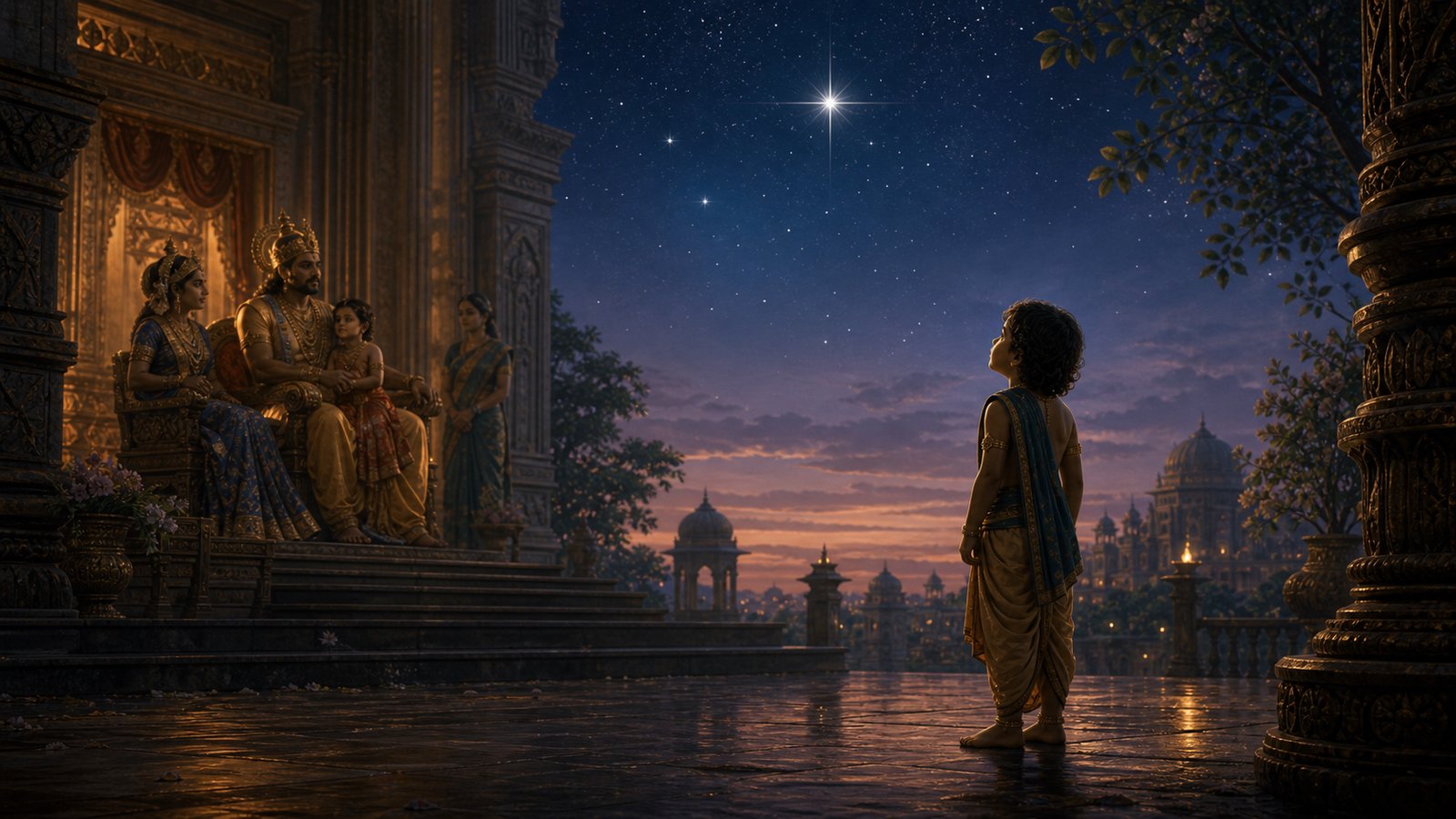
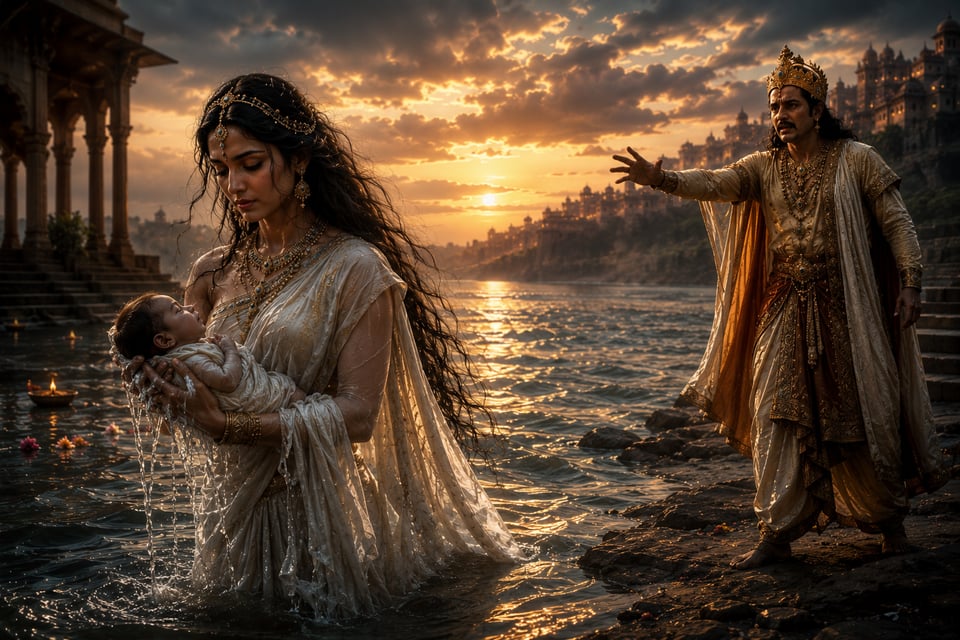
The royal court of King Uttanapada was a place of gold and incense, but for the young prince Dhruva, it felt like a wasteland of coldness. He stood there, a small child with wide eyes, reaching out for the one thing every child considers a birthright: the warmth of a father's lap. But the King did not reach back. Instead, Uttanapada held his other son, Uttama, cradling him with a tenderness that was pointedly absent for Dhruva. In that singular, freezing moment of rejection, the emotional premise of Dhruva's life was established. He learned that love was not a given, but a currency distributed by the powerful, and he was currently bankrupt.
The tension in the room thickened as Suruci, the King's favorite queen and Uttama's mother, looked upon the young boy with a mixture of pity and disdain. She did not hide her thoughts. She told Dhruva that he was unqualified to sit upon the King's lap because he was not born from her own womb. To her, the biological link was not enough; the emotional preference of the King was the only true law. Suruci's words were a surgical strike on the child's identity. She informed him that if he truly desired such a position of honor, he must not look to his father, but to the Lord of the Universe. She suggested that through intense worship, he might be reborn from her own womb in a future life to finally earn that lap.
For a child, this was an unthinkable cruelty. The suggestion that he must die and be reborn through another woman just to be loved by his father was a wound that went deeper than skin. Dhruva did not cry in the way other children do; instead, he felt a cold, hard knot of anger and ambition tighten in his chest. He was not seeking a spiritual awakening in that moment; he was seeking a way to outmaneuver the injustice of his household. He wanted a position that no one, not even the favored Uttama or the calculating Suruci, could ever take away from him.
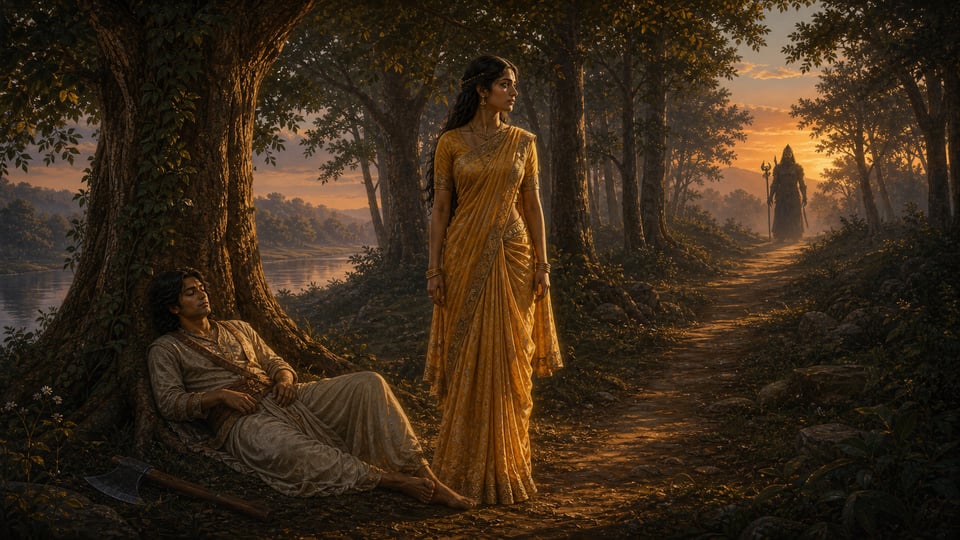
Dhruva turned away from the throne and ran to his mother, Suniti. Suniti was the shadow to Suruci's light, the neglected queen who lived in a state of quiet endurance. Seeing her son's distress, she tried to soothe him, explaining that the world is often unfair and that the heart of a father can be clouded. However, Suniti's words, while honest, could not heal the breach. The child's mind was already racing. He realized that as long as he remained within the walls of the palace, he would always be the "lesser" son. The only way to transcend the hierarchy of the court was to find a hierarchy that existed beyond the reach of human whims.
Driven by a mixture of grief and a fierce, burning desire for status, the young Dhruva decided to leave. He did not leave with a sense of peaceful detachment, but with the desperation of a child who had been told he was nothing. He headed for the forest, a place of wildness and danger, seeking a power that could dwarf the authority of any king. He was not looking for God out of love; he was looking for God as a means to an end. He wanted a throne that was permanent, a status that was immutable, and a recognition that would make his father's neglect seem insignificant.
As he ventured into the wilderness, he was intercepted by the sage Narada. The encounter was not immediately one of guidance, but of testing. Narada looked at the small child and questioned why he was wandering far from home. He tried to dissuade Dhruva, reminding him of his tender age and the comforts of the palace. He spoke of the duties of a son and the natural order of things. But Dhruva's resolve was like iron. He told the sage that he would rather perish in the forest than live in a palace where he was viewed as an intruder in his own father's heart.
Narada recognized that the boy's ambition, though born of anger and hurt, was potent. He saw that this was a level of determination that could be channeled. If Dhruva was willing to suffer for a worldly throne, he could be taught to suffer for a divine one. Narada did not romanticize the child's departure; he acknowledged the pain. But he provided the tool for transformation. He taught Dhruva the sacred syllable, the mantra of worship, and showed him how to focus his mind. He shifted the boy's gaze from the lap of a father to the heart of the Infinite.
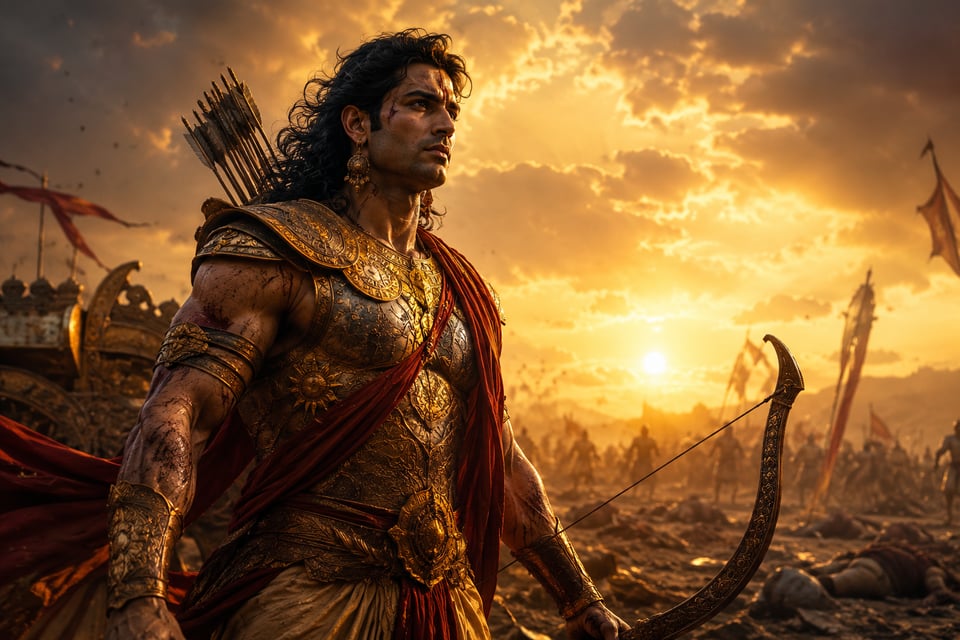
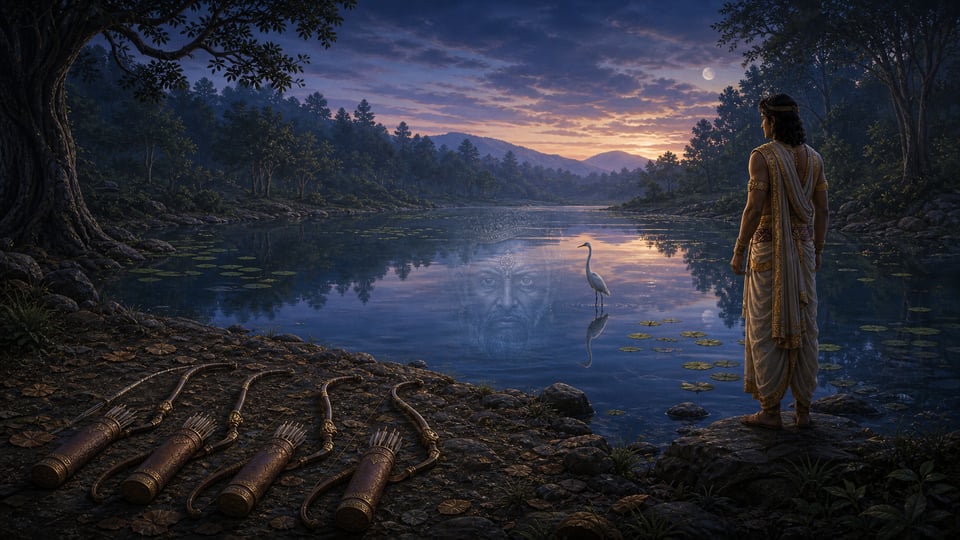
Dhruva began a regimen of austerity that would have broken a grown man. He did not seek a comfortable path. He fasted, he meditated in the biting cold, and he pushed his physical body to the absolute limit. There is a danger in prescribing such extreme austerity as a model for living, for it is a path of desperation. Yet, in the narrative of Dhruva, the austerity serves as a mirror. Each day of hunger and cold stripped away a layer of his ego. The anger that had fueled his departure began to burn itself out, leaving behind a vacuum that only a higher truth could fill. He was no longer fighting Suruci or Uttanapada; he was fighting the limitations of his own human nature.
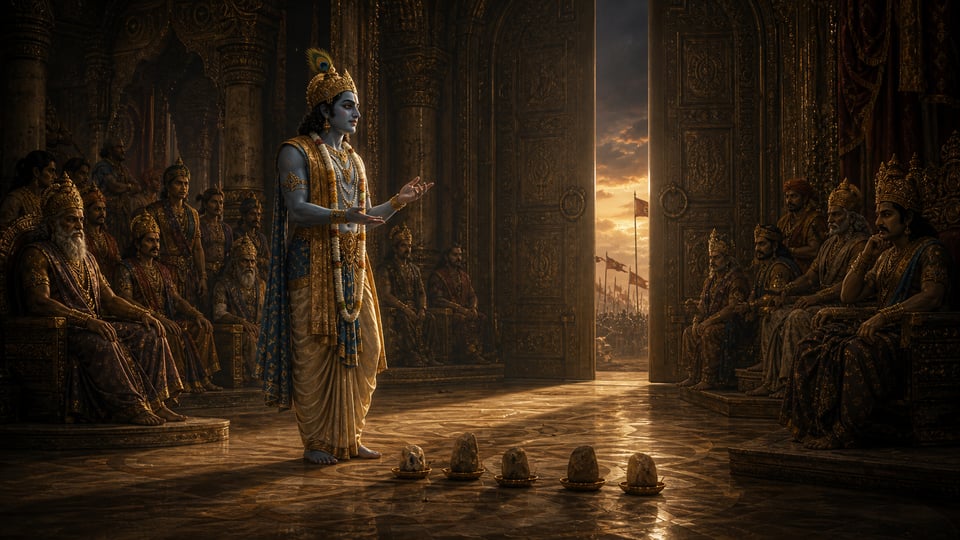
The climax of this struggle occurred when the veil of the material world finally tore. Vishnu appeared before him, not as a distant judge, but as the ultimate source of the love Dhruva had been denied. When the Lord spoke, the transformation in Dhruva was instantaneous and profound. The contact with the Divine did not just grant him a boon; it rewrote his internal language. The revenge he had planned, the desire to be "greater" than Uttama, and the need for his father's validation suddenly seemed like the playthings of a very small child. He looked back at his original ambition and saw it as a tiny, insignificant spark compared to the sun of spiritual realization.
Vishnu granted him a position that was indeed beyond anyone else's—the Pole Star, the Dhruva-loka. This was not a throne of earthly power, but a celestial anchor, a point of constancy around which the rest of the universe revolved. He was given an enduring position, but the true reward was the erasure of his wound. He realized that the lap he had been denied was a small thing, and that the love he had sought from a flawed man was available in an infinite, unconditional form. The child who had left the palace in a storm of anger returned as a beacon of peace.
Upon his return to the kingdom, the dynamics of the palace had shifted. The King, hearing of his son's achievement, was overcome with remorse. He sought to embrace Dhruva, to give him the lap he had withheld for so long. In a reversal of roles, it was now the father who was desperate for the child's acceptance. Dhruva accepted him, not because he needed the validation, but because he had evolved beyond the need for resentment. He saw his father not as a source of pain, but as a human being caught in the delusions of favoritism and attachment.
However, the story does not end with a neat, cinematic bow of total enlightenment. The Bhagavata Purana provides a crucial, grounding detail: spiritual achievement does not automatically erase the capacity for human emotion or the remnants of a wounded psyche. Years later, the death of his brother Uttama triggered a dormant volcano of grief and anger within Dhruva. The very brother he had once envied had become someone he loved, and the loss was unbearable. This grief manifested as a destructive campaign against the Yakshas, whom he blamed for the tragedy.
This later episode is essential to the narrative. It serves as a reminder that the "transformation" experienced in the presence of the Divine is often a peak experience, but the daily walk of a human being involves the constant management of old wounds. Even a being who has seen Vishnu and attained the highest celestial position can still be blindsided by anger and sorrow. Dhruva's campaign against the Yakshas continued until he was corrected, reminding us that the path to peace is not a straight line but a series of returns and corrections.
The tragedy of Dhruva's early childhood is a reflection of a universal human experience. Every person carries a "denied lap" a moment where they were told they were not enough, or where the people who were supposed to love them most failed to do so. The wound of parental favoritism is one of the deepest a child can endure because it attacks the very foundation of their worth. Dhruva's response was to seek a "higher throne," a common psychological defense where the neglected child attempts to overachieve to compensate for their perceived lack of value.
We see this in the modern world in the drive for perfectionism, the obsession with status, and the relentless pursuit of accolades. The "Dhruva complex" is the belief that if I can just become the best, the most successful, or the most powerful, the pain of that early rejection will finally vanish.
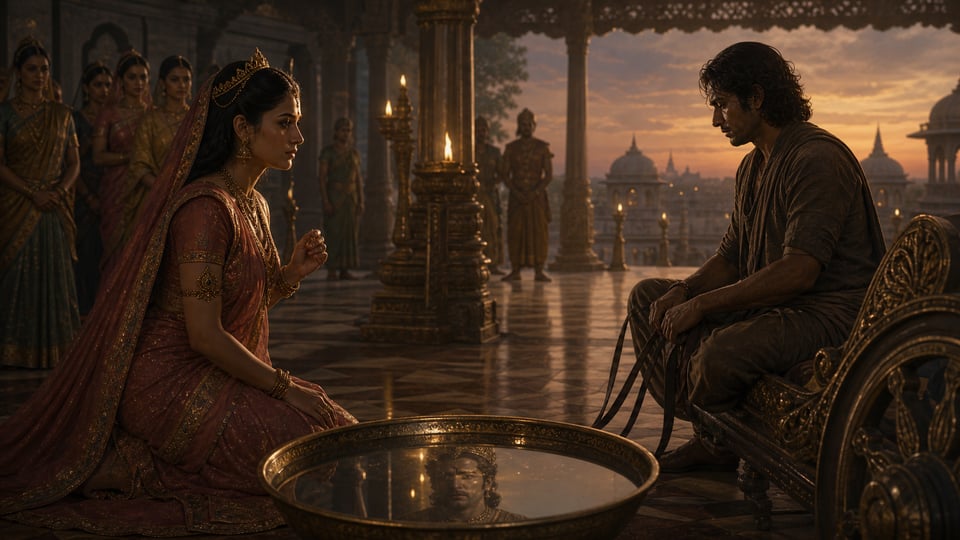
Suniti's role in this story is often overshadowed by the dramatic austerity of her son, but her pain is the quiet heartbeat of the narrative. She lived in the shadow of another woman's favor, enduring the silence of a husband who preferred another. Her strength was not in the fierce determination of Dhruva, but in her ability to remain compassionate despite her own marginalization. She did not teach her son to hate Suruci; she taught him the truth of the world, and in doing so, she gave him the mental space to seek a solution beyond the palace walls.
The story of Dhruva is not a prescription for children to leave home or for seekers to undertake extreme physical hardships. Such paths are dangerous and often unsustainable. Instead, it is a cinematic exploration of the alchemy of pain. It shows how a negative impulse anger, jealousy, and a sense of inadequacy can be the very fuel that drives a person toward a higher state of consciousness, provided they find a guide like Narada to redirect that energy.
The movement from the lap of the father to the light of the Pole Star represents the journey from the conditional to the unconditional. The lap of a father is conditional; it depends on the father's mood, his preferences, and his biases. The light of the Divine is unconditional; it is available to anyone who is willing to strip away the layers of their ego and face the void. Dhruva's journey was not about gaining a throne, but about discovering that he was already a part of the cosmic order, regardless of who held him in their arms.
In the end, the image that lingers is not that of the meditating child or the celestial star, but of the small boy standing in a golden court, feeling the coldness of a father's indifference. That image is the core of the human condition. We are all, in some sense, searching for the lap we were denied. We spend our lives building thrones, earning degrees, and accumulating wealth, hoping that these things will finally make us "qualified" for the love we crave.
The resolution of the Dhruva story is a quiet one. It is the realization that the throne is a distraction. The real victory was not in becoming the Pole Star, but in the moment Dhruva looked at his father and no longer felt the need to be seen. When the need for external validation dies, the internal void is filled. The anger that drove him into the forest was replaced by a stillness that could withstand even the death of a brother.
The narrative trajectory from the wound of the lap, through the fire of austerity, to the height of the celestial star, and back to the messy reality of human grief creates a complete portrait of a soul. It acknowledges that we are not perfected in a single flash of lightning. We are sculpted through a series of crises, failures, and awakenings. The "denied lap" is the catalyst, but the destination is a heart that no longer requires a lap to feel secure.
As we reflect on this journey, we are reminded that the most potent fuel for growth is often our deepest pain. The very thing that makes us feel broken is often the thing that pushes us to seek the Whole. Dhruva's story is a testament to the resilience of the human spirit and the possibility of transforming a childhood scar into a cosmic light. It tells us that while we cannot change the parents we had or the favoritism we endured, we can change the meaning we assign to those experiences.
The story concludes not with a crown, but with a correction. The later conflict with the Yakshas serves as a final, humbling reminder that the ego is a persistent ghost. Even after reaching the heights of the Dhruva-loka, the human heart remains a place of complexity. The true spiritual achievement is not the absence of anger, but the ability to be corrected and to return to the path of peace.
In the grand tapestry of the Puranas, this narrative stands as a bridge between the worldly desire for power and the spiritual desire for liberation. It warns us against the cruelty of favoritism and the danger of extreme asceticism, yet it celebrates the power of a focused will. It asks us to consider what "thrones" we are chasing in our own lives to fill the gaps left by those who failed to love us.
The legacy of Dhruva is not found in the stars, but in the courage to move beyond the boundaries of one's own hurt. It is the story of a child who asked for a lap and ended up finding the universe.
As you reflect on the journey of the child who sought more than a throne, consider the quiet strength of those who endure in the shadows, like Suniti, and the transformative power of a single, redirected ambition. May we all find the strength to turn our wounds into windows.
Srimad Bhagavatam, Canto 4, chapters 8–12, for the denied lap, Suruci's words, Suniti, Narada, austerity, Vishnu's appearance, return, and later Yaksha conflict.
Vishnu Purana, Book 1, chapters 11–12, H. H. Wilson translation, as a separately recognized parallel account.
Vedabase and the local Vishnu Purana extraction for passage cross-checking.
Mythological
15 July 2026 · 6 min read
Mythological
13 July 2026 · 6 min read
Mythological
30 June 2026 · 12 min read
Mythological
30 June 2026 · 12 min read
Mythological
26 June 2026 · 11 min read
Mythological
26 June 2026 · 12 min read