Nala lost everything to gambling and abandoned Damayanti in the forest. She refused to give up finding him through intelligence, not luck. A Mahabharata tale of resilience.
30 June 2026 · 12 min read
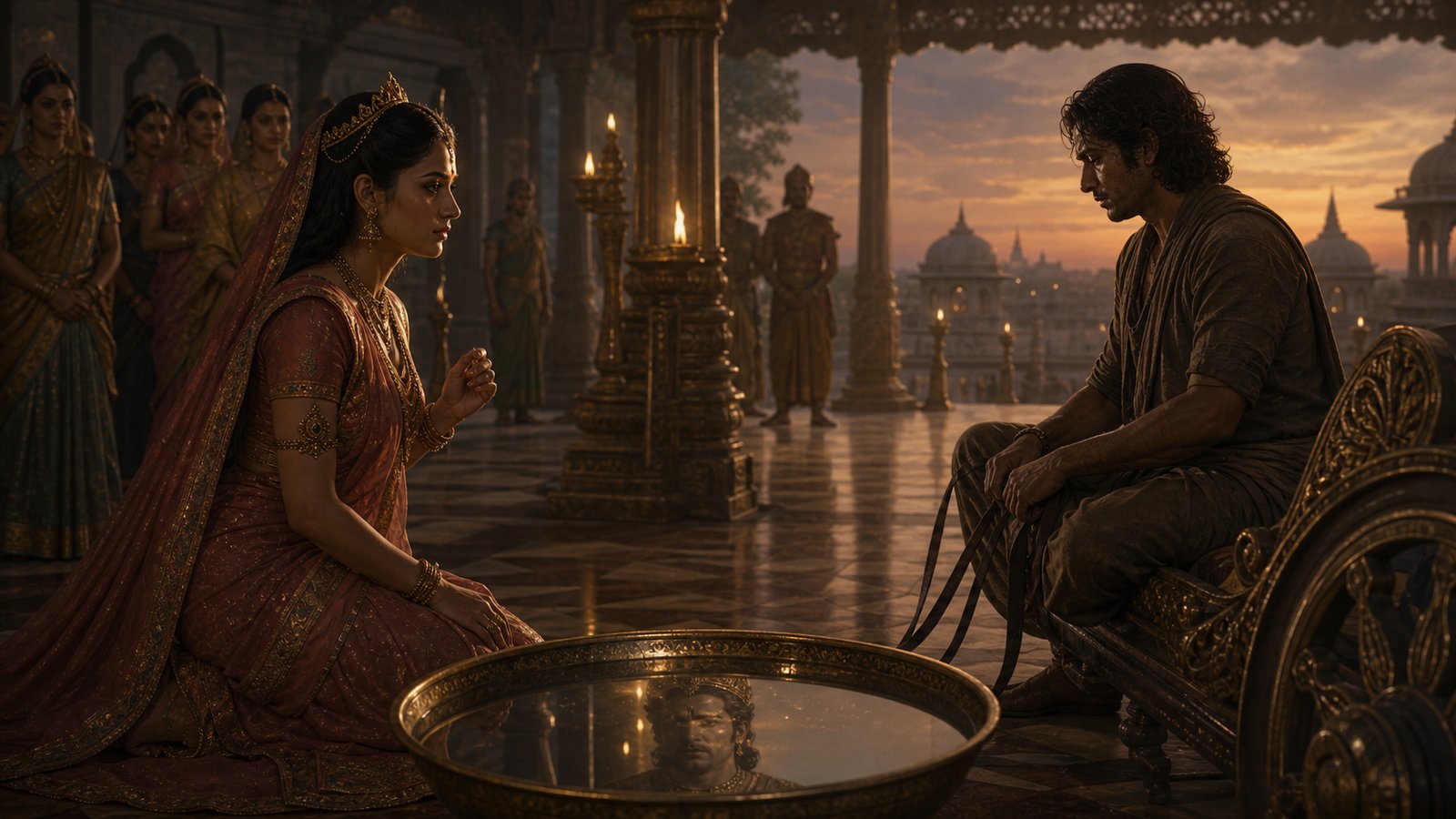
The wind howled through the desolate forest, carrying the scent of damp earth and ancient grief. Damayanti stood alone, her royal silks torn and stained by the thorns of a wilderness that cared nothing for her lineage. She looked at the empty space where Nala had stood only moments before, the silence of the woods echoing the sudden, violent void in her heart. He had left her. The man who had once been her world, the king who had won her heart through the whispers of a golden swan, had vanished into the gloom, leaving her to the mercy of predators and the crushing weight of betrayal. The emotional premise of her existence had shifted from the security of a marriage to the raw, terrifying necessity of survival.
The story of Nala and Damayanti did not begin with this loneliness, but with a miracle of communication. Long before the forest, there was a golden swan, a celestial messenger that flew between two distant kingdoms. The swan spoke of Nala's unmatched virtue and Damayanti's incomparable beauty, weaving a thread of longing between two souls who had never met. This was not merely a romance of chance; it was a convergence of destiny. When the gods themselves desired Damayanti, they sought Nala's help, asking him to act as their messenger to ensure her heart was open. At her swayamvara, the gathering of suitors, the gods played a trick of light and form, assuming Nala's appearance to confuse the princess. Yet, Damayanti possessed a perception that transcended sight. She looked past the divine illusions, recognizing the true essence of the man she had come to love through the swan's tales. She chose the human Nala, rejecting the gods for a mortal heart, a decision that anchored her life in a devotion that would soon be tested by the darkest of forces.
But the trajectory of a life can be altered by a single lapse in ritual or a momentary opening of the soul. Into Nala's life entered Kali, the personification of the age of discord. Through a ritual failure, Kali entered Nala's body, bringing with him a cloud of obsession and a hunger for the dice. This was not a simple case of greed, but an epic causation—a possession that stripped Nala of his judgment and his kingdom. In a series of catastrophic games, Nala lost everything to the deceitful Pushkara. The crown, the wealth, and the prestige of his ancestors vanished into the void of the gambling table. The addiction was a fever that burned through his rationality, leaving him a shell of a king. He did not just lose his land; he lost his sense of self. Driven by shame and the crushing weight of his failure, Nala fled his palace, taking Damayanti with him into the wilderness, only to find that the forest mirrored the chaos within his mind.
The abandonment in the forest remains the most harrowing chapter of their journey. Tormented by the loss of his status and the perceived inadequacy of his role as a protector, Nala succumbed to a psychological collapse. In a moment of profound instability, he abandoned Damayanti while she slept, believing that by removing himself from her life, he was sparing her from his own ruin. He did not excuse his departure with a noble lie; he simply vanished, leaving her to wake up to a world where the only hand she trusted had let her go. This act of abandonment was the nadir of Nala's descent, a fracture in the bond that had survived the jealousy of gods. Damayanti was left not only to fight the physical dangers of the wild but to wrestle with the agony of being discarded by the person she had chosen above all others.
Yet, the epic does not leave the protagonist in total darkness. As Nala wandered in his misery, he encountered the serpent Karkotaka. The bite of the serpent was not a death sentence, but a transformative ordeal. Karkotaka, seeing Nala's plight, granted him a strange kind of protection. The venom changed Nala's physical form, turning him into Bahuka, a short, dark, and unremarkable charioteer. This disguise was a shield, hiding him from his enemies and the crushing expectations of his former life. More importantly, the serpent gave him a secret weapon: the knowledge to master the dice, a way to undo the ruin he had wrought. Nala became a ghost of himself, serving in the stables of another king, his identity buried beneath the skin of a servant. He lived in a state of perpetual remorse, the memory of Damayanti acting as both his greatest pain and his only reason to endure the invisibility of his new existence.
While Nala was hiding in the skin of Bahuka, Damayanti was forging a new kind of strength. She did not succumb to the tragedy of her abandonment. After surviving the perils of the forest and returning to her father's house in Vidarbha, she refused to accept the narrative of a lost cause. She did not simply wait for fate to intervene; she exercised a fierce, intellectual agency. Damayanti began a systematic search for her husband, sending messengers to every corner of the known world. She gathered clues, tracked rumors, and analyzed the movements of kings and servants. Her intelligence became her primary tool of survival and recovery. She realized that if Nala were alive, he would be hidden, and the only way to draw him out was to create a situation where his unique skills would be undeniable.
The brilliance of Damayanti's plan lay in the announcement of a second swayamvara. She declared that she would marry again, but only to a man who possessed unmatched skill as a charioteer. This was a calculated trap, a beacon designed to attract the one person in the world who could drive a chariot with the precision of Nala. She knew that Nala's pride in his craft and his enduring love for her would compel him to emerge from the shadows. When Bahuka arrived at the court, he was a stranger to all, a dark-skinned driver with no lineage to speak of. But to Damayanti, he was a puzzle to be solved. She did not recognize him by sight, for the serpent's magic had been thorough, but she recognized him through the evidence of his soul and his skill.
The recognition process was a series of tests, a slow peeling away of the disguise. Damayanti questioned Bahuka on matters of knowledge and conduct, finding that his answers mirrored the wisdom of her husband. She observed his behavior, noting the subtle cues of a nobility that could not be erased by a change in skin color or stature. The most intimate test came through the art of cooking; she asked him to prepare a meal, and the taste of the food awakened memories of Nala's specific touch. Finally, she brought their children into the presence of the charioteer. The emotional reaction of the children and the profound, silent connection that formed between them broke the final barrier. In the presence of his children and the woman who had never stopped searching for him, the disguise of Bahuka dissolved. Nala regained his true form, not through a magical spell, but through the power of being seen and known by another.
The restoration of Nala was not merely a return to his old face, but a rebuilding of a shattered trust. The reunion was tempered by the memory of the forest and the weight of the abandonment. Nala had to face the reality of what he had done, and Damayanti had to decide if the man who returned was worth the pain he had caused. This was not a simple romantic reconciliation; it was a reckoning. Using the secrets taught to him by Karkotaka, Nala challenged Pushkara to a final game of dice. This time, the outcome was not dictated by the whims of Kali, but by Nala's mastery and his reclaimed will. He won back his kingdom, his wealth, and his honor, proving that restoration is possible even after total annihilation.
Looking back at this narrative, we see a profound reflection on the nature of addiction and possession. The epic treats Nala's gambling not as a moral failing of character, but as an external force—Kali—that hijacked his consciousness. This allows the story to explore the devastation of addiction without stripping the protagonist of his inherent nobility. It acknowledges that there are forces, whether spiritual or psychological, that can make a good man do unthinkable things. However, the story does not use this as an excuse for the abandonment of Damayanti. The pain of the forest remains a scar on their history, a reminder that even when a person is "possessed" or broken, the consequences of their actions fall upon those who love them.
The agency of Damayanti stands as the true engine of the story's resolution. In many epic traditions, the wife is a passive figure awaiting rescue. Damayanti subverts this entirely. She is the strategist, the detective, and the catalyst for Nala's return. She does not find him by luck; she finds him by design. Her intelligence is not a secondary trait but the primary force that overcomes the supernatural disguise of the serpent. She proves that while a face can be changed by a curse or a bite, the essence of a person—their skill, their taste, their way of speaking, and their bond with their children—remains an indelible signature.
The silence that followed their restoration was perhaps the most significant part of their journey. After the noise of the gambling halls and the screams of the forest, Nala and Damayanti had to learn how to live in the quiet of a reclaimed kingdom. They were no longer the naive lovers who had communicated through a golden swan. They were survivors of a psychic war. The trust they rebuilt was not the fragile trust of youth, but the tempered trust of two people who had seen the absolute worst of each other and decided to stay. They understood that the world could change a person's face, their status, and their fortune in a heartbeat, but the internal truth of a relationship is forged in the fire of endurance.
The story of Nala and Damayanti teaches us that recognition is not an act of the eyes, but an act of the heart and mind. To recognize someone after the world has changed their face requires a willingness to look past the surface and a memory of the essence. It requires the patience to test, the courage to search, and the strength to forgive without forgetting. Their journey from the heights of royalty to the depths of the forest and back again serves as a cinematic map of human resilience. It reminds us that no matter how deep the descent, there is always a path back, provided there is someone left in the world who remembers who you truly are.
As the sun set over the restored kingdom, Nala and Damayanti stood together, not as the perfect archetypes of a fairy tale, but as two flawed humans who had navigated the labyrinth of loss. The golden swan had started their journey, but it was Damayanti's intellect and Nala's remorse that finished it. They had moved beyond the illusions of the gods and the tricks of the dice. What remained was the simple, profound reality of their presence in each other's lives. The forest was far behind them, but the lessons of the wilderness remained etched in their souls, a reminder that the most precious things are those that are recovered after they have been presumed lost.
The narrative arc of the Nalopakhyana is a testament to the idea that identity is not static. Nala was a king, then a gambler, then a fugitive, then a servant, and finally a restored sovereign. Through each phase, he was stripped of the external markers of his identity. It was only through the eyes of Damayanti that his true self was mirrored back to him. This suggests that we are, in many ways, the sum of how those who love us perceive us. When the world saw Bahuka the charioteer, Damayanti saw Nala the husband. Her gaze was the bridge that allowed him to cross back from the shadow-world into the light of existence.
In the end, the story is less about the recovery of a kingdom and more about the recovery of a soul. The dice were merely the instrument of the fall, and the serpent was the instrument of the disguise. The real struggle was the internal battle against shame and the external battle against despair. By refusing to be a victim of her circumstances, Damayanti transformed her grief into a strategy for reclamation. She did not just save her husband; she saved the very idea of their union. The restoration was complete not when the gold returned to the treasury, but when the two of them could look at each other and see the truth, unburdened by the masks they had been forced to wear.
The legacy of this tale is the enduring power of the human spirit to rebuild from the ashes. It acknowledges the fragility of our stability—how a single lapse or a sudden stroke of misfortune can cast us into the wilderness. But it also celebrates the intelligence and devotion that can navigate that wilderness. The story asks us to consider what remains of us when everything else is taken away: our skills, our integrity, and the invisible threads that connect us to the people who truly know us. In the quiet aftermath of their victory, Nala and Damayanti found a peace that the golden swan could never have promised, a peace born of survival and the hard-won knowledge of each other's depths.
Now, as we close this chapter of the Vana Parva, let us reflect on the strength of a bond that survives the unthinkable. Let us remember the woman who refused to let the forest swallow her husband's memory. Let us honor the intelligence that sees through a disguise and the heart that dares to trust a broken man. This is the essence of the journey—the movement from loss to recognition, from disguise to truth. May we all possess the clarity of Damayanti to see the truth in those we love, even when the world has changed their face.
Mythological
15 July 2026 · 6 min read
Mythological
13 July 2026 · 6 min read
Mythological
1 July 2026 · 12 min read
Mythological
30 June 2026 · 12 min read
Mythological
26 June 2026 · 11 min read
Mythological
26 June 2026 · 12 min read