Before the Pandavas and Kauravas were born, vows by Shantanu, Ganga, Satyavati, and Bhishma had already narrowed the Kuru dynasty's future.
25 June 2026 · 12 min read
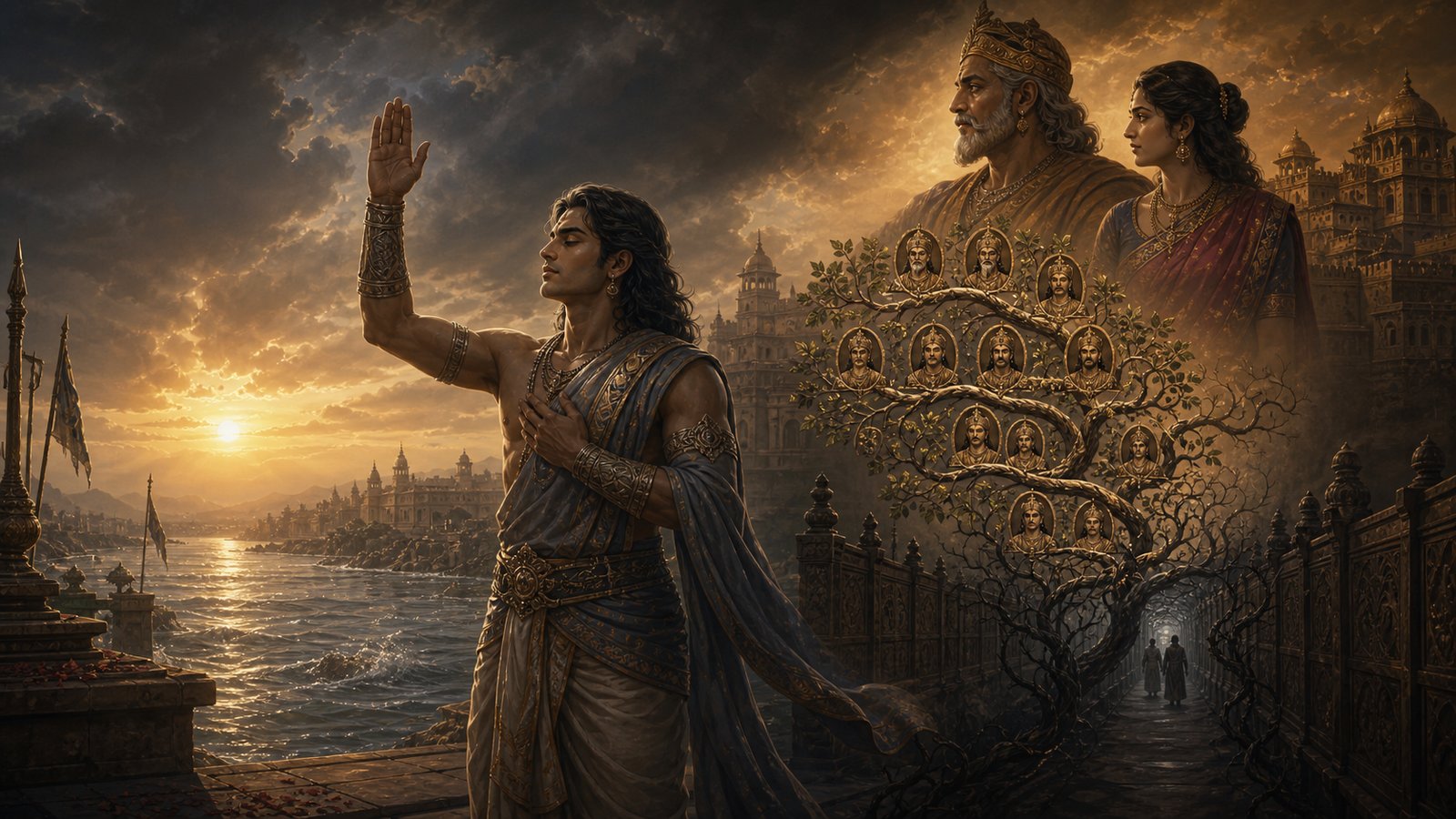
On the bank of the Yamuna, a young prince gave away his future.
Devavrata had come to secure Satyavati as a bride for his father, King Shantanu. Her father feared that Devavrata's claim to the throne would eclipse any son born to Satyavati. The prince answered by renouncing the crown.
It was not enough.
What if Devavrata's future children claimed it?
Before the river, the prince vowed lifelong celibacy. Heaven thundered its approval and called him Bhishma—the man of the terrible vow.
Shantanu gained the marriage he desired. The Kuru house gained a promise so absolute that, years later, when heirs died and queens waited without husbands, no one could ask the one capable prince to begin a family.
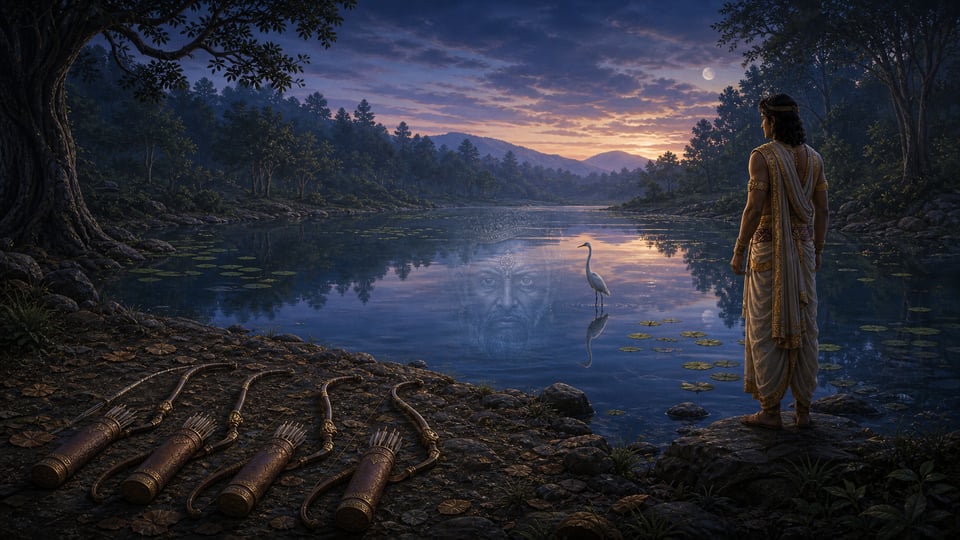
Long before Satyavati, Shantanu met Ganga in human form and asked her to marry him. She agreed on one condition: he must never question what she did or speak harshly to her. If he broke the condition, she would leave.
Love entered the Kuru palace with silence attached.
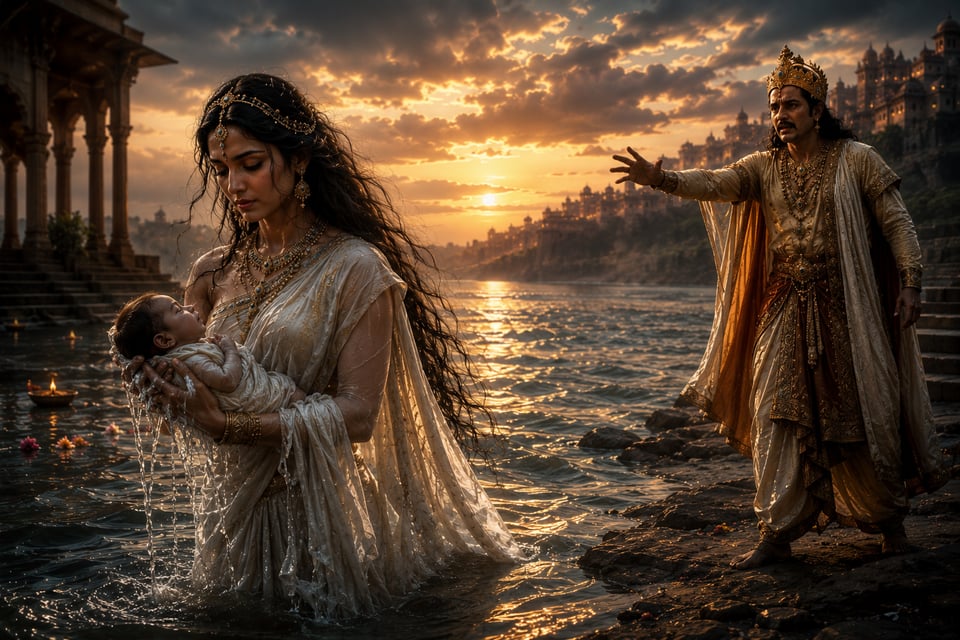
When their first child was born, Ganga carried the infant to the river and drowned him. Shantanu watched. The act repeated with a second child, then a third, until seven sons had disappeared into the water.
The king's promise kept him still, but stillness was not consent without anguish. Each birth renewed hope; each walk toward the river demanded silence. When Ganga moved to drown the eighth child, Shantanu could bear no more. He stopped her and asked how a mother could do this.
The condition broke.
Ganga revealed the divine history: the children were Vasus cursed to be born as humans. She had freed the first seven quickly; the eighth had to live a longer earthly life. Then she left, taking the surviving child to raise and educate.
That child was Devavrata.
Years later Ganga returned him to Shantanu, trained in arms, scripture, statecraft, and duty. The king named him heir. After seven deaths and one separation, the Kuru line seemed secure in a single extraordinary son.
But the household had learned a dangerous rhythm. Love came with conditions. Duty demanded silence. A promise could protect one relationship while causing suffering elsewhere.
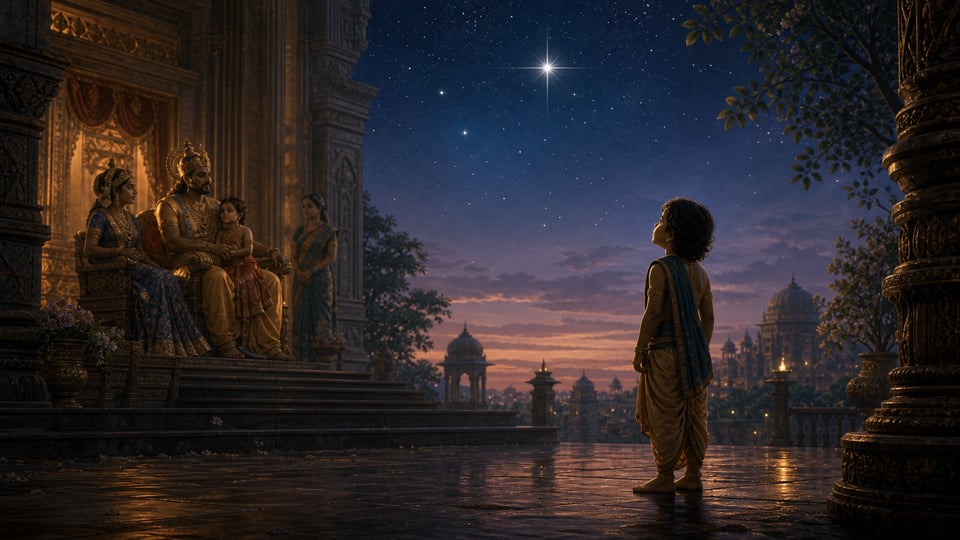
Devavrata grew inside the aftermath of a vow he had not made. Soon he would answer his father's sorrow with an even harsher one.
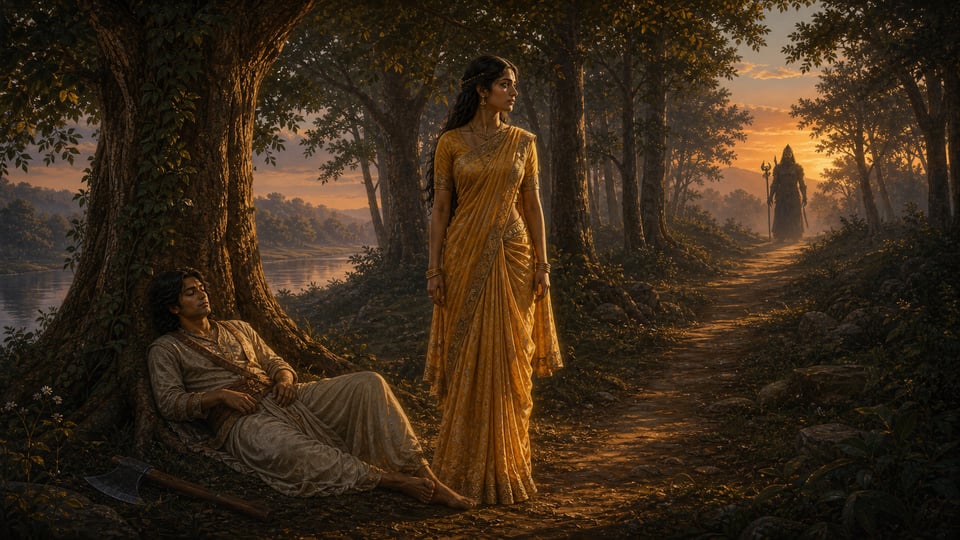
Shantanu later encountered Satyavati, daughter of a fisher chief, as she ferried people across the river. The king desired to marry her and approached her father.
The father did not simply refuse. He asked about succession.
Devavrata was already heir—beloved, qualified, and publicly recognized. If Satyavati entered the palace and bore sons, what would become of them? A marriage without a clear future could make her children dependent upon the goodwill of an older branch.
The concern was politically rational. Shantanu could not disinherit Devavrata without injustice, and he could not guarantee Satyavati's sons the throne while Devavrata's claim remained. He returned to the palace in grief and silence.
Devavrata noticed.
The son learned the cause from the king's attendants and went to the fisher chief. He renounced his right to rule. Satyavati's future sons would inherit.
Still the father hesitated. Devavrata might keep the promise, but his children could challenge it. A future generation might not feel bound by a sacrifice made before its birth.
So Devavrata erased that generation.
His vow of celibacy was praised because it was immense. It also changed the Kuru house from that instant. The most prepared heir would produce no descendants. The dynasty's continuity now depended entirely upon sons not yet born to a marriage created by his renunciation.
Shantanu, moved beyond measure, granted Bhishma the power to choose the time of his death. The gift honored sacrifice. It could not return the life Bhishma had surrendered.
The father's private longing became the son's permanent destiny and the dynasty's narrowing path.
Satyavati is sometimes introduced only as the woman whose marriage caused Bhishma's vow. Her story begins earlier.
Before Shantanu, she had encountered the sage Parashara while ferrying him. From that union was born Krishna Dvaipayana, later known as Vyasa. The child grew apart from her and promised to come when she needed him.
Satyavati entered the Kuru palace with a past known to few and a fierce concern for the future of the sons she would bear. She and Shantanu had two sons, Chitrangada and Vichitravirya.
The arrangement seemed to work. Bhishma kept his vow and protected the throne. Chitrangada became king after Shantanu's death.
Then Chitrangada died in combat with a Gandharva of the same name. His younger brother Vichitravirya inherited while still young, with Bhishma guiding the kingdom.
To secure marriages, Bhishma went to the swayamvara of the Kashi princesses and carried away Amba, Ambika, and Ambalika for Vichitravirya, following a warrior custom the epic presents but modern readers need not romanticize.
Amba loved another king and refused the marriage. Bhishma allowed her to go, but the other king rejected her after the abduction. She returned and demanded that Bhishma marry her. His vow made that impossible.
The vow that had once appeared to solve succession now left a woman without the future others had disrupted. Amba's grief and rage would eventually become part of Bhishma's own death through her rebirth as Shikhandi.
Vows do not remain inside the person who makes them. They enter other lives.
Vichitravirya married Ambika and Ambalika. He died without children.
The Kuru palace now faced the crisis hidden inside Bhishma's sacrifice. Shantanu's two sons by Satyavati were dead. Neither had secured a stable next generation. Bhishma was alive, capable, respected, and bound never to marry or father children.
Satyavati asked him to preserve the dynasty.
He refused to break the vow.
The refusal is central to Bhishma's greatness and to the catastrophe. A promise means little if abandoned when inconvenient. Yet an absolute promise can become destructive when circumstances change beyond what the speaker imagined.
Bhishma could rule, protect, advise, fight, and arrange other people's marriages. He could not provide the one thing the house now lacked. His identity had fused with the vow so completely that bending it would feel like ceasing to be Bhishma.
Satyavati then revealed the son born before her marriage: Vyasa.
Through the custom of niyoga, a designated man could be called to beget children for a deceased man's line. The institution belongs to the epic's social world and should not be flattened into modern romance or ordinary marriage. Vyasa would be the biological begetter; the children would continue Vichitravirya's dynastic house.
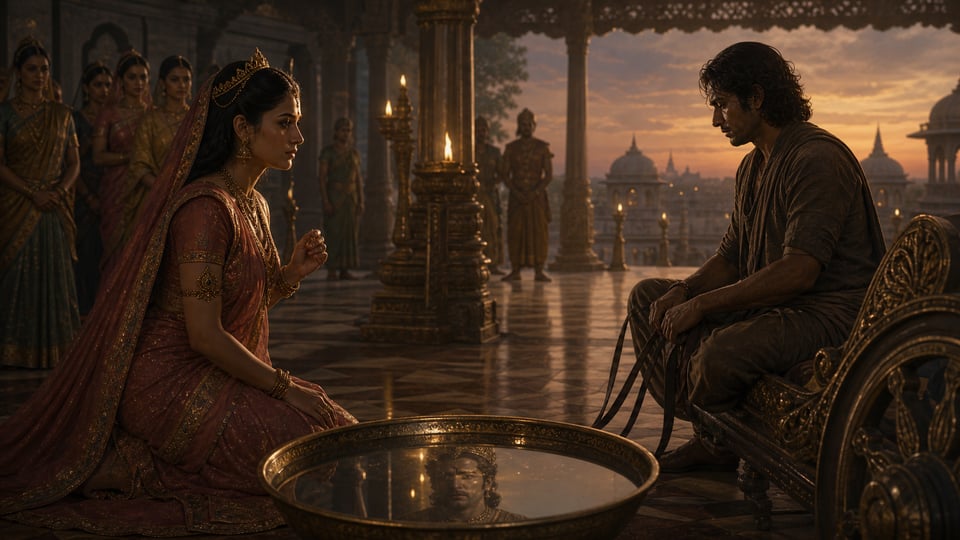
Ambika and Ambalika were called into a decision shaped by the survival of the kingdom. Their experience is not incidental. The future of the Kuru throne would be marked by each woman's fear and response.
The dynasty survived—but not through the straight path the original marriage bargain had imagined.
When Vyasa approached Ambika, his ascetic appearance frightened her. She closed her eyes. The son born to her, Dhritarashtra, was blind.
Satyavati wanted another child capable of kingship. Ambalika met Vyasa and turned pale with fear. Her son Pandu was born pale or marked by that pallor in the narrative's symbolic account.
Satyavati asked Ambika to try again. Ambika sent a maid in her place. The woman received Vyasa calmly and respectfully. Her son Vidura was born wise and righteous, yet his maternal status placed him outside the direct claim to kingship.
The three births expose how inadequate one simple sentence can be. Vyasa is the biological begetter. Vichitravirya remains the deceased king whose dynastic line the births continue. Satyavati is the strategist preserving the house. Ambika, Ambalika, and the maid are not interchangeable vessels; their fear, calm, rank, and treatment shape the sons' destinies.
Dhritarashtra is elder but blind. Pandu is younger but crowned king. Vidura is often the clearest moral intelligence in the court but cannot inherit the throne.
From the beginning, birth order, bodily condition, social status, ability, and legitimacy point in different directions.
The crisis was not solved. It was carried forward in a new form.
Dhritarashtra would grow knowing that seniority had not given him the crown. Pandu would rule with the burden of occupying his elder brother's place. Vidura would advise a throne he could never claim.
The children inherited not only names. They inherited unresolved meanings attached to their births.
Pandu became king and married Kunti and Madri. Dhritarashtra married Gandhari, who chose to cover her own eyes after marrying a blind husband. The next generation appeared secured.
Then Pandu, hunting in the forest, shot a mating deer that was actually a sage in animal form. The dying sage cursed him: if Pandu approached either wife sexually, he would die.
Once again, a hunter's act changed a dynasty. Once again, the future depended upon a path outside ordinary royal succession.
Kunti possessed a mantra from Durvasa by which she could invoke deities. Before marriage she had tested it and borne Karna, then abandoned the child in fear of social disgrace. That hidden son grew elsewhere.
With Pandu's consent, Kunti invoked Dharma, Vayu, and Indra, and Yudhishthira, Bhima, and Arjuna were born. She shared the mantra with Madri, who invoked the Ashvins and bore Nakula and Sahadeva.
Pandu was their social and dynastic father, though the birth narratives named divine fathers. The five were Pandavas because they belonged to his household and line.
Dhritarashtra and Gandhari's story moved differently. After a prolonged pregnancy and a strange birth account, Gandhari became mother to a hundred sons and a daughter, with Duryodhana eldest among the sons.
One branch had five sons born through divine invocation after a curse. Another had a hundred sons under ominous signs. Karna, Kunti's firstborn, stood outside both branches in public knowledge.
The dynasty had heirs at last. It also had every condition for rivalry: disputed seniority, hidden birth, unequal access to rule, parental fear, and children raised inside old grievance.
The Pandavas and Kauravas are often introduced as cousins who became enemies. Their conflict began before they could choose it.
Dhritarashtra had lost the throne because of blindness but governed when Pandu withdrew and after Pandu's death. Was Duryodhana therefore heir to the ruling king? Or did Yudhishthira, eldest son of crowned Pandu, hold the stronger claim? The family had never resolved how seniority, disability, prior coronation, and dynastic continuity should fit together.
Bhishma remained guardian of the house. His vow gave him moral authority but no children through whom responsibility could pass. He could advise everyone and belong fully to no branch. His loyalty to the throne kept him inside decisions he often knew were dangerous.
Satyavati eventually withdrew to the forest, having spent her life securing continuity. The line continued, but continuity alone did not produce peace.
The children grew amid attempted poisoning, the lac-house plot, competition over training, public comparison, and the politics of belonging. Drona's lessons intensified rivalry. Karna's humiliation at the arena gave Duryodhana a devoted ally. Partition produced Indraprastha but did not settle resentment. The dice hall converted rivalry into public violation.
No single vow caused Kurukshetra. The Mahabharata resists a single cause. Yet the old promises narrowed the options available to every later generation.
Shantanu's silence allowed seven sons to vanish before he spoke. Bhishma's vow removed the strongest heir and prevented later adaptation. Satyavati's insistence preserved the line through increasingly strained arrangements. Gandhari's blindfold became another absolute gesture inside a house already shaped by absolutes.
Each act made sense within a moment. Together they formed a corridor toward disaster.
Shantanu's boon allowed Bhishma to choose the time of his death. The gift sounded like triumph over mortality. At Kurukshetra, it became a long witness.
He fought for the Kuru throne under Duryodhana even while loving the Pandavas and warning against injustice. His obligation to the house held him on the side whose course he had repeatedly criticized.
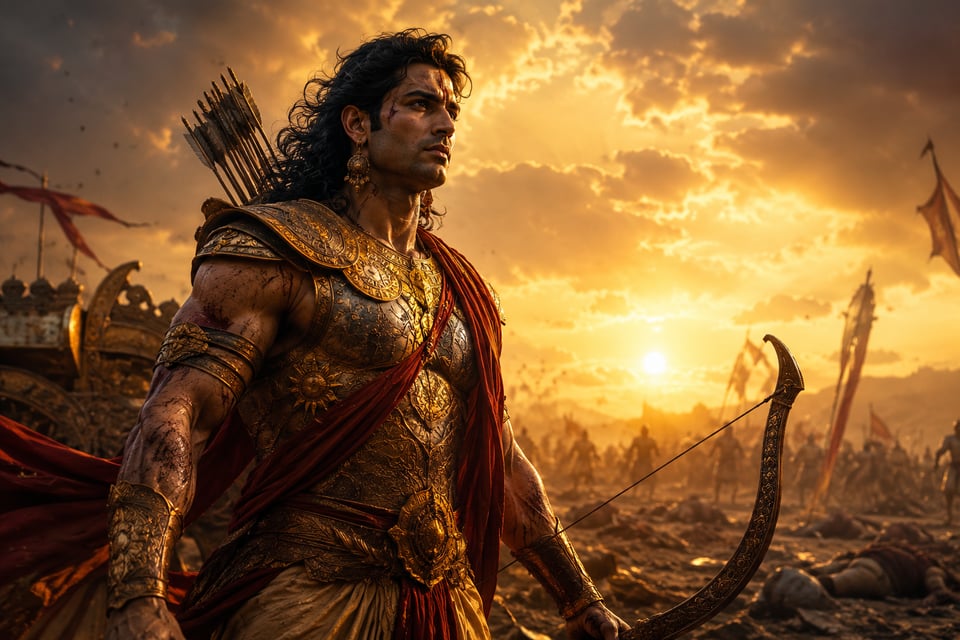
Shikhandi stood before Arjuna in the battle formation. Bhishma recognized the connection to Amba and would not fight Shikhandi as he would another warrior. Arjuna's arrows brought him down.
The woman whose future had collided with his vow returned, through the epic's rebirth narrative, at the moment that vow-bound warrior fell.
Bhishma did not die immediately. He lay upon a bed of arrows, choosing to wait for the auspicious time, teaching kings while the dynasty destroyed itself around him.
The image is almost unbearably complete. The man who gave away marriage and kingship so his father could have a family survives to watch that family annihilate its heirs.
His vow was not selfish. That is what makes the tragedy serious. He acted from love, duty, and astonishing self-command. But sacrifice is not automatically harmless because its motive is noble.
Some promises save a moment by sending the cost forward.
After the war, the Kuru future narrows again. The sons of the Pandavas die. Abhimanyu dies in battle. His widow Uttara carries their unborn son, Parikshit, through the final violence. The lineage survives through one vulnerable child.
The epic that began with grand kings and terrible vows reaches continuity through a pregnant widow protected amid ruin.
This does not prove that lineage itself is the Mahabharata's highest value. The war leaves too much grief for that. Survival is fragile, not triumphant. A name continuing does not justify the choices that nearly erased everyone who bore it.
The family's deeper inheritance lies in remembered consequences. Bhishma's vow, Satyavati's urgency, Ambika's closed eyes, Ambalika's fear, the maid's calm, Dhritarashtra's grievance, Pandu's curse, Kunti's secret, Gandhari's choice, and Duryodhana's refusal all remain part of the explanation.
A family story becomes false when it remembers only the honored promise and forgets who paid for it. It also becomes false when it condemns an ancestor without remembering the pressure under which the choice was made.
The Kuru house asks for both kinds of memory: reverence without blindness, judgment without simplification.
Bhishma's vow shook heaven because it was immense. The Mahabharata follows it across generations because immensity has consequences.
Preserve one family promise and the consequences later generations inherited through Bamsawali—especially when the sacrifice was praised so loudly that its cost became difficult to name.
Mahabharata, Adi Parva, Sambhava Parva, K. M. Ganguli translation, for Shantanu, Ganga, Satyavati, Bhishma, Vyasa, and the Kuru births.
Mahabharata, later battle books, for Amba/Shikhandi and Bhishma's fall.
Vishnu Purana dynastic material is used only as a separately recognized parallel where long lists vary.
Mythological
15 July 2026 · 6 min read
Mythological
13 July 2026 · 6 min read
Mythological
1 July 2026 · 12 min read
Mythological
30 June 2026 · 12 min read
Mythological
30 June 2026 · 12 min read
Mythological
26 June 2026 · 11 min read