King Harishchandra lost his kingdom, sold his family, and worked in a cremation ground yet never told a lie.
20 July 2026 · 5 min read
King Harishchandra of Ayodhya. History remembers him for a single reason he never told a lie. But this is not a simple moral tale. It is a story about a question: how much can truth actually cost? And when truth strips away a throne, a family, and every shred of dignity, where does the courage to hold onto it come from?
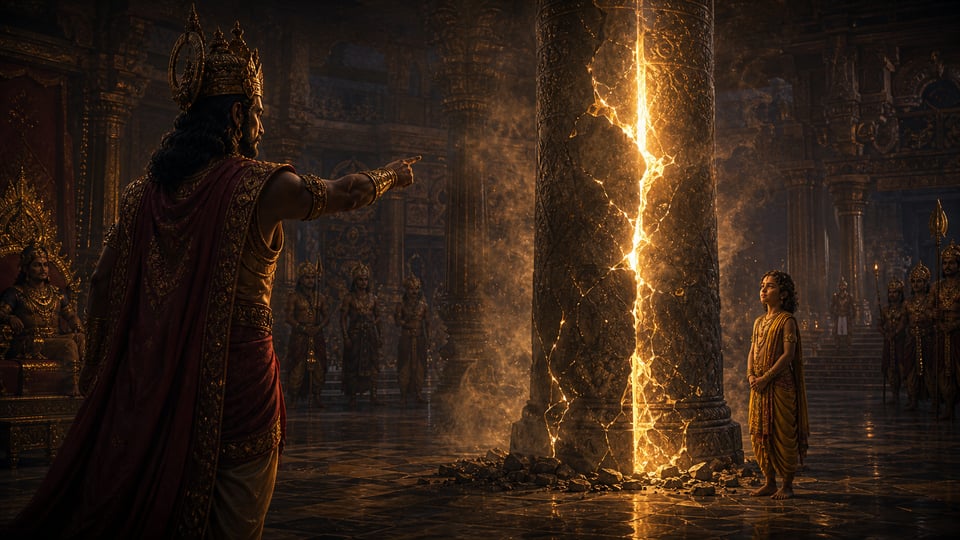
One day in the court of the gods, a debate broke out between the sages Vasishtha and Vishwamitra was there any king on earth who was truly, completely truthful? Vasishtha named Harishchandra. Vishwamitra disagreed. He made a vow: he would break Harishchandra's truthfulness, no matter what it took.
Vishwamitra tried illusion, fear, and temptation. Harishchandra did not waver. Finally, Vishwamitra demanded the ultimate sacrifice Harishchandra must donate his entire kingdom and all his wealth, and then pay an additional offering of gold on top of it.
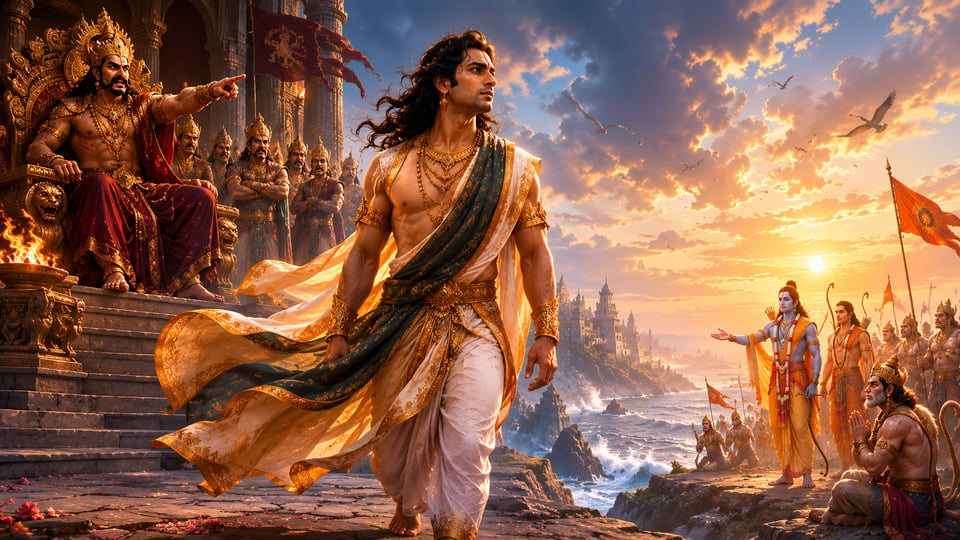
Without a moment's hesitation, Harishchandra gave away his kingdom. The royal court, the golden throne, the army all of it gone. But Vishwamitra pressed on for his offering. Unable to pay, Harishchandra sold his wife Shaivya and his son Rohitash into servitude, and finally sold himself into slavery to a Chandala a keeper of the cremation ground.
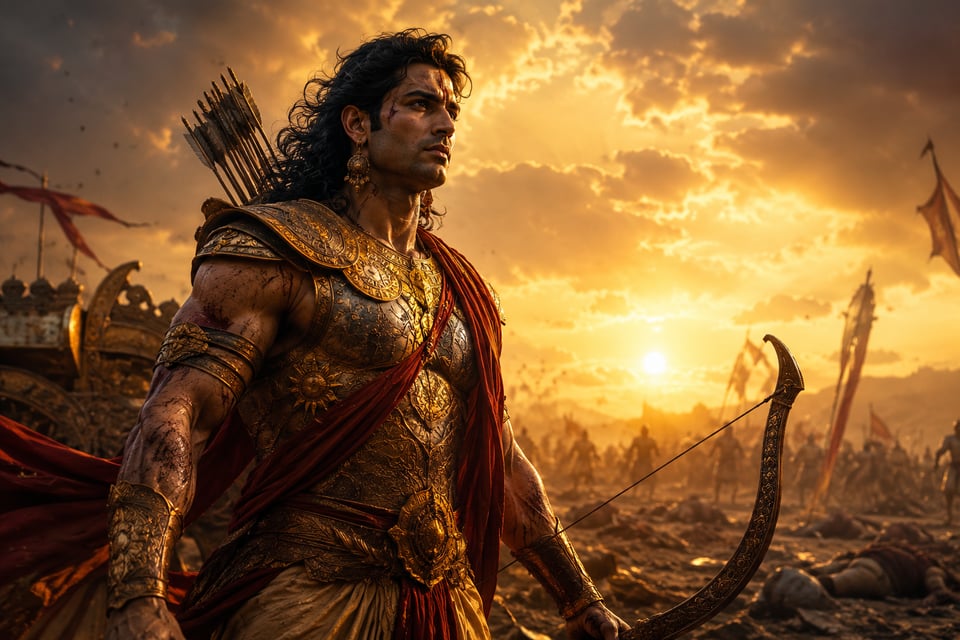
From king to pauper, and from pauper to slave this fall was not the result of defeat in war. It was a fall Harishchandra chose himself, to keep his word.
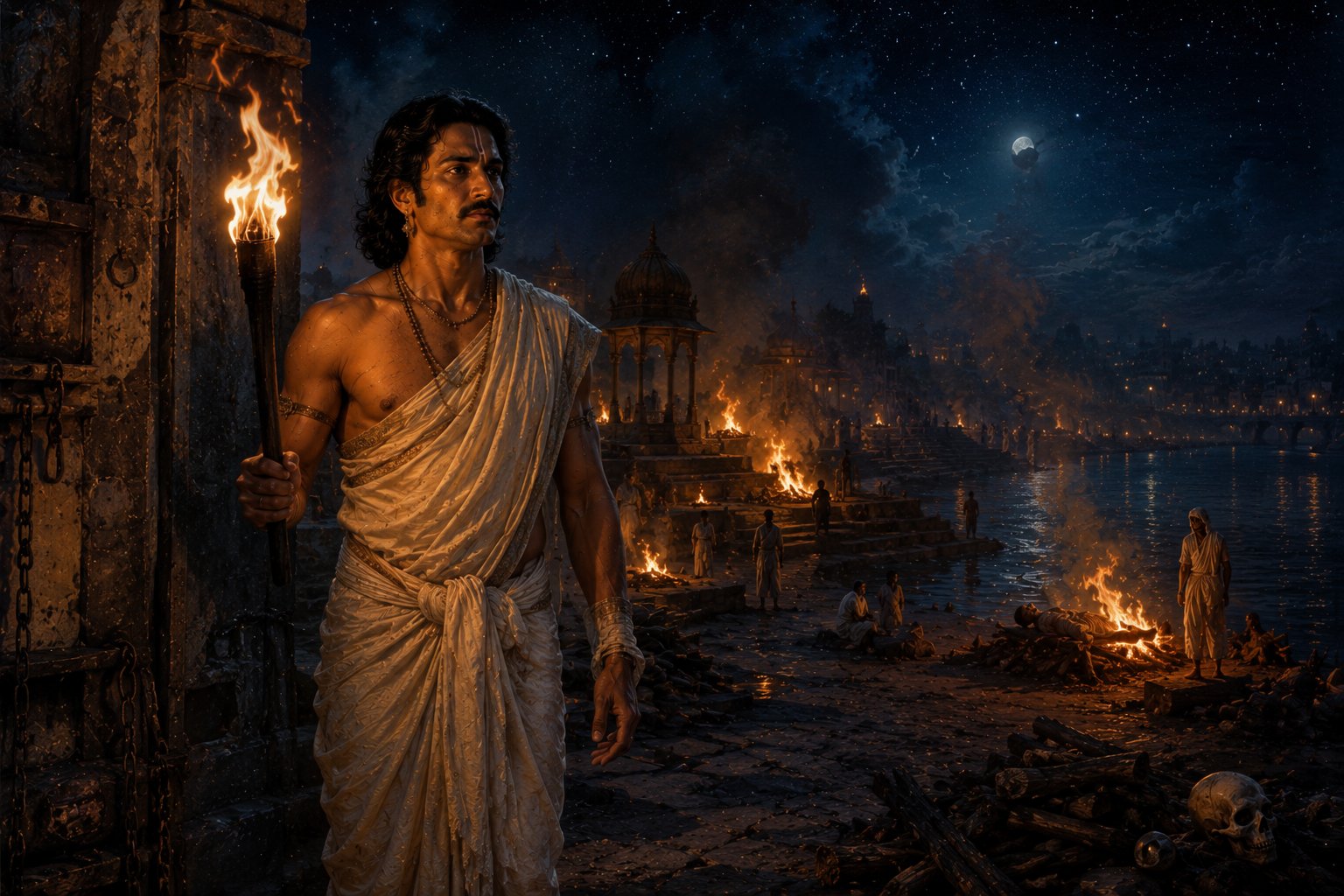
At the burning ghats of Kashi, Harishchandra's work was to collect a fee from every family that brought a body for cremation a task unimaginable for a man who had once commanded armies and sat on a throne studded with gold.
Then fate delivered its cruelest test. His own son Rohitash died of a snakebite. And his wife arrived at that same cremation ground, carrying her son's body, not recognizing the man who stood before her as the gatekeeper.
She had no money to pay the cremation fee. By the rules of his duty, Harishchandra asked his own wife for payment to cremate his own son not yet knowing that the woman standing before him in rags was his own Shaivya.
At that precise moment, when Harishchandra was caught between duty and grief, the gods appeared. Vasishtha materialized. Vishwamitra conceded his defeat. The entire ordeal had been a divine test and Harishchandra had not abandoned truth or dharma even at the very last breath.
His kingdom, his family, and his son were restored to him. But the lesson the story carries is not about what he got back. It is about what he refused to give up even when he had nothing left.
The story of Harishchandra carries a particular meaning in the context of family history and genealogy. We tend to remember our ancestors by their titles, their land, their achievements. But the reason Harishchandra's lineage remembers him is different his character, unbroken even when his position was gone.
Every family has its own "Harishchandra moment" an ancestor, an event, a point in time when someone held onto their values through difficulty, without reward, without anyone watching. Those stories are what become a family's real inheritance more durable than land or title, more alive than any deed or document.
King Harishchandra was a legendary king of Ayodhya, remembered across Hindu tradition as the greatest exemplar of truthfulness. His story appears in the Markandeya Purana and the Mahabharata. For centuries he has been held up as the symbol of truth and dharma in Hindu, Nepali, and Indian culture.
In the court of the gods, sages Vasishtha and Vishwamitra debated whether any truly and completely truthful king existed on earth. Vasishtha named Harishchandra. Vishwamitra challenged the claim and vowed to disprove it setting off the series of trials that forms the heart of the story.
Harishchandra lost his kingdom, all his wealth, his wife Shaivya, and his son Rohitash. He ended up as a slave in a cremation ground in Kashi, collecting fees from the families of the dead. Through all of it, he never told a single lie.
When Harishchandra reached his most agonizing moment standing between grief and duty, asked to collect the cremation fee from his own unrecognized wife for his own dead son the gods and sages appeared. Vishwamitra admitted defeat. The test was over. Harishchandra's kingdom, family, and son were all restored.
The story says that truth can cost more than anything else and that what is lost when you abandon it cannot be bought back. Harishchandra eventually got everything back, but the story's real message is not about the restoration. It is about what he refused to surrender when he had nothing left to protect it with.
Every family's history has its own "Harishchandra moment" a point when an ancestor held to principle under pressure, without reward or recognition. Those stories are the real inheritance of a lineage more lasting than property, more meaningful than titles and they are exactly the kind of stories that banshawali and family memory exist to preserve across generations.
Mythological
9 July 2026 · 12 min read
Mythological
7 July 2026 · 12 min read
Mythological
7 July 2026 · 12 min read
Mythological
15 July 2026 · 6 min read
Mythological
14 July 2026 · 4 min read
Mythological
13 July 2026 · 6 min read