The churning of the Ocean of Milk unleashed a lethal poison before nectar emerged. Shiva drank it to save the universe, becoming Nilakantha the blue-throated one.
9 July 2026 · 12 min read
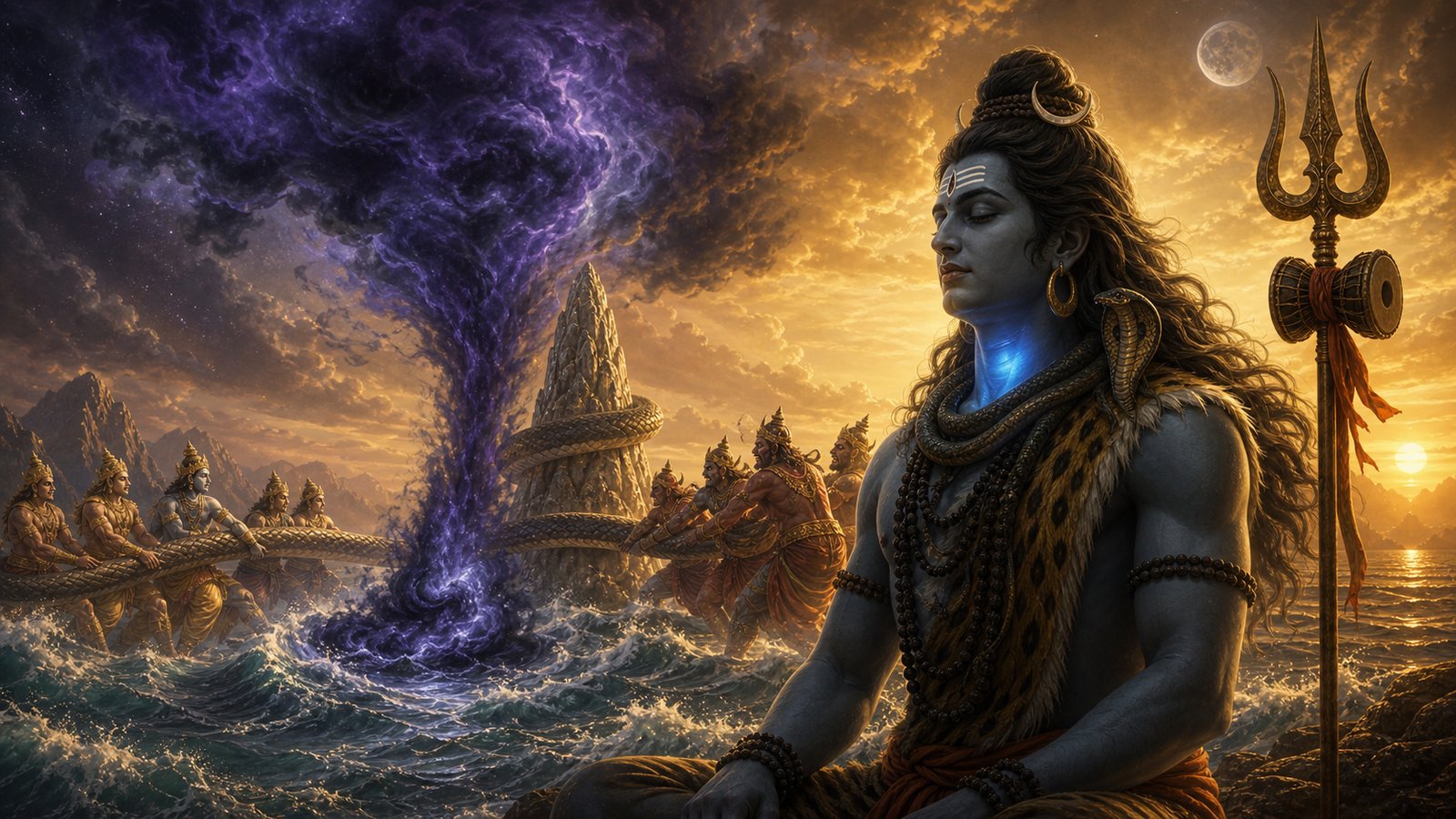
The air above the Ocean of Milk did not smell of salt or brine; it smelled of extinction. A thick, iridescent vapor, darker than a moonless midnight and more caustic than a thousand acid fires, surged from the depths of the churning waters. It was the hala-hala, a poison so potent that it threatened to dissolve the very fabric of existence. The Devas and Asuras, who only moments ago had been locked in a desperate, sweat-soaked struggle to pull the great serpent Vasuki, now recoiled in absolute terror. Their alliance of convenience shattered instantly. The emotional premise of this cosmic crisis was simple: the pursuit of immortality had unleashed a lethal byproduct, and the reward of nectar was suddenly irrelevant if there was no world left to inhabit.
The scene was one of chaotic desperation. The mountain Mandara, serving as the churning rod, stood tall, supported by the immense shell of Vishnu in his Kurma avatar, who held the weight of the world on his back. But the physical stability of the mountain meant nothing when the atmosphere itself had become a weapon. The poison did not merely drift; it hunted. It seeped into the lungs of the gods and the pores of the demons, turning their golden skin ashen and their breath into rattles. They had sought the amrita, the nectar of immortality, but they had forgotten that the depths of the ocean hold as much trauma and toxicity as they do treasure. In their greed for eternal life, they had stirred the sediment of the universe's oldest sorrows.
The panic was systemic. The Devas, weakened by a previous curse and desperate for their lost strength, looked at the Asuras, and the Asuras looked back with equal dread. There was no longer any rivalry, only the shared realization that they were out of their depth. They had the strength to churn the ocean, but they lacked the spiritual capacity to neutralize the waste. They turned their eyes toward the peaks of Mount Kailash, seeking the only being whose consciousness was vast enough to encompass the void and whose will was strong enough to withstand the dissolution of form. They sought Shiva, the Great Ascetic, the one who exists on the periphery of social order and cosmic desire.
The journey to Kailash was a frantic pilgrimage of the damned. The gods and demons arrived at the feet of the Mahadeva, not as conquerors or seekers of boons, but as refugees of their own ambition. They pleaded with Shiva to intervene, describing the suffocating cloud of hala-hala that was erasing the horizon. They spoke of the innocent creatures of the earth and the celestial realms who had no part in the churning but were now choking on its fumes. The request was an admission of failure. The powerful had played a game of cosmic alchemy and had accidentally brewed a catastrophe. They asked Shiva to take the poison into himself, essentially asking him to become the universe's filter.
Shiva did not immediately agree. He did not act out of a reflexive need to be a savior, but out of a deep, meditative consideration for the welfare of all sentient beings. He turned to Parvati, his consort and the embodiment of the primordial energy, Bhavani. Their conversation was not one of fear, but of strategic compassion. Parvati's presence in this moment is critical; she represents the grounding force of the earth and the nurturing aspect of nature. She understood that the poison was not an external enemy but a result of the churning process itself a manifestation of the hidden costs of ambition. Shiva's decision to drink the poison was a conscious choice to absorb the collective toxicity of the world to ensure that the cycle of life could continue.
As Shiva stepped toward the churning ocean, the atmosphere shifted. He did not approach the poison with a sword or a spell, but with a vessel of openness. He gathered the hala-hala into his palms, the shimmering, deadly liquid swirling like a trapped nebula. The act of drinking was not a quick gulp but a slow, deliberate absorption. As the poison entered his system, it sought to incinerate everything in its path. The heat was unimaginable, a fire that could melt the stars. However, Shiva did not allow the poison to descend into his stomach, where it would have permeated his entire being and potentially affected the cosmic balance. Instead, through a supreme act of will and yogic control, he held the toxin in his throat.
The result was a vivid, physical transformation. The poison remained trapped in the throat, staining the skin a deep, bruised blue. This is the origin of the image of Nilakantha, the Blue-Throated One. It is a visual testament to the fact that some burdens cannot be fully eliminated; they can only be contained. Shiva did not destroy the poison for in the laws of the universe, energy is rarely destroyed, only transformed but he neutralized its ability to harm others by housing it within his own anatomy. He became a living seal, a dam against the tide of annihilation. The blue of his throat became a badge of honor, not because he suffered, but because he chose to endure a permanent scar for the sake of the collective.
This moment reveals a profound truth about the nature of responsibility. The Devas and Asuras had cooperated to get the nectar, but they had not considered the waste product of their labor. They wanted the reward without the risk. Shiva's intervention was not just a rescue mission; it was a lesson in the ethics of power. The truly powerful are not those who can command the ocean to churn, but those who can absorb the consequences when the churning goes wrong. The containment of the poison was a silent act of leadership that required no throne and no crown, only the willingness to stand in the gap between existence and void.
Once the poison was contained, the atmosphere cleared, and the Ocean of Milk returned to its serene, white expanse. Only then did the treasures begin to emerge. The churning continued, and the rewards followed in a cascade of splendor. First came the wish-fulfilling cow, then the divine horse, and the celestial elephant. Then emerged Lakshmi, the goddess of prosperity, rising from the foam in a display of blinding radiance. Finally, Dhanvantari, the physician of the gods, appeared holding the golden pot of amrita. The joy that swept through the assembly of gods and demons was electric, a sudden surge of euphoria that almost erased the memory of the suffocating blue clouds.
However, the emergence of the nectar did not bring peace; it brought a new, sharper conflict. The temporary alliance between the Devas and Asuras dissolved the moment the prize was within reach. They began to fight over the pot of immortality, forgetting that they had only survived because one of them had swallowed the world's poison. This cycle of greed and amnesia is the tragedy of the churning. The nectar was the goal, but the poison was the reality. The conflict that followed necessitated the intervention of Vishnu in the form of Mohini, the enchantress, who used illusion to ensure the nectar reached the Devas, as the Asuras' hunger for power had become a threat to the cosmic order.
When we reflect on this narrative from a modern perspective, we see a mirror of our own collective struggles. Every great human achievement—every industrial revolution, every technological leap, every empire-building project—has a corresponding "poison." We churn the earth for resources and create pollution; we churn the digital space for connection and create fragmentation. Often, the "nectar" of progress is celebrated while the "poison" is ignored or pushed onto the marginalized. We look for a Shiva—a hero, a government, a scientist, or a martyr—to absorb the toxicity of our systems. But the story of Nilakantha warns us against the danger of glorifying the endless absorption of poison. If we rely solely on the strength of one to contain the waste of many, we are not practicing sustainability; we are practicing a dangerous form of dependence.
The containment of the poison in Shiva's throat is a metaphor for conscious processing. It is not about denial or pretending the poison does not exist. Shiva did not spit the poison back into the ocean, nor did he pretend it was sweet. He acknowledged its lethality and found a way to hold it without letting it destroy him or others. This is the essence of emotional and spiritual maturity: the ability to witness pain, trauma, and toxicity, and to hold it in a space of awareness where it can no longer cause harm, without allowing it to seep into the heart or the gut. It is the difference between being consumed by a crisis and becoming a vessel that can manage it.
The presence of Parvati throughout this sequence serves as a reminder that the ascetic's sacrifice is supported by the domestic and the earthly. Shiva does not act in a vacuum of isolation; he acts within a relationship of mutual understanding. The balance between the stillness of Kailash and the turbulence of the Ocean of Milk represents the balance we must all find. We must be able to enter the fray of the world, to churn our own oceans of ambition and desire, but we must also have a center of gravity—a place of stillness—where we can process the inevitable toxins that arise from those efforts.
In the various versions of the story, from the Bhagavata Purana to the Vishnu Purana, the sequence of events may shift, but the core logic remains. The nectar is never the first thing to appear. The poison always comes first. This is a cosmic law: the crisis precedes the cure. The struggle is not a detour on the way to the reward; the struggle is the process that qualifies the seeker for the reward. If the Devas and Asuras had received the nectar without the poison, they would have remained arrogant and blind. The terror of the hala-hala was the only thing that could have forced them to recognize their shared vulnerability.
As the story concludes, the image of Shiva remains—calm, meditative, with a throat that glows with a permanent, haunting blue. He does not ask for gratitude, nor does he remind the gods of the debt they owe him. He simply exists as the guardian of the threshold. The blue throat is a silent reminder that every victory has a hidden cost, and every immortality is paid for by someone's willingness to face the finite and the foul. The nectar of the gods is sweet, but the blue of the throat is where the true strength resides. It is the strength of containment, the power of the pause, and the grace of the protector.
The cinematic scale of the Samudra Manthan—the mountain, the serpent, the giant turtle, the swirling milk, and the iridescent poison—serves to amplify a very human truth. We are all churning something in our lives. We are all seeking our own version of amrita, whether it be success, love, or enlightenment. And in that process, we will all encounter our own hala-hala. The question is not how to avoid the poison, for the churning always brings it to the surface. The question is how we handle it. Do we panic and let it suffocate our surroundings, or do we find the inner stillness to contain it, to transform it, and to move forward with the wisdom of the scar?
The quiet ending of this episode is not found in the distribution of the nectar, but in the silence of the mountain. After the chaos of the battle and the illusions of Mohini, the image that lingers is the Mahadeva in his meditation. He is the one who knows that the nectar is temporary, but the capacity to hold the poison is an eternal quality of the soul. The blue throat is not a wound; it is a trophy of compassion. It tells us that the highest form of power is not the ability to create or to destroy, but the ability to protect.
In the end, the churning of the ocean was a lesson in the interdependence of opposites. The gods needed the demons, the mountain needed the turtle, and the world needed the ascetic. Nothing in the cosmos happens in isolation. The nectar was not a gift; it was a result of a grueling, dangerous, and collaborative effort. The poison was the price of admission. By accepting that price, Shiva did more than save the world; he defined the nature of the divine as the one who stands in the most dangerous place so that others may walk in safety.
As we step away from this ancient narrative, we are left with the image of the blue throat. It asks us to consider the poisons we have asked others to drink for us—the emotional labor of the patient, the physical toil of the worker, the silent endurance of the parent. It invites us to recognize the "Nilakanthas" in our own lives and to understand that the most profound acts of love are often those that are invisible, contained, and quietly endured. The nectar is for the many, but the blue throat is the mark of the few who truly understand the cost of existence.
The story of the ocean churning is a cycle of ambition, catastrophe, sacrifice, and reward. The poison is not an obstacle to the nectar; it is the catalyst that proves the necessity of the divine. Without the poison, there would be no need for Shiva's grace. Without the crisis, there would be no revelation of the true nature of the protector.
May we all find the strength to face the iridescent vapors of our own lives with the composure of the Great Ascetic. May we learn that the goal is not to live a life devoid of poison, but to develop the spiritual anatomy capable of containing it without letting it touch the heart. In the silence of the blue throat, we find the ultimate answer to the chaos of the churning: that the greatest victory is not in winning the nectar, but in ensuring that the world survives the process of seeking it.
Srimad Bhagavatam, Canto 8, chapters 5–12, especially chapter 7, for the alliance, Mandara, Kurma support, poison, Shiva's decision, and later emergence of nectar.
Vishnu Purana, Book 1, chapter 9, H. H. Wilson translation, as a parallel account with differences in order and emphasis.
Vedabase and the local Vishnu Purana extraction for passage cross-checking.
Mythological
20 July 2026 · 5 min read
Mythological
7 July 2026 · 12 min read
Mythological
7 July 2026 · 12 min read
Mythological
15 July 2026 · 6 min read
Mythological
14 July 2026 · 4 min read
Mythological
13 July 2026 · 6 min read