Gajendra, the elephant king, fought a crocodile for a thousand years. When his strength failed, he raised a lotus and surrendered and Vishnu answered. A story of divine rescue.
7 July 2026 · 12 min read
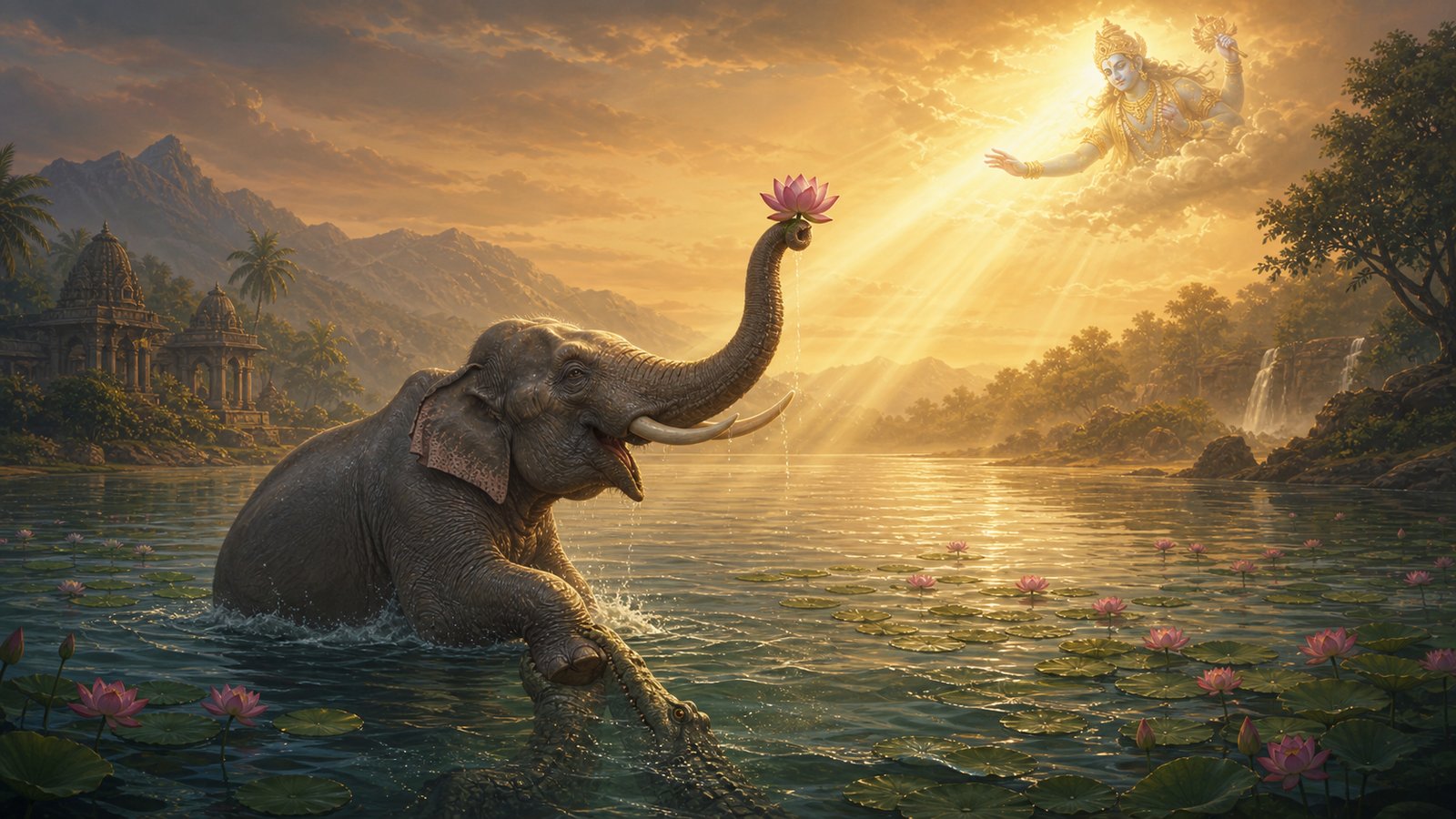
The water of the lake was a deceptive mirror, shimmering with a crystalline purity that invited the weary. Gajendra, the mighty king of elephants, stepped into the cool depths with the confidence of a sovereign. He was not alone; his herd, a sprawling family of strength and loyalty, splashed beside him, their trumpeting echoing through the forest. But beneath the surface, in the silent, murky depths where the light faded, a predator waited. The strike was sudden and absolute. A crocodile's jaws clamped shut around Gajendra's leg with a crushing force that defied the elephant's immense power. In that first moment of agony, the emotional premise of the story is laid bare: the terrifying realization that physical strength, no matter how vast, is utterly useless against the inevitable pull of fate.
The struggle began not as a spiritual crisis, but as a physical war. Gajendra roared, his massive frame heaving against the current, attempting to drag himself back to the safety of the shore. The crocodile, however, played the long game of the water. It did not fight with the frantic energy of the elephant; it fought with the steady, suffocating patience of the deep. For a time, the herd rallied. The other elephants pushed against the current, their trunks entwined, trying to pull their king from the grip of the reptile. They fought with a desperation born of love and social duty, refusing to let their leader be dragged into the abyss. Yet, the crocodile's grip was a lock of iron. One by one, the family members grew exhausted. The water, once a sanctuary of coolness, became a theater of attrition.
As the days turned into months and the months into a mythic span of a thousand years, the geography of the struggle shifted. This was not biological time, but the time of the soul a slow, grinding erosion of the ego. In the water, the crocodile grew stronger, fed by the environment of the depths and the slow draining of the elephant's vitality. On land, Gajendra had been a god of the forest, but in the lake, he was merely prey. His muscles, once capable of uprooting trees, began to wither. His skin grew pale, and his breath became a ragged prayer of exhaustion. The social support he had relied upon vanished. His herd, unable to withstand the relentless pull of the predator, eventually retreated. They left him not out of cruelty, but out of the sheer impossibility of the task. Gajendra found himself in the most terrifying of all solitudes: the moment when the world you knew, and the people you loved, can no longer reach you.
This isolation was the crucible. For centuries of struggle, Gajendra had fought with the tools of the material world muscle, leverage, and the help of his peers. He had treated the crocodile as an enemy to be defeated by force. But as the water rose to his chin and the crocodile's teeth sank deeper into his bone, the elephant reached the end of his own capacity. He realized that the predator was not merely a creature of the lake, but a manifestation of a karmic debt that could not be paid with strength. The physical battle had failed because the problem was not physical. It was here, in the absolute void of hope, that a dormant seed of memory began to stir within his consciousness.
Beneath the identity of the elephant king lay a buried history. In a previous existence, Gajendra had been King Indradyumna, a ruler of profound devotion and spiritual discipline. For lifetimes, that identity had been shrouded by the instincts of the animal kingdom, buried under the weight of hunger, pride, and the desire for dominance. But the agony of the present acted as a key. The pain stripped away the elephant's ego, peeling back the layers of the animal self until the royal soul of Indradyumna flickered back to life. He did not suddenly remember his palace or his kingdom; rather, he remembered a feeling a deep, resonant connection to the Supreme Source, the one who exists beyond the cycle of birth, death, and the crushing jaws of time.
The prayer that emerged from Gajendra was not a plea for a simple rescue. He did not ask for the crocodile to be killed or for his leg to be healed. He asked for liberation from the very cycle that had placed him in the lake. He sought the source beyond death. This was the pivot of the story: the transition from fighting for survival to surrendering for salvation. He realized that the crocodile was the catalyst, the terrible instrument that had finally forced him to look upward. In his desperation, he ceased to fight the water and instead began to fight for the Divine. He called upon Narayana, the Preserver, the one who dwells in the heart of all beings, recognizing that only a power beyond the material plane could sever the bond of this particular suffering.
The response from the heavens was immediate. Lord Vishnu, riding upon the golden wings of Garuda, descended with a speed that defied the laws of nature. The arrival of the Divine was not a quiet affair; it was a cosmic intervention. As Vishnu approached, the atmosphere of the lake changed. The oppressive weight of the thousand-year struggle evaporated, replaced by a light that illuminated the depths of the water. Gajendra, seeing the Lord, felt a surge of devotion that transcended his pain. In a final, poignant gesture, he reached for a lotus flower blooming in the lake. With the last of his strength, he lifted the flower in his trunk and offered it to the Lord. This was the lotus raised from pain a symbol of purity emerging from the mud of suffering, an offering of the heart when the body has nothing left to give.
Vishnu did not merely save the elephant; he resolved the cosmic tension of the scene. With his Sudarshana Chakra, the divine disc of light, Vishnu severed the crocodile's grip and liberated both beings. The crocodile was not simply killed; it was released from a curse. It had been the Gandharva Huhu, a celestial musician fallen from grace due to pride, cast into the form of a reptile to learn the lesson of humility. The struggle between the elephant and the crocodile was, in reality, a collision of two karmic trajectories, both destined to be resolved by the touch of the Divine. As the crocodile was freed from its scaly prison, Gajendra was not merely returned to the shore, but was granted a renewed divine identity, his soul liberated from the constraints of the animal form.
The silence that followed the rescue was profound. The lake, once a place of terror, became a sanctuary of peace. The herd, who had watched from the distant shore with a mixture of grief and helplessness, witnessed the return of their king, not as a wounded animal, but as a being touched by the eternal. The story leaves us with a quiet, lingering image: the elephant standing in the shallows, the lotus still floating on the water, and the realization that the most dangerous moment of our lives the moment when we are pinned down and unable to move is often the only moment we are truly ready to surrender.
Reflecting on this narrative in a modern context, one cannot help but see the "crocodile" in our own lives. We all have those invisible jaws debts, addictions, chronic failures, or the crushing weight of grief that seem to pull us deeper into the murky waters of existence. We spend years, perhaps decades, fighting these forces with the tools we think are sufficient. We rely on our intelligence, our wealth, our social networks, and our sheer willpower. We believe that if we just push harder, or find a better strategy, we can pull ourselves free. But there is a specific kind of suffering that cannot be solved by effort. There is a point where the "herd" of our support system cannot reach us, and where our own strength becomes a liability, keeping us tethered to the very thing that is destroying us.
The lesson of Gajendra is not that effort is useless, but that effort has a limit. He did not surrender the moment the crocodile bit him; he fought for a thousand years. He exhausted every material possibility before he turned toward the spiritual. This is a crucial distinction. Surrender is not the absence of effort; it is the recognition of the limit of effort. It is the transition from "I can do this" to "Only the Divine can do this." The lotus Gajendra offered was not a product of his strength, but a product of his vulnerability. It was the only thing he had left, and it was the only thing that mattered.
In the parallel accounts found in the Vishnu Purana, the core essence remains the same, though the details of the struggle may shift. Whether the time is described as a thousand years or a shorter span, the symbolic truth is unwavering: the descent into helplessness is the prerequisite for the ascent into liberation. The crocodile is not the villain of the story, but the teacher. Without the crocodile, Gajendra would have remained a proud king of elephants, grazing in the forest, oblivious to the dormant divinity within him. The pain was the catalyst for the memory. The entrapment was the path to freedom.
The cinematic quality of this story lies in its contrast. We see the massive, grey bulk of the elephant against the sleek, dark hide of the crocodile. We see the wide, open expanse of the lake contrasted with the narrow, suffocating grip of the jaws. And finally, we see the immense scale of the cosmic Lord descending upon a golden eagle to save a single, trembling creature. It suggests that no matter how small or trapped we feel in the machinery of karma, the Divine is attentive to the cry of the sincere heart. The rescue is not just a physical extraction from the water, but a psychological extraction from the ego.
As the story concludes, we are left to contemplate the nature of memory. Gajendra's salvation did not come from a new piece of information, but from the remembering of something he had always known. This implies that within every human being, there is a "prior birth" of spiritual awareness, a dormant connection to the infinite that is often buried under the noise of our current identity. We spend our lives building our "herd" our reputations, our families, our assets only to find that when the real crisis hits, these things are merely spectators. The only thing that can truly save us is the memory of our own divine origin, triggered by the very pain we wish to avoid.
The final image is one of profound stillness. The water settles. The crocodile is gone, the Gandharva is restored, and the elephant is free. There is no celebration of victory, for this was not a victory of strength, but a victory of surrender. The story of Gajendra Moksha is a reminder that the end of our own strength is the beginning of a much greater strength. It teaches us to look for the lotus in the midst of the struggle, to recognize the predator as a pointer toward the Preserver, and to understand that being "pulled under" is sometimes the only way to finally look up.
The narrative arc from the first splash in the lake to the final touch of the Sudarshana Chakra mirrors the human journey from innocence to suffering, and from suffering to enlightenment. We enter the world with the confidence of the elephant king, believing the lake of life is a place of pleasure. We are blindsided by the crocodiles of circumstance. We fight, we scream, and we rely on those around us. But eventually, the water reaches our chin. In that silence, in that absolute surrender, the lotus blooms. We realize that we were never just the elephant; we were always the soul seeking the shore.
The beauty of this tradition is that it does not ask us to ignore the pain, but to use it as a bridge. The pain of the crocodile's grip was the very thing that woke the King Indradyumna within Gajendra. Without the agony, there would have been no prayer. Without the prayer, there would have been no rescue. This transforms our perception of hardship. The crisis is no longer an interruption of our life, but the purpose of our life. The struggle is not a detour; it is the destination.
When we look back at the scene, we see that the most important action was not the fighting, nor even the rescue, but the lifting of the flower. The lotus represents the highest aspiration of the human spirit the ability to remain pure and devoted even while the world is tearing us apart. It is the act of offering one's suffering back to the source from which it came. In doing so, the suffering is transformed into a sacrament. The elephant did not save himself; he simply made himself available to be saved.
This story persists through the ages because it speaks to the universal fear of helplessness. It tells us that there is a place where our strength ends and Grace begins. It invites us to stop fighting the water for a moment and remember who we are beneath the identity of the struggle. The lake is still there, the crocodiles still wait, but for those who know how to lift the lotus, the water is no longer a grave, but a gateway to the divine.
As we close this chapter of the epics, let the image of the lotus remain. Let it be a reminder that no matter how deep the water or how strong the grip, there is a power that can sever any bond and a memory that can awaken any soul. The journey from the depths of the lake to the heights of liberation is a journey we all take, one prayer and one lotus at a time.
The lotus makes the scene more than an escape story. Gajendra offers something while still trapped. He does not wait to become safe before turning toward the source he remembers. The raised flower shows a self no longer defined only by the jaws around its leg, even though the pain and danger remain entirely real.
Srimad Bhagavatam, Canto 8, chapters 2–4, for the lake, crocodile struggle, remembered prayer, lotus offering, Vishnu's arrival, and liberation.
Vishnu Purana, elephant-and-crocodile account, as a separately recognized parallel tradition.
Vedabase and the local H. H. Wilson Vishnu Purana extraction for passage cross-checking.
Mythological
20 July 2026 · 5 min read
Mythological
9 July 2026 · 12 min read
Mythological
7 July 2026 · 12 min read
Mythological
15 July 2026 · 6 min read
Mythological
14 July 2026 · 4 min read
Mythological
13 July 2026 · 6 min read