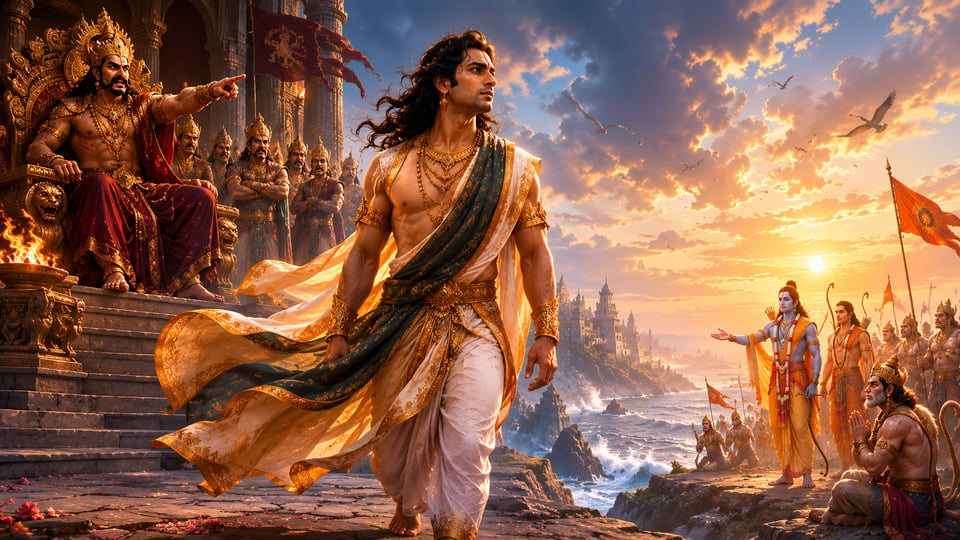
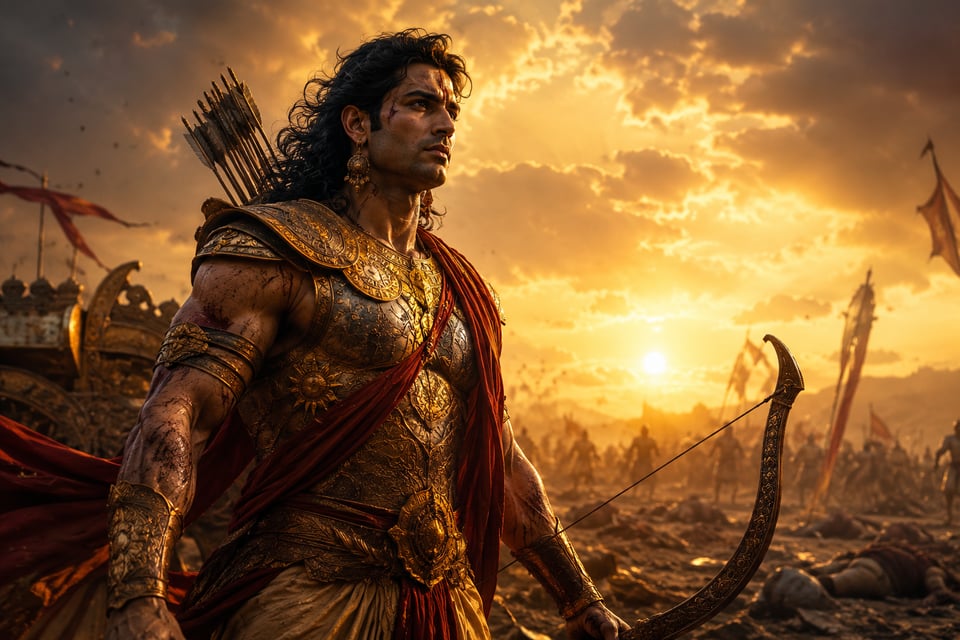
Hiranyakashipu's tyranny, Prahlada's unwavering faith, and Narasimha's emergence the triumph of devotion over inherited hatred in this Puranic tale.
7 July 2026 · 12 min read
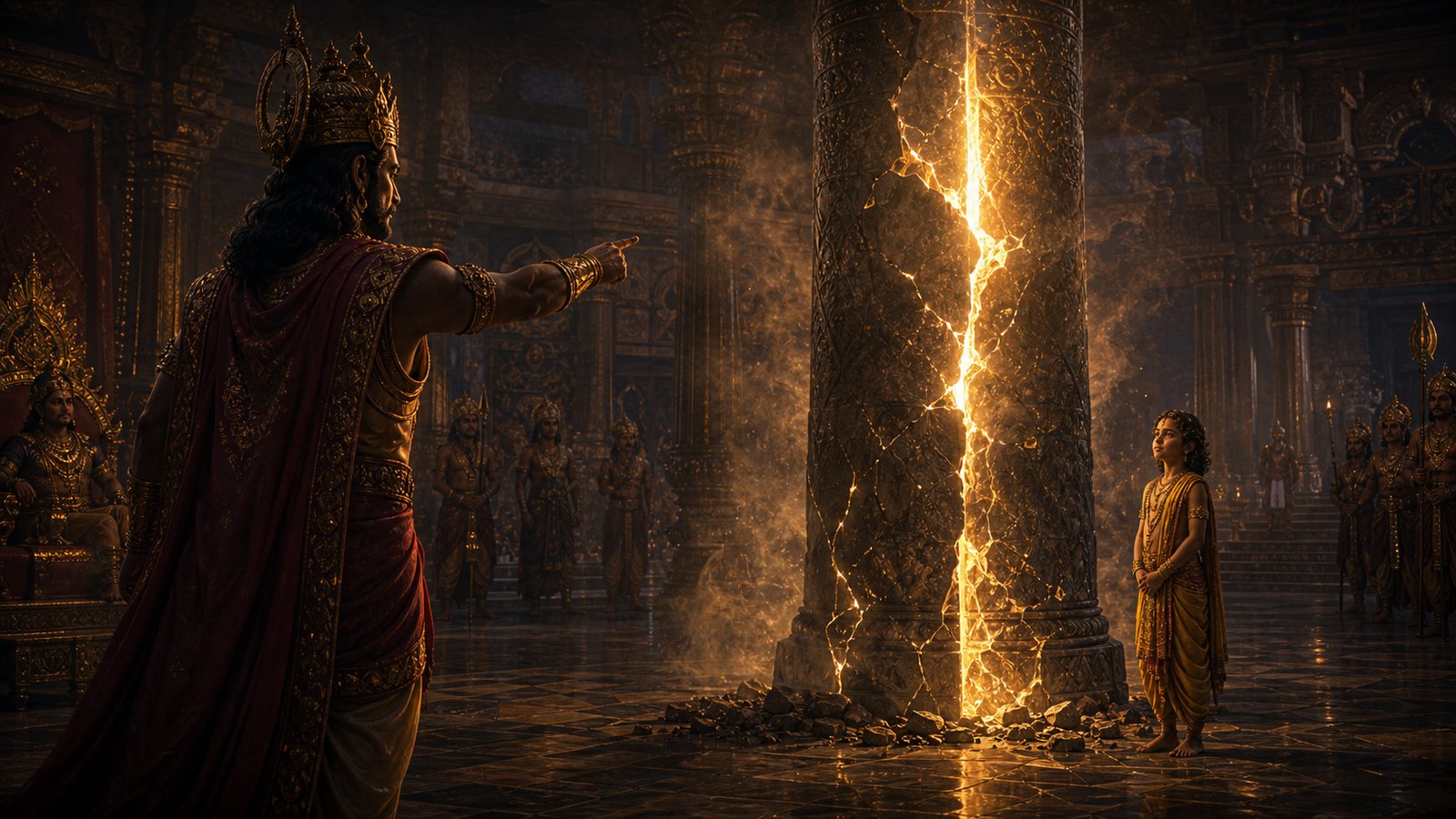
The air in the royal court of the demon king Hiranyakashipu was thick with the scent of incense and the heavy, suffocating weight of absolute power. The king stood towering, his eyes burning with a mixture of confusion and murderous rage, staring down at his young son, Prahlada. The boy was small, his frame fragile compared to the massive, gold-clad warriors surrounding them, yet his expression remained an island of serenity in a sea of violence. The emotional premise of this moment was a clash of two incompatible worlds: one built on the terror of control and the other on the liberation of surrender. Prahlada did not fear his father's wrath because he had found a sanctuary within himself that no earthly sword could reach.
Hiranyakashipu had spent eons sculpting his existence into an impenetrable fortress. Through severe penance and an unwavering will, he had extracted a boon from Brahma that rendered him virtually immortal. He could not be killed by man or beast, neither indoors nor outdoors, neither during the day nor at night, neither on the earth nor in the air, and by no weapon created by human hands. With these protections, he had ceased to be a mere king and had become a god-emperor of the three worlds, demanding that every living creature bow only to him. He had erased the name of Vishnu from the annals of his kingdom, attempting to replace the cosmic order with his own ego.
The tragedy began not with the child's rebellion, but with the child's inception. According to the Bhagavata Purana, Prahlada's devotion was not a learned behavior but a seed planted while he was still in the womb. While his mother slept, the sage Narada had whispered the truths of the universe to the unborn child, teaching him that the only permanent reality is the Divine. By the time Prahlada was born, he was already an old soul in a young body, possessing a conscience that refused to align with the inherited hatred of his lineage. He was a glitch in his father's perfect system of domination.
Hiranyakashipu viewed his son as a project to be corrected. He assigned the finest teachers in the land to mold Prahlada's mind, instructing them to instill the values of political cunning, material dominance, and the absolute supremacy of the father. They taught him how to rule, how to manipulate, and how to despise the weakness of faith. Yet, every lesson was filtered through Prahlada's innate devotion. When the teachers spoke of power, Prahlada spoke of service. When they spoke of the king's glory, Prahlada spoke of the glory of Vishnu.
The king's frustration grew into a cold, calculated fury. He did not see a devotee; he saw a traitor in his own blood. He viewed Prahlada's faith as a psychological defect or a direct insult to his sovereignty. To Hiranyakashipu, the idea that there was a power greater than his own was an existential threat. He attempted to break the boy through psychological pressure, demanding that Prahlada renounce his "delusion." But the child's resolve was not born of stubbornness or a desire to oppose his father; it was born of a love so profound that it made the king's threats seem like distant echoes.
As the years passed, the attempts to "correct" Prahlada escalated into attempts to erase him. The stories vary across texts, but the Bhagavata account emphasizes the relentless nature of these trials. The boy was thrown into pits of venomous snakes, cast from the heights of mountains, and trampled by elephants. Each time, the child remained untouched, his mind anchored in a meditative state, calling upon the name of the Lord. These were not merely physical attacks; they were the desperate attempts of a man who controlled everything in the visible world to destroy something he could not see or touch.
To understand the horror of Hiranyakashipu is to understand the pathology of total control. He had used the laws of the universe to create a loophole for his own survival, believing that by defining the terms of his death, he had conquered death itself. He lived in a state of perpetual arrogance, convinced that the divine was either absent or outsmarted. His relationship with Prahlada was the only mirror in which he could see his own limitation. The fact that a small child could possess a peace that the king could not buy with a thousand kingdoms drove him to the brink of madness.
The king's obsession with Prahlada's faith was a projection of his own insecurity. He needed the world to acknowledge his supremacy to feel real. When Prahlada refused to bow, he was not just refusing a king; he was denying the validity of the king's entire worldview. This created a tension that could only be resolved by the total submission of the child or the total destruction of the faith. The court became a theater of cruelty where the king played the role of the judge and the son played the role of the witness to a truth the judge refused to accept.
Modern reflections on this dynamic reveal a timeless struggle between the authoritarian impulse and the individual conscience. We see this in the way power structures attempt to colonize the minds of the young, demanding loyalty to a flawed ideology. Prahlada represents the resilience of the human spirit the part of us that knows, instinctively, that there are values higher than the mandates of a powerful man. He did not seek to overthrow his father's government; he simply refused to let his father's hatred become his own.
The climax arrived in a moment of peak volatility. Hiranyakashipu, pushed to the edge of his patience, dragged Prahlada into the center of the assembly. The king's voice boomed, shaking the very foundations of the palace, as he demanded to know where this elusive Vishnu was hiding. He mocked the invisibility of the god, challenging the boy to produce this deity if he truly existed. He asked with a sneer if Vishnu was in the air, in the water, or hidden in the depths of the earth.
Prahlada's response was not a shout, but a gentle affirmation. He told his father that the Divine is omnipresent, residing in every atom, every breath, and every stone. He explained that the Lord is the witness to all actions and the source of all existence. This claim that God was everywhere was the final straw for Hiranyakashipu. The idea that the Divine was present even in the palace he had claimed as his own sanctuary was an intolerable blasphemy.
In a fit of blind rage, the king pointed to a massive stone pillar that supported the roof of the hall. He bellowed that if Vishnu were truly everywhere, he must be in this pillar. With a roar of defiance, Hiranyakashipu struck the pillar with his fist and his mace, intending to shatter the stone and prove the emptiness of his son's faith. He expected the pillar to crumble into dust, leaving Prahlada defeated and humiliated. Instead, the strike triggered a cosmic rupture.
The sound that followed was not the crash of stone, but a thunderous roar that silenced the universe. The pillar split open with a violence that defied physics, and from the wreckage emerged a form that chilled the blood of every witness. It was Narasimha the Man-Lion. He was neither purely human nor purely animal, a terrifying hybrid of divine fury and predatory power. His claws were like diamonds, his mane was a storm of golden fire, and his eyes were twin suns of judgment.
This was the divine response to the king's legalistic loophole. Vishnu had not come to argue; he had come to execute a cosmic contract. Narasimha was the perfect answer to the boon of Brahma. Because he was neither man nor beast, the protection against both was nullified. He did not use a weapon of human make; he used his own claws. He did not attack on the earth or in the air; he dragged the king to the threshold of the palace, the same spot that was neither indoors nor outdoors.
The scene was one of absolute terror. The king, who had spent his life as the predator, suddenly found himself as the prey. He fought with the desperation of a cornered animal, but his strength was nothing compared to the primordial force of the avatar. The timing was the final stroke of precision: it was twilight, the blurred edge between day and night. As the sun dipped below the horizon, Narasimha lifted the king and placed him across his own lap a space that was neither ground nor sky.
The death of Hiranyakashipu was not merely a killing; it was a systematic dismantling of an ego that had grown too large for the universe to sustain. With his claws, Narasimha tore open the chest of the demon king, ending the reign of terror that had gripped the three worlds. The violence was visceral and absolute, reflecting the intensity of the imbalance that had been allowed to persist. The king's protections, which he had relied upon as an absolute shield, had become the very blueprint for his destruction.
As the king breathed his last, the atmosphere of the court shifted from terror to a heavy, ringing silence. The power that had dominated the worlds had vanished in a flash of divine fury. However, the emergence of Narasimha did not immediately bring peace. The avatar's rage was so immense that it continued to radiate from his form long after the enemy was dead. The gods, the celestial beings, and the royal attendants were paralyzed with fear. They dared not approach the Man-Lion, for his presence was like a forest fire that threatened to consume everything in its path.
The terror of divine protection is a recurring theme in these narratives. It suggests that when the cosmic balance is severely disrupted, the correction is not always gentle. The "terrible" aspect of the divine is a mirror to the "terrible" aspect of human cruelty. The violence of Narasimha was the necessary counter-weight to the systemic violence Hiranyakashipu had inflicted upon the world. It was a cleansing fire, though it left the survivors trembling in its wake.
While the gods and the powerful trembled, one figure moved forward without hesitation. Prahlada, the child who had suffered the most at the hands of the king, walked toward the roaring avatar. He did not see a monster; he saw the protector who had come to rescue him. He did not see a killer; he saw the embodiment of the truth he had whispered in his heart since the womb. With a purity of spirit that bypassed fear, Prahlada knelt before Narasimha and began to pray.
His prayer was not for his own glory or for the destruction of his enemies. In a staggering display of grace, Prahlada asked for mercy not for himself, but for his father. He acknowledged the king's cruelty and his arrogance, but he pleaded for the soul of the man who had given him life. He asked Narasimha to soothe his anger and to forgive the demon who had been blinded by his own power. This was the ultimate victory of Prahlada's faith: it had transformed a relationship of abuse into a plea for redemption.
The effect of the child's devotion was instantaneous. The roaring Man-Lion, whose fury had shaken the heavens, became as gentle as a father with his child. Narasimha licked the boy's forehead, his terrifying expression softening into one of infinite tenderness. The contrast was profound—the same claws that had torn through a demon's chest now rested lightly on the shoulder of a boy. The violence of the divine was neutralized by the innocence of the devotee.
The story of Prahlada and Narasimha leaves us with a haunting image of the pillar—the point where the physical world and the spiritual world collide. The pillar represents the hidden presence of the Divine in the most unlikely places, suggesting that no matter how deeply a person tries to bury the truth or erase the sacred, it remains present, waiting for the moment of rupture. It teaches that the most rigid structures of control are often the most fragile when faced with an authentic, unwavering faith.
For the modern reader, this narrative is not about the mechanics of ancient boons, but about the courage to remain soft in a hard world. Prahlada's refusal to inherit his father's hatred is a powerful testament to the possibility of breaking generational cycles of trauma. He proved that one does not need to become a monster to defeat a monster; one only needs to remain anchored in a truth that is larger than the conflict. His compassion toward his father, even after the abuse, suggests that the goal of spiritual victory is not revenge, but the liberation of all beings from their own delusions.
As the dust settled in the royal court, the three worlds returned to a state of equilibrium. Prahlada eventually ascended to the throne, ruling not with the terror of his father, but with the wisdom of a servant-leader. He turned the kingdom into a sanctuary of dharma, proving that power, when guided by devotion, can be a force for healing rather than harm. The memory of the pillar remained as a reminder that the Divine is not a distant entity to be sought in far-off lands, but a presence that can emerge from the very walls of our own prisons.
The quiet ending of this epic is found in the stillness that followed the storm. The roar of the lion faded into the hum of a peaceful kingdom. The child who had been hunted by his own father became the light for an entire civilization. The story reminds us that while the path of faith may lead through pits of snakes and heights of mountains, it ultimately leads to a place where fear is replaced by love, and where the most terrifying aspects of existence are calmed by the simple, honest prayer of a pure heart.
Srimad Bhagavatam, Canto 7, chapters 4–10, especially chapter 8, for Prahlada's steadfastness, the pillar, Narasimha, Hiranyakashipu's death, and Prahlada's prayers.
Vishnu Purana, Book 1, Prahlada chapters, as an important parallel whose narrative emphasis differs.
Vedabase and the local H. H. Wilson Vishnu Purana extraction for passage cross-checking.
Mythological
20 July 2026 · 5 min read
Mythological
9 July 2026 · 12 min read
Mythological
7 July 2026 · 12 min read
Mythological
15 July 2026 · 6 min read
Mythological
14 July 2026 · 4 min read
Mythological
13 July 2026 · 6 min read