Draupadi's dice-hall humiliation was not a silent tragedy. She challenged the assembly with a question that exposed its fear, confusion, and moral failure.
25 June 2026 · 12 min read
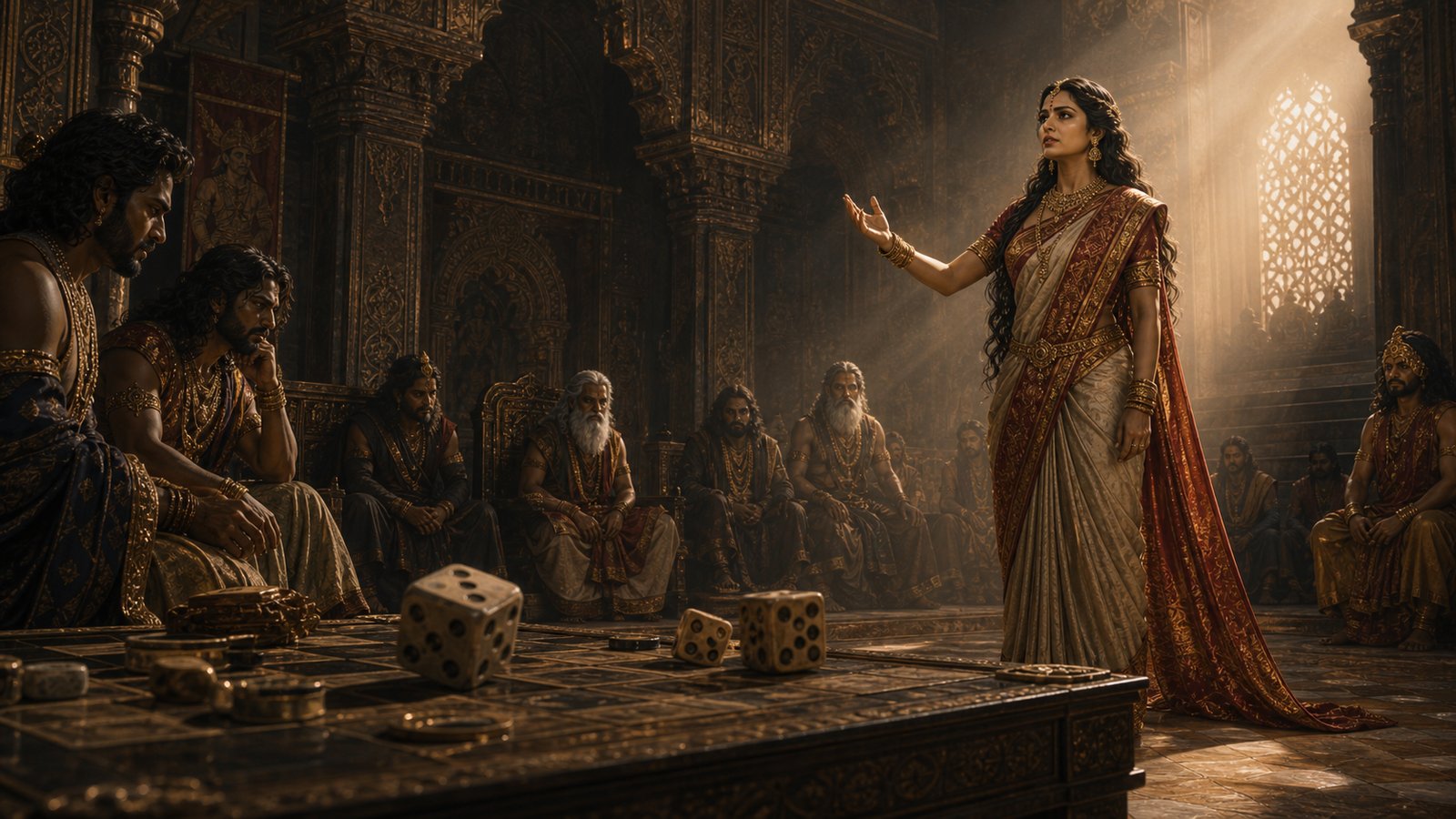
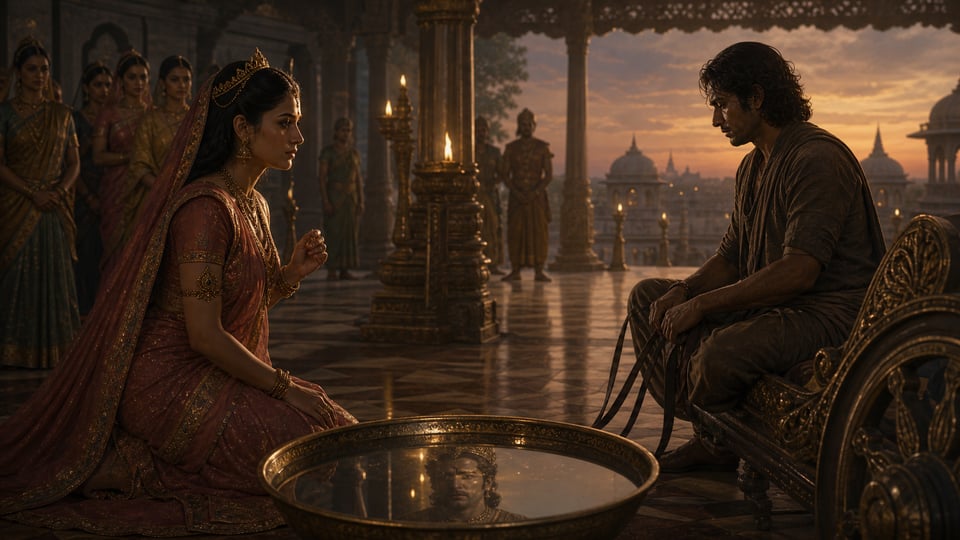
Draupadi was not in the hall when Yudhishthira gambled away his wealth, his kingdom, his brothers, and finally himself. Yet when a messenger entered her chamber and ordered her to appear as a servant won at dice, she saw the fracture more clearly than the kings who had watched it happen.
She did not begin by begging. She asked a question: had Yudhishthira lost himself before he staked her, and if so, what right remained in him to wager another person?
That question changed the scene. The humiliated woman became the sharpest mind in the room, and the glittering Kuru assembly became a place where elders, teachers, husbands, and rulers were forced to reveal what their silence was worth.
The dice game begins as courtly spectacle. Shakuni throws on Duryodhana's behalf; Yudhishthira continues despite loss after loss. Jewels vanish into the wager. Chariots, servants, territories, brothers, and sovereignty follow. The hall does not stop him. Each throw makes the next outrage easier to imagine.
Then Draupadi's name is spoken.
She is elsewhere in the palace, unaware that men are debating whether she has become property. A messenger arrives with Duryodhana's command. In the Sabha Parva, her first response is not submission but astonishment disciplined into inquiry. What king, she asks in effect, would stake his wife? Ask the gambler whether he lost himself first or her first.
The messenger returns to the assembly carrying a question instead of a captive. No one gives him a clean answer. Duryodhana sends him back. Draupadi insists that the elders decide the matter. The journey between chamber and hall becomes its own accusation: the men who created the crisis keep demanding her presence while refusing to establish the right by which they demand it.
At last Dushasana is sent. He drags her into the hall despite her protests. The scene has been retold in many visual, devotional, theatrical, and regional forms, and those forms do not always agree in every detail. The baseline Sanskrit epic, however, is unambiguous about the public coercion, the assault on her dignity, and the assembly's inability to protect her.
Draupadi enters not as someone invited to speak, but as someone whom power expects to silence. Her achievement is that she makes speech impossible to avoid.
Popular memory often introduces Draupadi through the most unusual fact about her marriage. The label is not false, but it can become a curtain. Behind it stands a woman with names, place, kin, political significance, and a history before the Pandavas.
She is Krishnaa, the dark-complexioned one. She is Yajnaseni, daughter of Yajnasena, another name for King Drupada. She is Panchali, princess of Panchala. In the epic's birth account, she and her brother Dhrishtadyumna arise from the sacrificial fire prepared amid Drupada's conflict with Drona. Before marriage places her inside the Kuru struggle, her life is already marked by another court's injury and ambition.
Her swayamvara brings the disguised Pandavas to Panchala. Arjuna wins the contest, but the brothers return home and a maternal instruction, spoken before Kunti sees what they have brought, becomes part of the chain leading to Draupadi's marriage to all five. The epic surrounds that marriage with explanations; later traditions add others. None should erase the simpler truth that Draupadi remains a daughter of Panchala even after becoming queen at Indraprastha.
That identity matters in the dice hall. Duryodhana's party is not humiliating an anonymous dependent. They are assaulting a queen, a daughter of an allied royal house, and a woman whose natal family possesses power of its own. The outrage will not remain inside one household. Dhrishtadyumna and the sons of Panchala will later stand in the war born from accumulated wrongs.
Calling her only a wife makes the hall seem like a domestic dispute. Remembering Krishnaa, Yajnaseni, and Panchali reveals the political world that the Kuru court is setting on fire.
Draupadi's question is devastating because it does not accept the hall's chosen terms. The men speak as though the only issue is whether Yudhishthira placed her in the game. She asks whether he still possessed the authority to do so.
If he had already lost himself, he was no longer a free sovereign making a wager. If he staked her before losing himself, another problem remained: by what moral law could a husband treat his wife as alienable wealth? The question opens in two directions, and neither offers the assembly an easy escape.
Vikarna, one of Dhritarashtra's sons, speaks against the treatment of Draupadi. He notes the force of her challenge and the circumstances of Yudhishthira's gambling. Karna rejects the objection and uses cruel language to strip her of status. Bhishma, revered for wisdom and vows, says dharma is subtle. His uncertainty may be intellectually honest, but in that moment subtlety becomes shelter. A woman is standing under coercion while those with authority discuss complexity.
Draupadi keeps asking. She appeals to elders, law, custom, and conscience. She does not merely say, "Save me because I am suffering," though she is. She asks the assembly to name what has happened. Is she won or not won? Can a man deprived of himself dispose of someone else? What becomes of royal honor when a daughter-in-law is dragged before the court?
Her reasoning exposes the difference between force and legitimacy. Dushasana can seize her. Duryodhana can issue commands. Shakuni can claim the dice have decided. None of those acts settles whether the claim is just.
The hall has power. Draupadi forces it to confront whether it has a right.
The terror of the dice hall does not come only from obvious cruelty. It comes from the number of people who understand enough to intervene and do not intervene effectively.
Dhritarashtra is king, yet attachment to his son has weakened his judgment through years of warning. Bhishma carries unmatched moral prestige, yet cannot turn prestige into protection. Drona and Kripa are present. Vidura condemns the course of events, but his warning does not control the room. The Pandavas sit bound by the result of the game and by their own understanding of duty, even as the cost of that submission stands before them.
This is why the episode cannot be reduced to one wicked man. Duryodhana drives the humiliation; Dushasana enacts it; Karna sharpens it. But institutions fail through gradations of surrender. One person proposes harm. Another normalizes it. A third calls the rules unclear. A fourth waits for someone senior. A fifth grieves without acting. By the time outrage becomes undeniable, everyone can claim that responsibility belonged elsewhere.
The epic does not let the silence remain neutral. Draupadi addresses the room repeatedly because every unanswered appeal adds another witness to the failure.
Later retellings often center divine rescue during the attempted disrobing, especially the image of unending cloth associated with Krishna's grace. Devotional traditions have given that moment immense emotional power. Textual recensions and translations differ in how the protection unfolds and in how explicitly Krishna appears in the hall. A source-aware telling can honor the living image without pretending every version says exactly the same thing.
Yet no version should make the miracle an excuse for the men. Whether protection arrives through divine intervention, extraordinary cloth, or another textual framing, the human assembly has already failed. Grace does not erase accountability.
Public humiliation does more than cause pain. It tries to impose a new story on the person being humiliated.
Draupadi enters the episode as queen of Indraprastha, daughter of Drupada, and partner in a royal household. Duryodhana's side attempts to rename her as a slave. The command to bring her into the hall is an effort to make the new label visible. The insults, the gesture toward Duryodhana's thigh, and the attempted stripping all aim at the same transformation: from person to possession, from speaker to spectacle.
Draupadi refuses the imposed story. She speaks her lineage. She invokes her relationships, but she does not disappear inside them. She reminds the court of its own standards. She turns the gaze back upon those who intended to gaze at her.
That reversal is why her question survives more vividly than many speeches by kings. She cannot control the room physically. She controls the moral frame. After she speaks, no one can honestly describe the event as an ordinary transfer produced by a game.
Dhritarashtra eventually offers her boons, alarmed by the danger and the omens surrounding the outrage. Draupadi first asks for Yudhishthira's freedom, then for the freedom of the other Pandavas with their weapons. She refuses to continue asking merely for gain. The immediate crisis loosens, but the injury is not undone. A second game sends the Pandavas and Draupadi into exile.
This matters because rescue is not restoration. Freedom after degradation does not return the lost trust of the hall. A concession made under fear does not become justice simply because it stops the worst moment from continuing.
The court survives the day. Its moral authority does not.
What follows makes that loss visible. The Pandavas recover freedom only to be summoned into another game, and the court repeats the mechanism that produced the first disaster. Draupadi has compelled the elders to see the abyss, but seeing is not the same as turning away. The second wager proves that a household can recognize harm, express alarm, and still restore the conditions that made the harm possible. That repetition deepens the tragedy: the failure is no longer ignorance. It is a choice made after warning.
There is a second kind of erasure that can happen while condemning the first. Draupadi can be remembered only as the woman who was humiliated.
The dice hall is central, but her life exceeds it. She questions, argues, remembers, demands, governs, travels, grieves, and endures exile. She can be fierce and strategic. She can speak words that disturb modern readers. She is not a smooth emblem created to fit one political slogan, nor is she merely a model of suffering made sacred by endurance.
To call her a modern feminist without qualification may flatten the distance between an epic queen and present movements. To deny the force of her resistance because the category is modern flattens her in another way. The more honest approach is to stay with the scene: when powerful men tried to define her without consent, she insisted on being heard as a moral and reasoning subject.
Her anger also has consequences. Bhima makes terrible vows in response to the insults. The humiliation becomes one of the memories carried toward Kurukshetra. It would be simplistic to say that one event alone causes the war; the Mahabharata builds catastrophe from succession rivalry, jealousy, deceit, oath, exile, revenge, and failed peace. Still, the dice hall becomes a wound no later negotiation can ignore.
That is how family and public memory often work. A crisis is never only the date on which it happened. It is retold in later arguments, alliances, silences, and choices. The person harmed may be asked to "move on" while everyone else continues to benefit from the arrangement that produced the harm.
Draupadi's memory refuses that convenient forgetting. She does not allow reconciliation to mean pretending the hall was honorable.
The assembly's failure was not lack of information. Draupadi explained the issue. Vidura warned them. Vikarna objected. The people with titles had enough knowledge to recognize danger.
They lacked the courage to let testimony change the course of power.
Families repeat smaller versions of this failure when a woman's account is preserved only through someone else's summary. "She was unhappy there." "There was some property issue." "She stopped visiting." "The elders settled it." Such sentences may conceal the one voice that could explain what the turning point actually felt like.
Listening does not require treating every memory as infallible. People remember from different positions; accounts can conflict. But disagreement is not a reason to erase the person who bore the consequence. Two versions can remain side by side, named and dated, without forcing one into silence for the comfort of the family.
Draupadi's many names offer another lesson in attention. A woman's life includes natal place, parents, siblings, teachers, friendships, work, skills, migrations, convictions, losses, and words—not only spouse and children. The dice hall becomes even more horrifying when we remember everything the command "bring her here" attempted to compress.
Modern reflection should not turn the Mahabharata into a handbook. The epic's institutions are not ours, and its legal arguments do not substitute for present law. Its power lies elsewhere: it stages the instant when a room full of respected people hears a precise question and chooses reputation, loyalty, or confusion over protection.
Every generation knows such rooms.
The dice hall ends, but Draupadi's question does not. It follows the exiles into the forest. It enters later debates about peace and war. It survives the destruction of the dynasty that failed to answer it.
Perhaps that is because the question is larger than the wager. What can power claim after it has lost moral authority? Who decides whether a person has been reduced to someone else's possession? What does silence mean when the vulnerable have already spoken clearly?
The easiest retelling gives the scene heroes and villains, then lets the listener leave untouched. The harder retelling notices the pauses. Bhishma's uncertainty. Dhritarashtra's delayed fear. The husbands' constrained stillness. Vikarna's lonely objection. Vidura's warning. Karna's cruelty. Dushasana's hands. Draupadi standing among them, refusing to let rank decide truth.
Her victory is not that the hall immediately becomes just. It does not. Her victory is that the hall can never again pretend it did not know the question.
When families remember women only through marriages, scandals, sacrifices, or the opinions of male relatives, they rebuild that hall in miniature. A fuller memory asks for her own words: What did she choose? What did she refuse? What happened from where she stood? Which name did she use for herself?
Preserve one woman's account of a turning point, in her own language and with her consent, through Bamsawali—so the next generation inherits her voice, not merely the labels others placed upon her.
Mahabharata, Sabha Parva 58–72, especially the dice-hall question and debate in the Ganguli translation.
Mahabharata, Vana Parva and Udyoga Parva, for later remembrance and consequences of the humiliation.
Later devotional and performance traditions are acknowledged separately where the disrobing scene differs in detail.
Mythological
15 July 2026 · 6 min read
Mythological
13 July 2026 · 6 min read
Mythological
1 July 2026 · 12 min read
Mythological
30 June 2026 · 12 min read
Mythological
30 June 2026 · 12 min read
Mythological
26 June 2026 · 11 min read