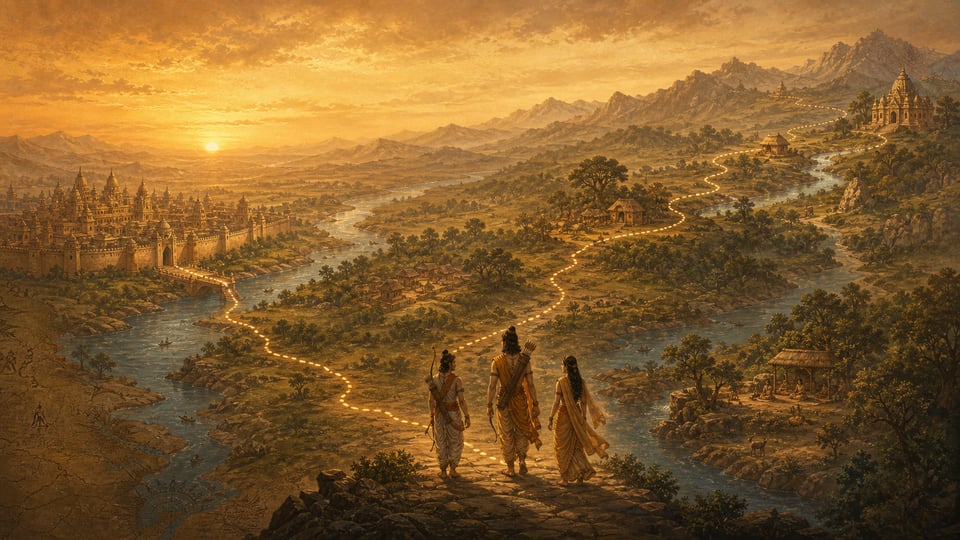
What is Raghuvansh? Why is Rama called Raghava? Explore how the Ramayana uses lineage as inherited identity not automatic virtue.
23 June 2026 · 12 min read
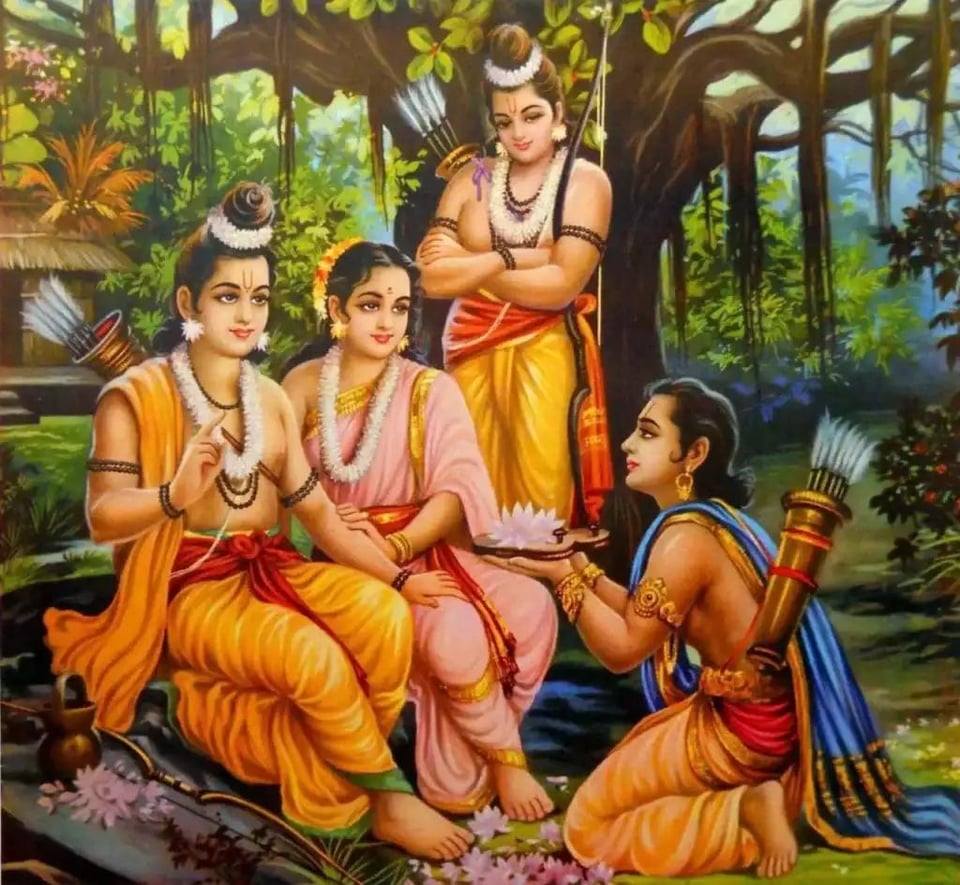
Before Rama draws a bow, enters exile, or confronts Ravana, the story has already placed him inside a much older chain of memory.
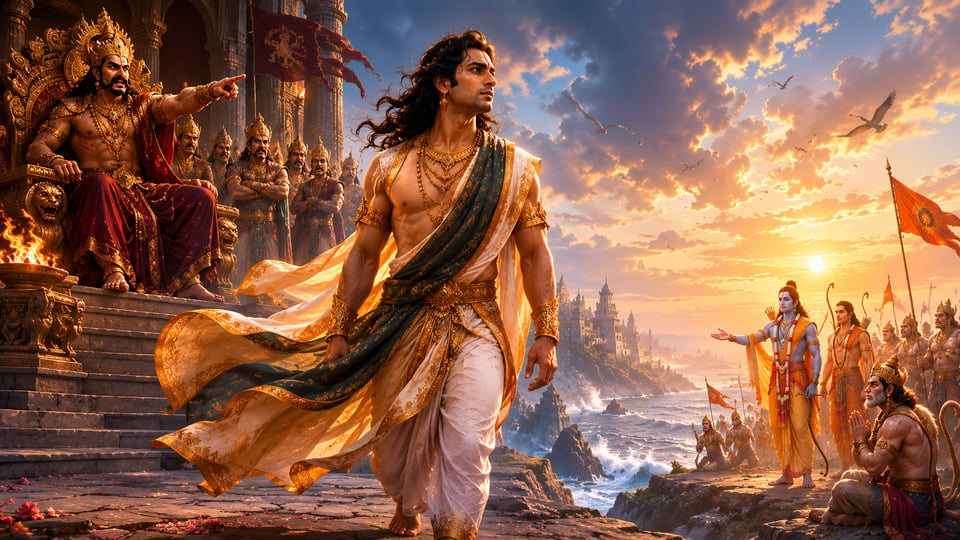
He is not introduced only as Rama. He is Dasharatha's son, a descendant of Ikshvaku, a Raghava, and an heir to a royal house whose name carries expectations. Raghuvansh matters because the Ramayana treats identity as inherited context, not as a substitute for conduct. Rama receives a remembered lineage, but every choice determines what that inheritance will mean.
That distinction still matters in modern families. A surname, gotra, ancestral village, or respected grandparent may tell us where a story began. It cannot decide what the next generation will do with it.
Modern readers usually meet one stable name: Rama. The Sanskrit epic uses a larger label of identity. Depending on the scene and translation, Rama is addressed as Raghava, descendant of Raghu; Kakutstha, associated with another remembered ancestor; Dasharathi, son of Dasharatha; or a prince of the Ikshvaku line.
These are not decorative synonyms. Each name changes the scale of the person being addressed.
"Rama" points to the individual. "Dasharatha's son" places him inside an immediate household. "Raghava" places him inside a longer dynastic memory. "Prince of the Ikshvakus" connects him to the royal line of Kosala and Ayodhya. The epic can therefore speak to him as a son, husband, brother, prince, exile, warrior, or bearer of an inherited reputation.
The local Ramayana text in this project's knowledge base repeatedly uses "Raghava," "son of Raghu," "descendant of Raghu," and "Ikshvaku race." The repetition tells the audience how epic identity works: a person enters a scene accompanied by relationships and memory.
That does not mean every reference supplies a complete historical family memory. It means lineage is one of the epic's main languages for explaining who a person is expected to be.
The terms surrounding Rama's dynasty can sound interchangeable, especially in short online summaries. They refer to connected layers of the tradition.
Suryavansh, the Solar dynasty, is the broad sacred-dynastic category. Puranic genealogies trace this royal line through the Sun and Manu into lines of kings. Ikshvaku is remembered as a foundational ruler in that line, so "Ikshvaku dynasty" identifies a major branch and royal inheritance. Raghu is a celebrated later king whose reputation becomes so powerful that descendants such as Rama are called Raghavas and the line is remembered as Raghuvansh.
A simplified orientation looks like this:
Solar dynastic tradition
↓
Manu
↓
Ikshvaku line
↓
many remembered kings
↓
Raghu
↓
Aja
↓
Dasharatha
↓
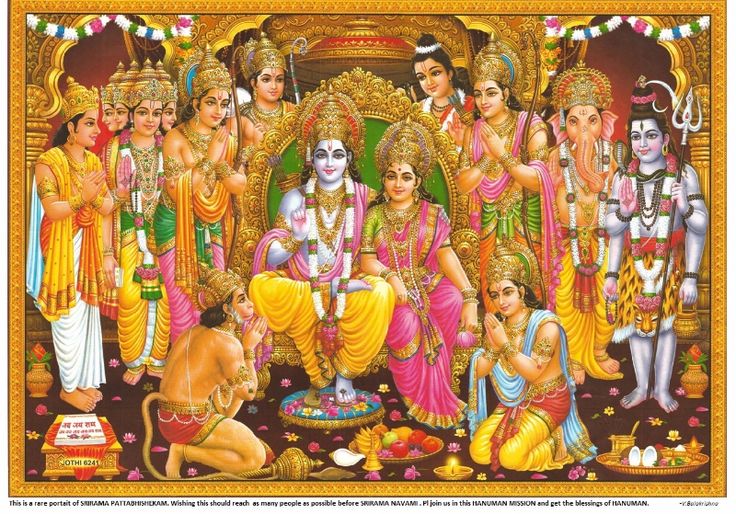
Rama and his brothers
This straight-line account is an orientation tool, not a claim that every Sanskrit text gives precisely the same uninterrupted list. The Vishnu Purana, the Ramayana, later Puranas, court poetry, chronicles, and regional traditions may preserve different names, spellings, sequences, or numbers of generations.
That variation is not a minor inconvenience to hide. It is part of the source history.
A responsible Rama family memory should therefore say which text it follows. Combining several traditions can be useful, but only when the editor marks where the lists differ. Otherwise, a clean straight-line account creates a false certainty that the source material itself does not provide.
Why does the epic keep invoking ancestors during moments of decision?
Because lineage creates a standard against which conduct can be judged. To call someone a Raghava is not merely to praise his bloodline. It can remind him that he carries a public reputation larger than his immediate desire.
This is visible across the Ramayana's moral world. Characters are identified through parents, dynasties, teachers, places, and inherited obligations. Those links help establish trust, duty, rivalry, alliance, and expectation. Yet the epic never proves that ancestry alone makes a person righteous.
Ravana offers the clearest counterweight. His ancestry is linked to the sage Pulastya through Vishrava, but an eminent lineage does not prevent destructive choices. Other characters also complicate the picture: a person of high birth may fail, while someone outside royal power may show courage, loyalty, hospitality, or wisdom.
The point is not that lineage is meaningless. The point is that lineage and character are different kinds of information.
A family record can tell us that an ancestor held office, performed a ritual role, founded a settlement, taught students, served in an army, farmed a difficult landscape, or supported a community. It cannot transfer that achievement automatically to descendants. Inheritance offers memory and responsibility. It does not issue a certificate of personal merit.
This is why claims of "pure," "superior," or morally guaranteed descent misuse genealogy. The Ramayana's own story-world is more demanding: the name establishes the expectation; conduct answers it.
Most people inherit family identity before they can evaluate it.
A child receives a name, language, kinship network, place of origin, ritual calendar, and collection of stories. Some inherit a famous ancestor. Others inherit migration, debt, silence, discrimination, conflict, or a family record with missing pages. Usually, the inheritance is mixed.
Raghuvansh gives us a useful way to think about that mixture. Rama does not select the dynasty into which he is born. He must decide how to act while carrying it. His inherited identity creates privileges, limits, loyalties, and public scrutiny.
Modern families experience smaller versions of the same pressure.
"People from our family always become doctors."
"Our branch must lead the committee."
"Your grandfather never refused a community request."
"No daughter from this house has done that."
"We belong to an old and respected line."
Such sentences can preserve courage and service. They can also become a burden, especially when memory turns one ancestor's path into a command for every descendant.
The healthier question is not, "How do I prove that my lineage is great?" It is, "What did this family actually value, where did that memory come from, and which parts deserve to continue?"
That question allows inheritance to become thoughtful rather than automatic. It also makes room to reject harmful practices without rejecting every relationship to the past.
Lineage in the Ramayana is not only private. It helps explain political legitimacy.
A prince belongs to a household, but the household also belongs to a kingdom. Succession, marriage alliances, promises, and public duty depend on remembered relationships. This is one reason epic genealogies are larger than domestic family memorys: they connect family sequence with the right to rule.
Nepal's chronicle tradition shows a related use of memory. The Gopalaraja Vamsavali preserves dynastic sequences, historical events, sacred claims, and political legitimacy within one layered record. Its text includes a sequence moving through Kakutstha, Raghu, Dasharatha, Rama, Lava, and Kusha. The chronicle does not turn that entire sequence into modern archival proof. It shows how Nepal's political memory used the prestigious language of epic lineage.
The introduction and scholarly discussion around the chronicle also note claims connecting rulers with Solar or Raghu lines. Such claims need historical criticism because dynastic genealogy can serve political purposes. A ruler may invoke a renowned lineage to strengthen authority, connect a local court to a wider Sanskritic world, or make succession appear sacred and continuous.
This is precisely why a source note matters.
"Recorded in a chronicle" does not mean the same thing as "verified by a dated inscription." "Preserved in family tradition" does not mean "confirmed by contemporary government records." Both can belong in a serious archive, but they should not carry identical confidence.
The old chronicle teaches two lessons at once: lineage has cultural power, and powerful lineage claims require careful reading.
Online family memorys often reward neatness. Every person occupies one box, every child descends through one line, and every generation appears certain.
Real memory is rarely that clean.
Names change spelling. Two people may share a name. A branch may remember a different ancestral village. A printed vansawali may skip daughters. An oral account may compress three generations into two. A sacred genealogy may organize time differently from a legal record. A royal list may prioritize succession rather than biological descent.
The long Solar-dynasty lists illustrate this problem. If several texts disagree, an editor has choices:
choose one baseline and identify it;
display variants in notes;
show alternative branches;
or mark a relationship as uncertain.
The irresponsible choice is to merge everything silently and present the result as the one unquestionable lineage.
Uncertainty does not destroy family history. Unmarked uncertainty does.
For ordinary families, the same rule is practical. If one elder says an ancestor came from Jumla and another says Achham, record both statements, the speakers, and any supporting documents. If a later source resolves the difference, update the confidence level without deleting the history of the disagreement.
A trustworthy lineage does not look perfect. It shows how it knows what it claims to know.
Dynastic summaries usually move from one male ruler to the next. That structure helps readers follow succession, but it can create the illusion that only kings carried history.
Every remembered reign depended on a much larger network: mothers who connected houses, daughters whose marriages created alliances, siblings who supported or challenged succession, teachers, ministers, messengers, ritual specialists, soldiers, cultivators, craftspeople, and communities that sustained the kingdom. Even within the Ramayana, the story cannot be understood through a single father-to-son chain. Kaushalya, Kaikeyi, Sumitra, Sita, Urmila, Mandavi, Shrutakirti, the brothers, and the families of Mithila all change what the dynasty becomes.
This matters when modern families copy royal genealogy's narrowest habits. A lineage that records only the "main male line" may be easy to print, but it loses the relationships through which property, language, care, migration, ritual, and memory actually travelled.
Imagine a family that remembers a great-grandfather's move from a hill village to the Tarai but cannot name the great-grandmother who moved with him, managed the household, maintained contact with her maiti, or taught the children the family's rituals. The migration story appears to belong to one man even though an entire household carried it.
A source-aware lineage should therefore distinguish between a succession line and a family network. The succession line answers who inherited a title or office. The family network records the people whose relationships made that succession and ordinary life possible.
Raghuvansh may orient us through kings, but a modern family archive can do something broader. It can retain the clear sequence while restoring the people a short dynastic list leaves outside the frame.
That restoration is not a gesture of courtesy. It changes the accuracy of the record. Once maternal links, daughters, siblings, and household partners return, researchers can better understand migration, inherited property, ritual changes, naming patterns, and connections between branches that otherwise appear unrelated.
What should a family record learn from the Ramayana's use of lineage?
First, a person should never be reduced to a name in a box. Rama's many relational names show that identity includes parents, ancestors, place, role, and responsibility. A useful family profile can preserve:
the person's full name and spelling variants;
parents, spouses, children, and other meaningful relationships;
ancestral and lived places;
migration;
occupation or community responsibility;
remembered values or consequential choices;
photographs and documents;
the person who supplied the information;
and the confidence attached to each claim.
Second, lineage should not become a ranking system. Bamsawali is most useful when it preserves context, not when it certifies that one branch is greater than another.
Third, stories should remain attached to sources. A statement such as "our elders connect this branch to a royal line" may be culturally important. It should be recorded as oral or published family tradition unless stronger evidence supports it.
Finally, descendants should be allowed to add new meaning. A family archive is not a script requiring everyone to repeat an ancestor's profession, politics, or social expectations. It is a record that helps people understand what they received and decide what they will carry forward.
Choose one ancestor your family speaks about often. Do not begin by asking whether the person was "great." Begin with questions that produce usable memory:
What was the person's full name, including alternate spellings or titles?
Where were they born, and where did they later live?
Who were their parents, siblings, spouse, daughters, and sons?
What work or family responsibility are they remembered for?
What difficult decision did they make?
Who tells this story today?
Is there a photograph, letter, land record, certificate, diary, or printed vansawali?
Which parts are documented, and which come from oral memory?
Do other branches remember the story differently?
What value does the family associate with the story and should that value still guide the next generation?
This method changes a vague reputation into a source-aware record. "He was respected" becomes a question: respected by whom, for what action, and according to which evidence? "She held the family together" becomes an invitation to name the work, relationships, sacrifices, and decisions hidden inside that sentence.
Record one ancestor today with a place, a remembered responsibility, and the source of the memory. A lineage survives more honestly when context travels with the name.
Raghuvansh carries Raghu's remembered name.
Raghuvansh means the lineage or dynasty of Raghu. Rama is frequently called Raghava because he is remembered as a descendant of Raghu. The term belongs within the larger Solar or Suryavansh tradition associated with the Ikshvaku line.
The names belong to connected but different layers of memory.
They are connected but operate at different levels. Suryavansh is the broad Solar-dynasty category. Ikshvaku names a foundational dynastic line within that tradition. Raghuvansh emphasizes the branch and reputation associated with King Raghu and his descendants.
Sacred genealogy is not the same as modern biological proof.
The genealogies are important sacred, literary, and dynastic traditions preserved across the Ramayana, Puranas, poetry, and chronicles. They should not be presented as a fully verified modern biological genealogy. Lists vary by text, and each family-memory straight-line account should identify its source.
The inheritance is responsibility, not superiority.
The most useful lesson is not inherited superiority. It is inherited responsibility. Families can preserve names, places, relationships, choices, and sources while allowing descendants to evaluate which values should continue.
Valmiki Ramayana, especially Bala Kanda 70–74 for dynastic and marriage-lineage context.
Romesh Chunder Dutt translation in knowledge-base-ai-ingest/markdown/028_ramayana_dutt_1892_text.md.
H. H. Wilson, The Vishnu Purana, Solar-dynasty material in knowledge-base-ai-ingest/markdown/002_vishnu_purana_wilson_1840_text.md.
Dhanavajra Vajracharya and Kamal P. Malla, eds., Gopalaraja Vamsavali, local text at knowledge-base-ai-ingest/markdown/008_gopalaraja_vamsavali_vajracarya_malla.md.
planning-and-strategy/ramayana-vansawali-seo-content-video-strategy-2026-06-17.md.
Mythological
14 July 2026 · 4 min read
Mythological
29 June 2026 · 12 min read
Mythological
29 June 2026 · 10 min read
Mythological
26 June 2026 · 12 min read
Mythological
25 June 2026 · 4 min read
Mythological
25 June 2026 · 6 min read