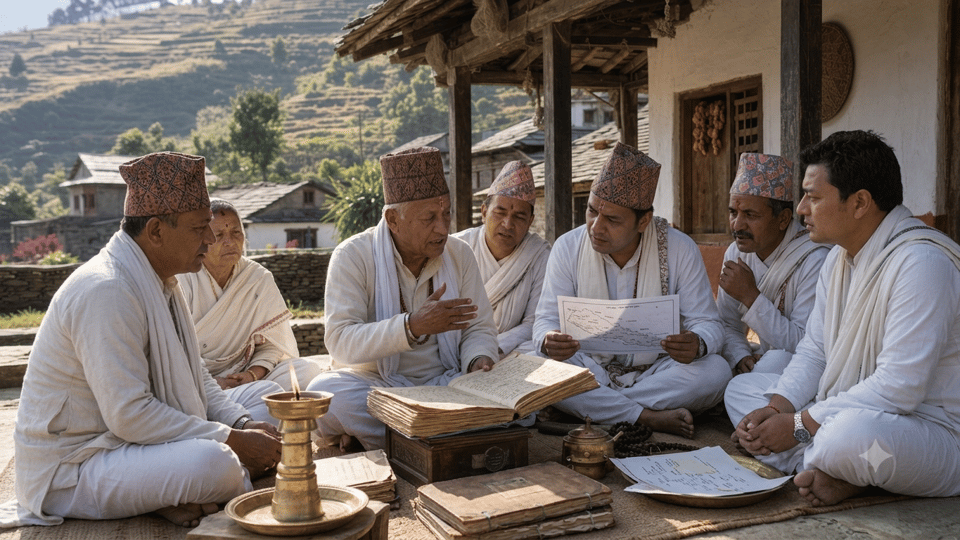
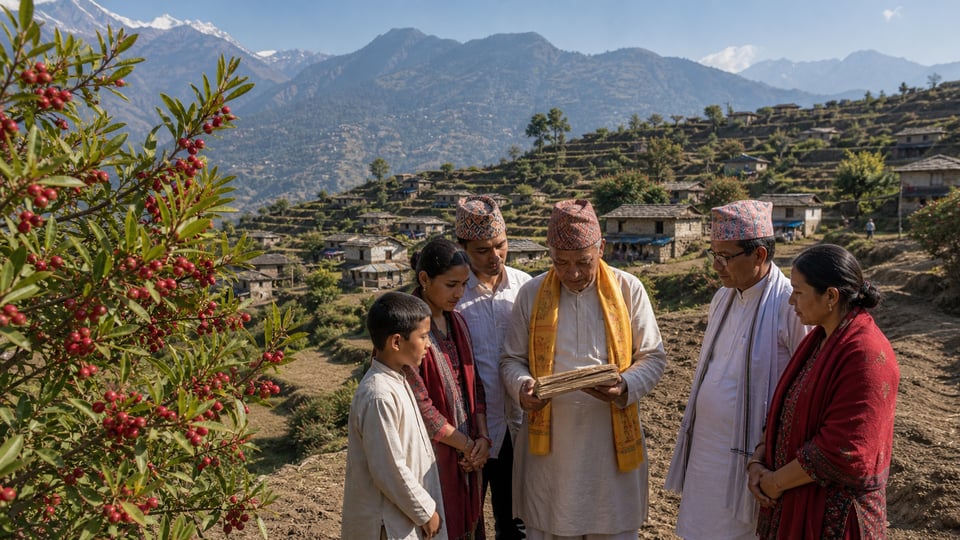
Explore why Nepali kinship is uniquely powerful and why it still matters today.
21 July 2026 · 9 min read
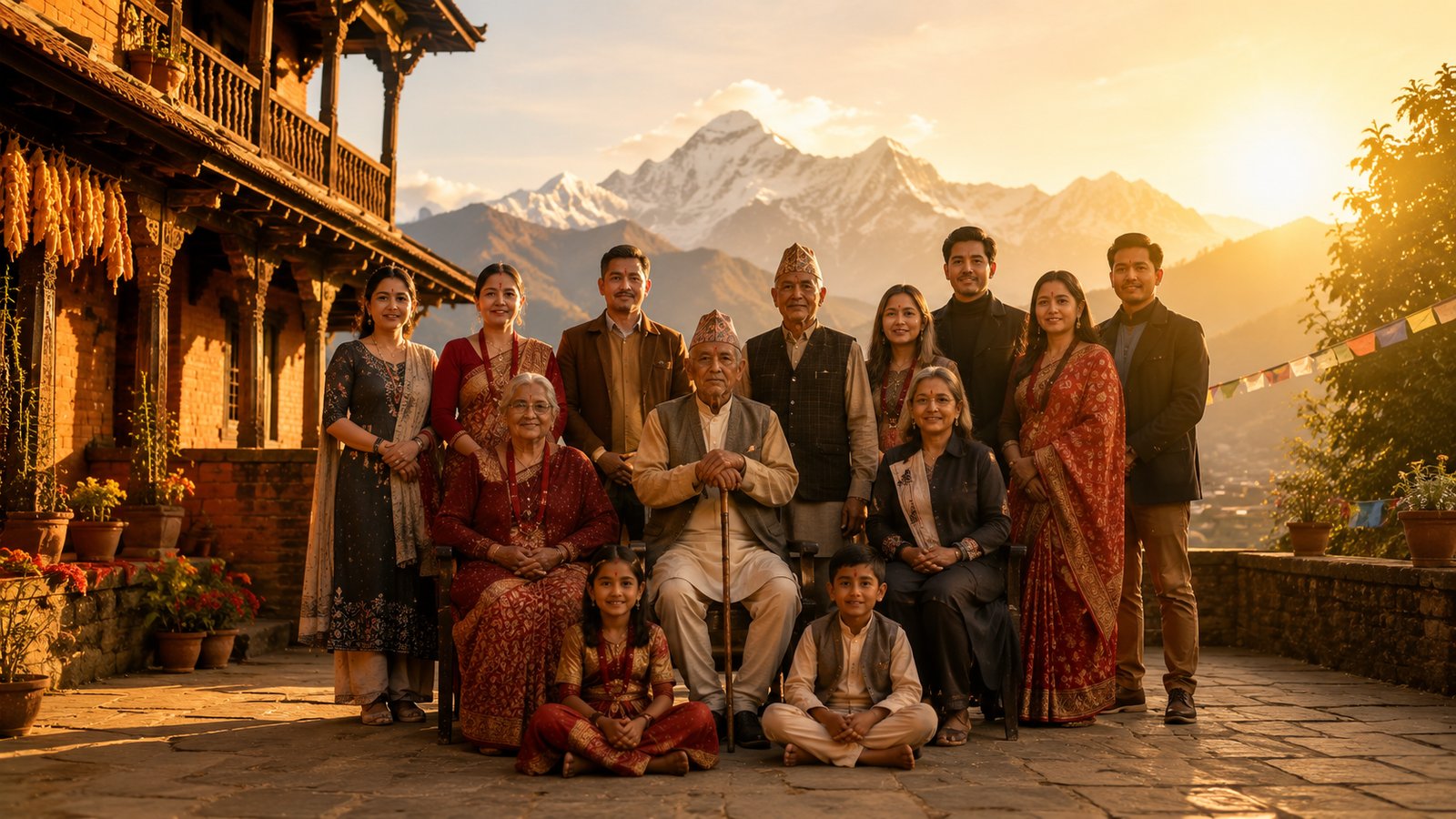
English has one word for uncle. Nepali has many kaka (father's younger brother), thulaba (father's older brother), mama (mother's brother), phupaju (father's sister's husband). Each carries not just a label but a specific relationship, a set of expectations, a particular kind of love.
This is not a coincidence. It is a window into something much deeper about how Nepali society is built and what makes it genuinely different from most of the modern world.
The Nepali dictionary defines nata (kinship) as the mutual relationship formed through birth in the same clan or through marriage. But in practice, Nepali kinship extends far beyond that definition.
In most Western societies, close family means a spouse and their children perhaps one generation beyond that. By the time children reach eighteen, they typically leave the parental home. Parents expect this. Children expect it.
In Nepal, relatives four and five generations removed are still considered close. When a wedding happens, when illness strikes, when a festival arrives people travel from cities and from abroad to be present. The obligation is felt. The desire is real. And crucially, neither party finds this unusual.
As journalist Chandrakishor notes, invitations for weddings, bratabandha, and puja ceremonies still arrive from his grandfather's maternal family. A connection that, in most of the world, would have dissolved generations ago.
What makes Nepali society remarkable is that kinship does not end with blood or marriage. It extends outward in several directions at once.
The most immediate circle includes parents, children, grandparents, siblings, and all the relatives their marriages create in-laws, brothers-in-law, sisters-in-law, and their extended families. Each relationship has its own name in Nepali, its own form of address, its own social obligations.
Anthropologist Suresh Dhakal points out that even the English words "dad," "mom," and "grandfather" fail to carry the same intimacy and texture as their Nepali equivalents. The language itself encodes a depth of relationship that translation cannot fully capture.
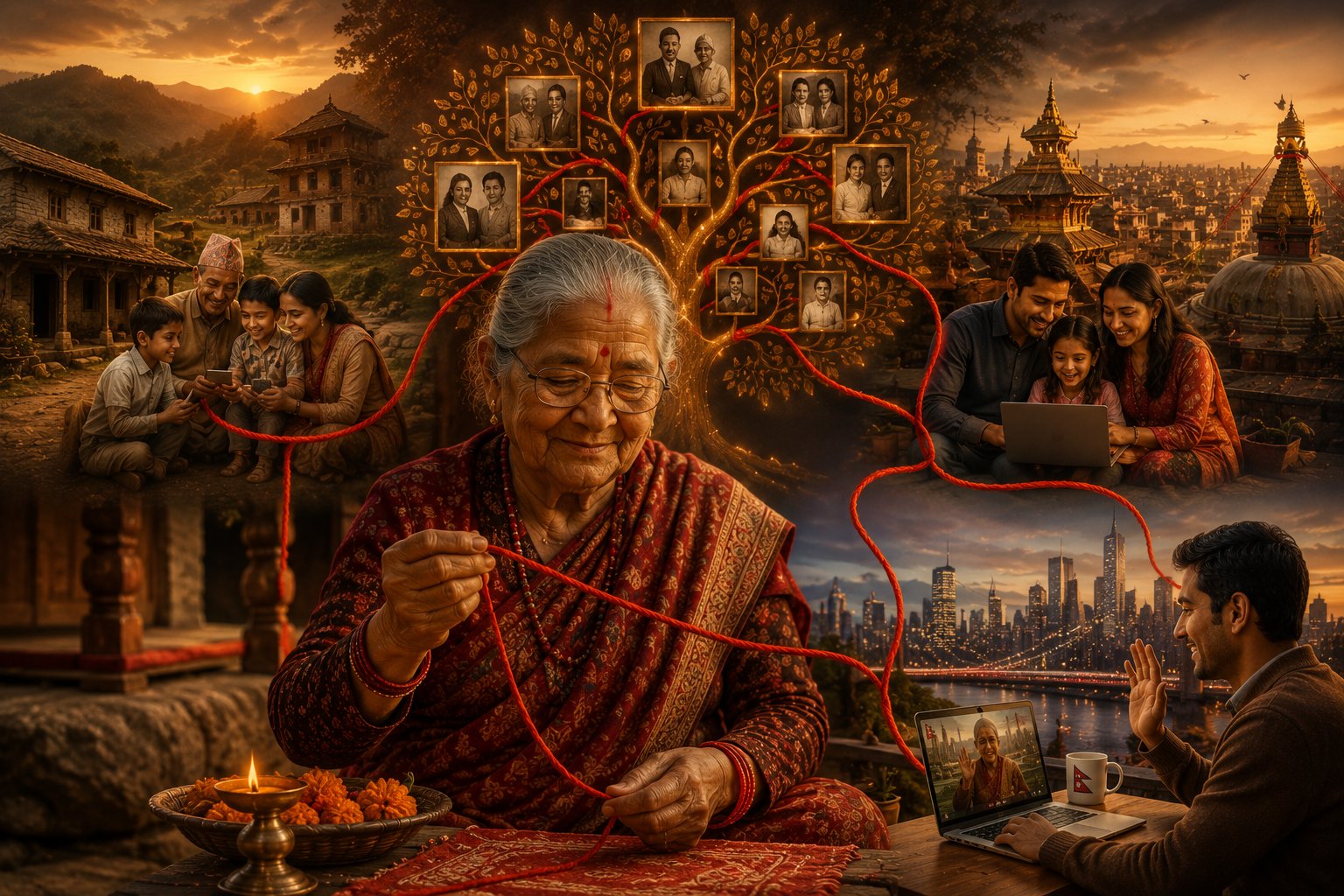
One of the most distinctive features of Nepali social life is mitteri a chosen kinship bond between two people or families who have no blood or marital connection. Once formed, a mit (ritual friend) becomes family in every meaningful sense, and the bond extends outward to both families.
A Nepali saying captures this beautifully: "Other kinships last seven generations; a mit relationship lasts fourteen." The bond recognizes no barriers of caste, religion, or economic status. It is, in its purest form, kinship chosen rather than inherited.
Relationships like dharmputra (godson), dharmmata (godmother), and dharmbhai (ritual brother) extend the kinship circle further still. The Guru Purnima festival, celebrated across Nepal, is living evidence that teacher-student bonds carry the weight of family relationships in Nepali culture.
"Jiundo ko janti, marda ko malami" a neighbor joins your wedding procession and your funeral procession. The Nepali neighbor is not a stranger who lives nearby. In villages and even in many urban neighborhoods, neighbors are addressed as ba (father), aama (mother), daju (elder brother), didi (elder sister) and are treated accordingly.
Historian Dineshraj Pant observes that the Nepali language itself is structured to draw strangers into intimacy: the words and the forms of address are designed to make people feel like their own.
Nepal does not have a comprehensive state-funded social security system in the way that many Western countries do. But it has something else: an extraordinarily dense network of human relationships that functions as a social safety net.
When someone grows old, when illness comes, when disaster strikes it is the family and the neighbors who show up. This is not seen as a burden. It is seen as the natural order of things.
Sociologist Dillaram Dahal frames it this way: "Western society teaches people to live and survive alone. Our society both culture and state teaches us to live together. Our customs do not teach us to eat or live alone. Western behavior is individual-centered; ours is collective."
This collective orientation shows up in business too. Many of Nepal's most successful industries and family enterprises trace their growth directly to networks of kinship relatives who invested, supported, vouched for, and collaborated across generations.
Formal schooling provides knowledge. Kinship provides something else: the moral formation that shapes how a person moves through the world.
Historian Rajesh Gautam makes this point plainly: "What children learn from their elders is moral education. The love, care, and wisdom that grandchildren receive from their grandparents that kind of nurturing is not available anywhere else."
The joint family, whatever its complications, creates a living classroom across generations. Children grow up watching how elders handle conflict, how they receive guests, how they observe rituals, how they speak to people younger and older than themselves. This formation cannot be replicated in a classroom or a parenting book.
It would be dishonest to pretend that Nepali kinship is unchanged and unchanging. It is under pressure and has been for decades.
Urbanization has fractured joint families. Education and employment have sent people to cities and abroad. The agricultural production system that once made extended family an economic necessity where many hands working shared land was the basis of survival has given way to wage labor and individual careers.
Sociologist Chaitanya Mishra takes the long view: "Before industrialization, Europe and America had family structures and kinship patterns very similar to ours. As economic structures change, kinship patterns change with them. We are on the same road just some distance behind."
Anthropologist Suresh Dhakal adds that as production relationships shift away from shared agriculture, kinship naturally evolves too: "The relationship is changing in the same way that our economic life is changing."
Meanwhile, a newer tension has emerged. Associate Professor Neeti Aryal Khanal of Tribhuvan University observes that while Nepalis continue to build relationships wherever they go in new cities, in new countries maintaining those relationships has itself become a source of stress. The question is no longer just "who are my people?" but "which circles can I realistically keep up with?"
If there is one institution that holds Nepali kinship together more than any other, it is Dashain.
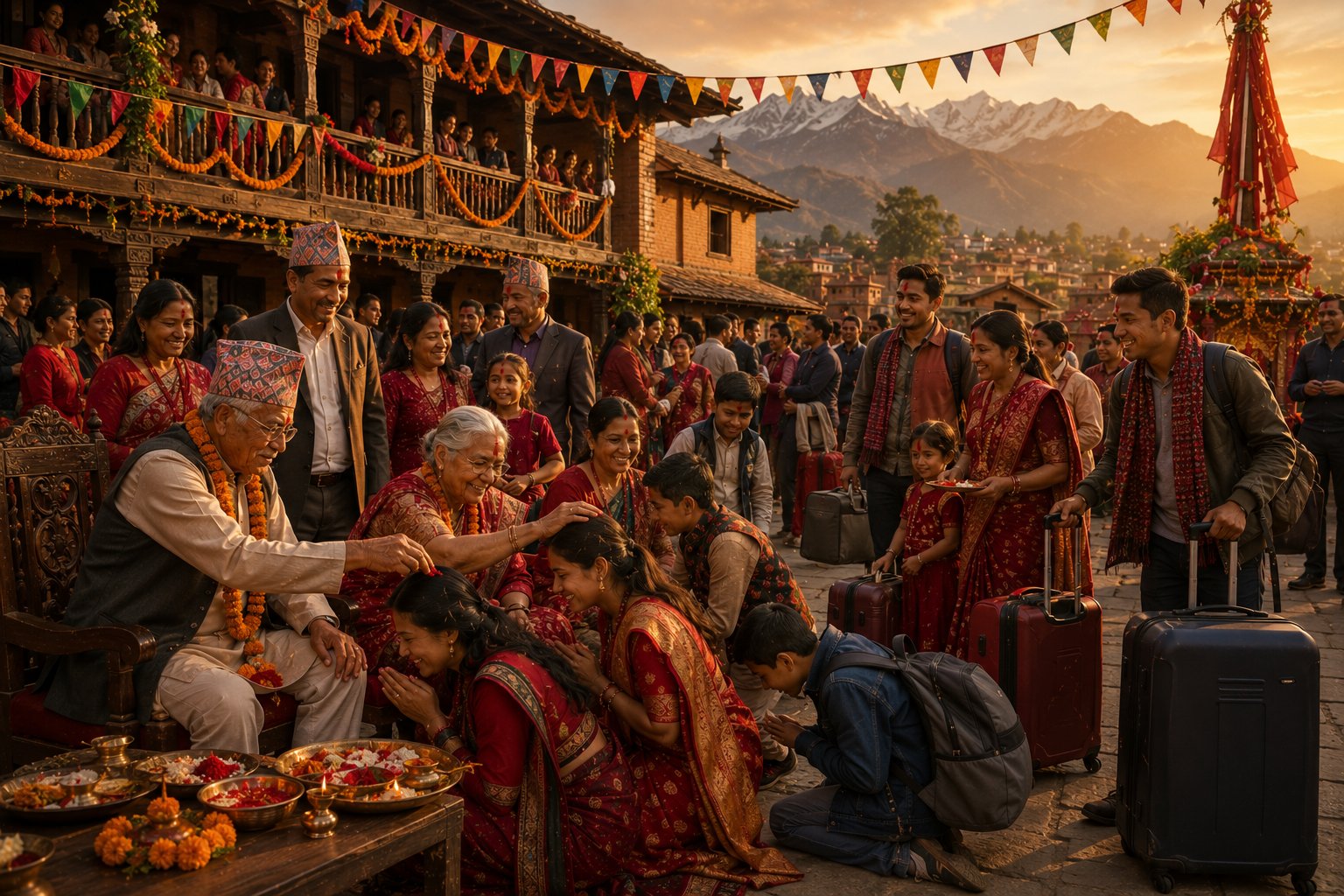
Every year, tens of thousands of Nepalis empty out the capital and reverse their migrations to reach home not for business, not for property, but for tika (the blessing ceremony) and for the simple act of being with family. Non-Resident Nepali organizations have learned to time their annual gatherings around Dashain precisely because that is when the largest number of diaspora Nepalis are already trying to come home.
Culturalist Satya Mohan Joshi describes Dashain's social function: it acts as cement setting aside grievances and renewing bonds that might otherwise crack over a year of distance and difficulty. A mother-in-law who has not been speaking to her daughter-in-law still gives tika and blessings. A daughter-in-law who has been keeping her distance still touches the elder's feet. The ritual creates a moment in which the relationship is renewed before personal friction is allowed to permanently damage it.
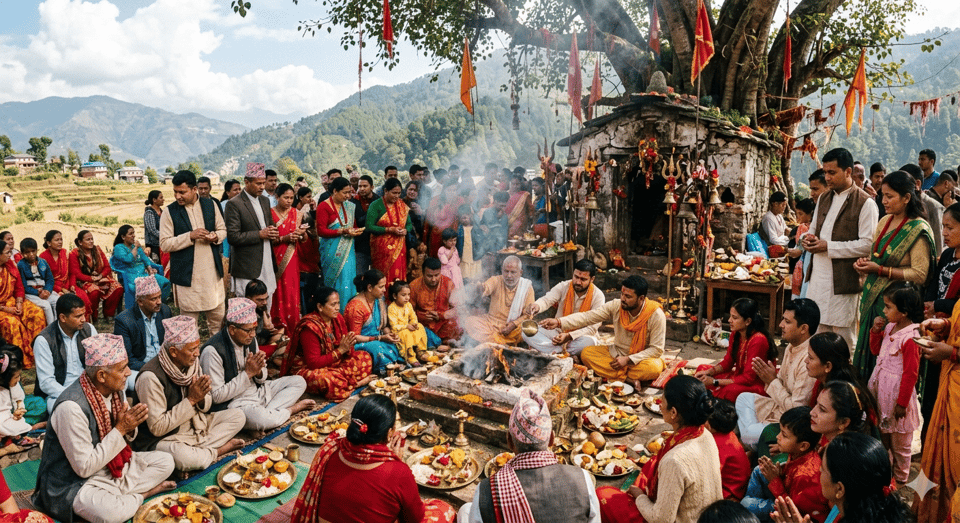
Every religion, caste, and community in Nepal has its own version of this festivals that pull dispersed families back together and remind them of what connects them.
Where geography once threatened kinship, technology now repairs it.
Historian Gyanmani Nepal offers a telling comparison: in his generation, someone posted to Palpa from Bhojpur might need twelve days traveling through India to reach home for Dashain. Today, someone living in America can leave in the morning and arrive the next day. And on the days they cannot come, video calls, family WhatsApp groups, and social media keep the thread alive between visits.
Technology has not replaced Nepali kinship. It has given kinship new infrastructure.
The richness of Nepali kinship is also its vulnerability. Every generation that migrates, every family that moves to a new city, every decade that passes the specific details begin to blur. The name of the ancestral village. The branch of the family that went east. The cousin twice removed who settled in Darjeeling. The grandmother's mother's side of the family.
Oral memory is powerful but fragile. Grandparents carry histories that no one has yet written down.
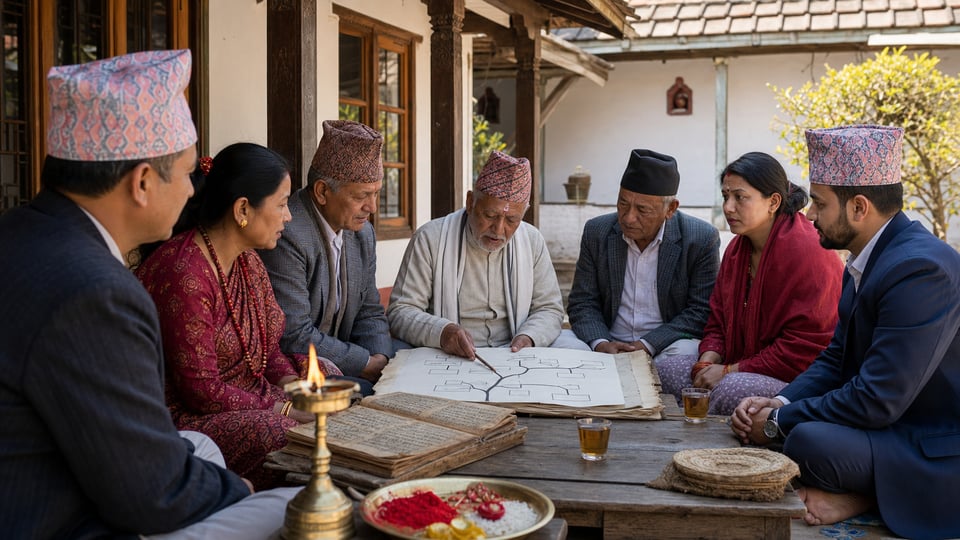
This is precisely what Bamsawali was built for to help families preserve the map of their kinship before it fades. A digital family tree that records not just names and dates but the routes of migration, the branches of relationship, and the stories that give a family its particular character.
The Nepali tradition of kinship is extraordinary. But it only survives if someone takes the trouble to write it down.
Nepali society maintains meaningful family relationships across four and five generations far beyond what is typical in most modern societies. The Nepali language itself reflects this: every type of relative has a distinct name and a distinct set of social obligations. This depth of kinship is unusual in the contemporary world.
Mitteri is a chosen kinship bond in which two people or families who share no blood or marital relationship formally become mit — ritual kin. The bond extends to both families and carries the weight of a blood relationship. A Nepali saying holds that while ordinary kinship lasts seven generations, a mit bond lasts fourteen. The bond crosses lines of caste, religion, and class.
The forms of Nepali kinship are changing urbanization, migration, and individual careers have altered how families live and interact. But the underlying bonds remain strong. Festivals like Dashain continue to pull dispersed families together, and technology has given kinship new ways to stay alive across distance.
Dashain is the most powerful annual renewal of Nepali kinship. Families travel from cities and from abroad to receive tika and blessings, to meet relatives they may not have seen all year, and to reset relationships that have been strained. For many Nepalis, Dashain is the one time of year when the full breadth of their family network comes back together in one place.
The joint or extended family creates a multigenerational environment in which children learn moral formation, social behavior, and cultural values by observing not just being taught. The care and wisdom transmitted between grandparents and grandchildren is a form of inheritance that no school or book can fully replicate.
Genealogy is kinship written down. As families migrate and generations pass, the specific details of family history ancestral villages, migration routes, branch relationships, old stories begin to fade from living memory. A banshawali (family genealogy) preserves that map so that future generations can understand who they are and where they came from.
Gotra
22 July 2026 · 13 min read
Gotra
19 June 2026 · 7 min read
Gotra
18 June 2026 · 5 min read
Gotra
18 June 2026 · 12 min read
Surname History
23 June 2026 · 11 min read
Surname History
19 June 2026 · 14 min read