Explore Ghimire surname history from Kashyap gotra and Ghamir, Ghermu and Gherung traditions to Barah-Masta kul puja and digital vansawali preservation.
23 June 2026 · 11 min read
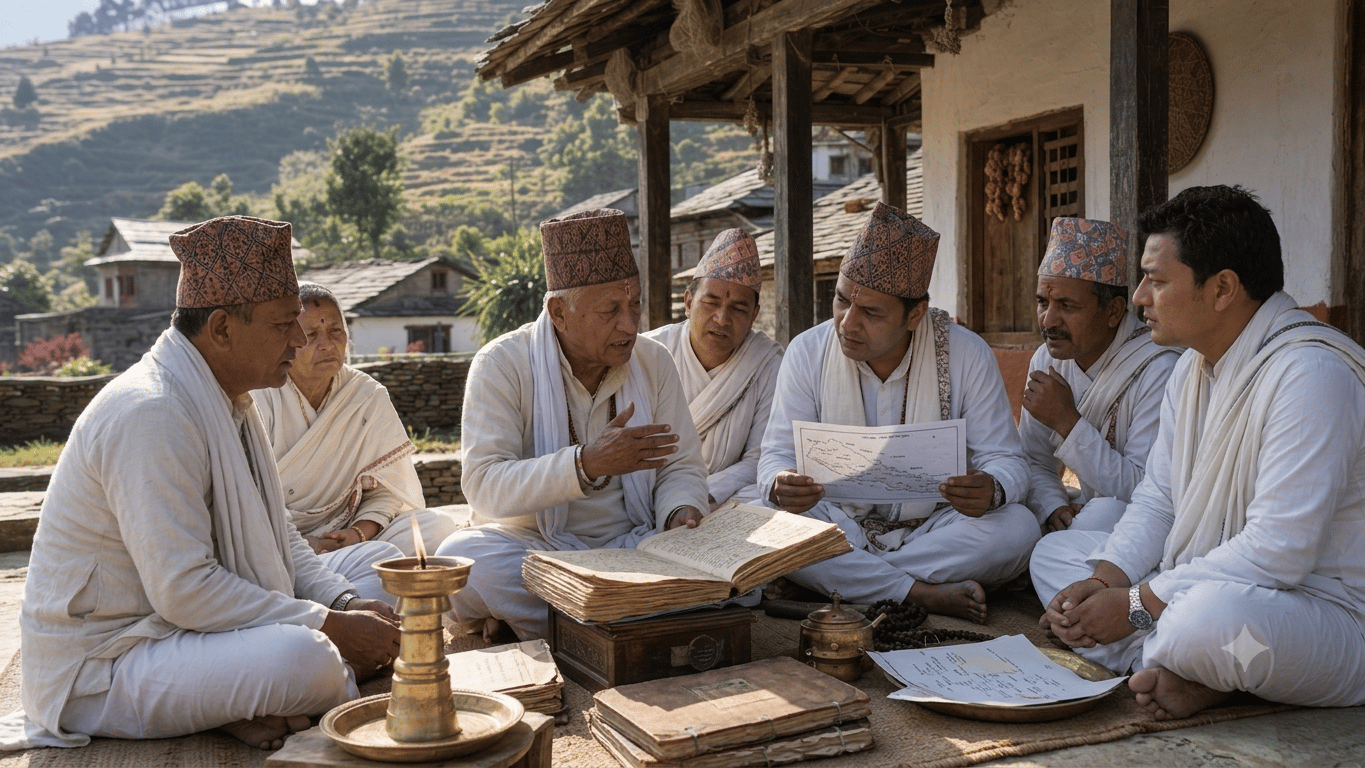
If your surname is Ghimire, your family name may be carrying more than one kind of memory.
It may carry the memory of a gotra.
It may carry the memory of an old settlement.
It may carry the memory of migration, kul puja, royal priesthood, ponds, temples, local vansawalis and the modern attempt to connect scattered families through a digital family tree.
That is what makes the Ghimire surname interesting. It is not a simple one-line origin story. The Ghimire Bandhu National Foundation itself records more than one explanation: one tradition connects the name with Ghamir in Gulmi, another with Ghermu in Lamjung, and another with Gherung in Kalikot. The same source also preserves an older migration memory that moves from Ujjain through Uttarakhand, Almora and Kumaon toward Sinja and then eastward.
So this article does not try to force one final answer. It does something more useful: it lays out the living traditions, explains what they mean, and shows why a platform like Bamsawali matters for families whose history is spread across many districts, old books, oral memory and kul records.
Surname history must be handled with care.
The information below is based mainly on the public material shared by the Ghimire Bandhu National Foundation and the related Ghimire Bandhu website. Their own description says that the different origin accounts need further research and investigation. That honesty is important.
In family history, a story can be meaningful even before it is fully proven. But when we publish it, we should separate:
what a community source clearly records,
what is remembered as a legend or tradition,
what needs documentary confirmation,
and what must be checked branch by branch through vansawali, kul records, land records, temple records and elder testimony.
That is also Bamsawali's approach: respect the story, but record the source.
The Ghimire Foundation describes Ghimires as belonging to Kashyap gotra, meaning that the lineage is traditionally associated with Rishi Kashyap.
In Nepali family identity, gotra is not only a ritual label. It is a way of connecting a family to an ancient rishi lineage, and it often appears in ceremonies such as bratabandha, marriage rituals, shraddha, kul puja and other family rites. For many families, the gotra is remembered even when detailed generation-by-generation history has faded.
For Ghimire families, the Kashyap gotra becomes the deeper root. The surname itself may have formed later from a place or migration memory, but the ritual identity remembers a rishi-lineage connection that is much older than the modern spelling of the surname.
This difference matters:
Gotra points toward ritual ancestry.
Thar or surname often points toward place, title, occupation, branch or historical identity.
Vansawali connects those two layers through actual family lines, names, generations, marriages and migrations.
When a Ghimire family records its history properly, it should not stop at "Kashyap gotra." It should also ask: which branch, which ancestral village, which kul devata, which local vansawali, which migration route and which elders can verify the story?
The most striking origin tradition recorded by the foundation connects the surname to Ghamir in Gulmi.
According to this account, ancestors who had once been known by learned titles and other names eventually settled around Ghamir, and the place-name gradually became attached to the people. In this telling, those associated with Ghamir became known as Ghamire, which later became Ghimire.
This pattern is common in Nepali surname history. Many surnames are not invented in a single moment. They grow slowly from a place:
people from a certain settlement become known by that place,
the name changes through pronunciation,
scribes and local records stabilize one spelling,
and after generations the place-name becomes a hereditary surname.
If the Ghamir account is correct for a branch, then the Ghimire surname is not only a family name. It is a geographical memory. It says: once, our people were remembered through a place.
The Ghimire Foundation site also preserves a story from Ghamir, Gulmi involving two brothers, remembered as Bhanu and Janu.
In that tradition, the two brothers lived in Ghamir and were associated with the old Musikot state as royal priests. They are also remembered as cattle keepers. Bhanu is said to have built a pond for cattle water, which became known as Bhanu Pokhari. Janu, according to the same local memory, later left Ghamir after a dispute related to birta land granted by the king.
Whether each detail can be documented historically is a separate question. But as family memory, this story is powerful because it contains the exact things vansawali often preserves:
a place,
named ancestors,
royal or administrative association,
a pond or built landmark,
land memory,
movement away from the ancestral settlement.
This is the kind of detail families often lose when genealogy is reduced to just "name, father, grandfather." A complete vansawali should also preserve ponds, temples, paati-pauwa, chautari, dharmashala, schools, bridges, fields, migration points and the stories attached to them.
That is not decoration. That is family history.
The foundation does not present only the Ghamir story. It also records other explanations.
One account links the surname to Ghermu in the Bahundanda-Pustun area of Lamjung. Another links it to Gherung in Kalikot. These may represent different branches, different oral memories or different attempts to explain similar-sounding place names.
This is exactly why surname history should not be flattened.
If a Ghimire family from one district remembers Ghamir, another remembers Ghermu, and another remembers Gherung, the correct response is not to immediately choose one and reject the others. The better method is to document each branch:
What does the local vansawali say?
What do elders remember?
Which kul puja site is used?
Which ancestral village is named in marriage, death or land records?
Are there older manuscripts, calendars, smarikas or temple documents?
How does the family identify its origin during rituals?
Over time, these details can show whether the stories are competing explanations or whether they describe different waves of the same broader lineage.
Another tradition recorded by the foundation is broader and older in scale.
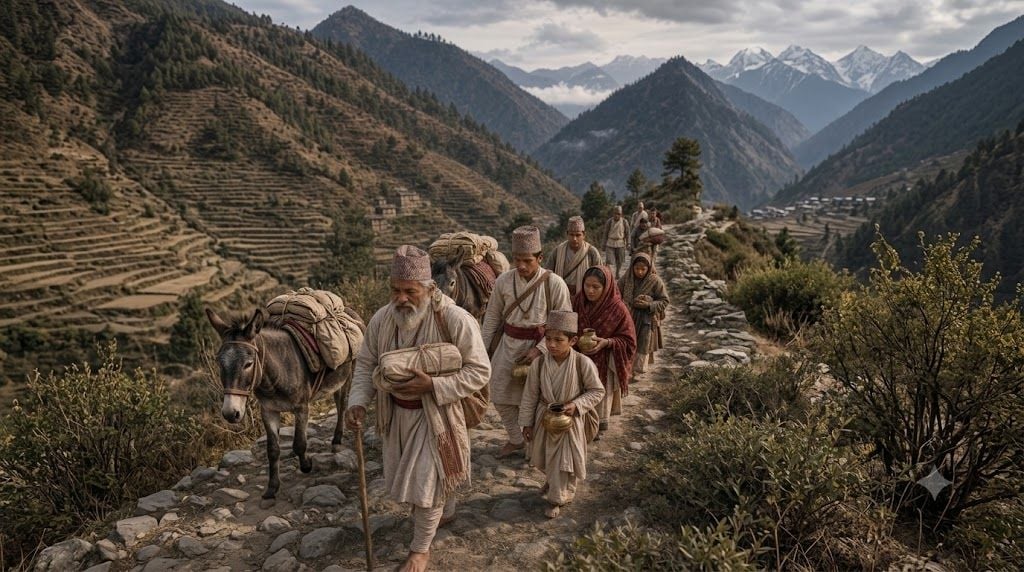
It says that ancestors once connected with the name Vyas in Ujjain migrated under pressure created by Muslim rule or invasion. From there, the remembered route moves through Uttarakhand, Almora, Kumaon and toward Sinja. At different points, the families were known by names such as Joshi and other surnames before moving eastward and eventually being associated with Ghamir.
This story should be treated carefully. It is a community memory, not a fully verified historical proof. But it is still useful because it preserves a pattern common in many Nepali Brahmin lineage traditions:
movement from older learning centers,
migration through the western Himalayan corridor,
settlement in Karnali or western Nepal,
later movement toward the mid-hills and eastern regions,
surname formation after settlement.
If future Ghimire research compares old vansawalis, regional records, land grants, temple traditions and family manuscripts, this migration memory may become clearer.
One of the most useful details on the foundation website is the reference to traditional Ghimire kul puja where Barah and Masta are worshipped, especially in the context of Dolakha Ghimire kul puja material shared on the site.
This should be written carefully. It does not automatically mean every Ghimire branch everywhere performs the same ritual in the same way. But it does show that kul puja is central to Ghimire identity, and that Barah-Masta worship is part of at least some recorded Ghimire ritual memory.
For Bamsawali, this is important because kul puja details are one of the strongest bridges between ancestry and living practice. A family tree can show names, but kul puja shows continuity:
which deity is worshipped,
where the kulsthan or kul mandir is located,
which branch attends,
which tithi or season is followed,
which priests, elders and organizers hold responsibility,
and how the ritual connects relatives who may live far apart.
When these details are recorded properly, kul puja becomes more than a yearly event. It becomes a living archive.
The Ghimire Bandhu National Foundation is important because it shows how a surname group can move from scattered local memory toward organized preservation.
According to the foundation's public material, the national effort took shape after meetings around 2066 B.S. and was formally registered on 2067 Chaitra 28 at the District Administration Office, Kathmandu. The foundation describes itself as an umbrella organization working to unite Ghimire groups across Nepal and beyond.
Its scale is also notable:
Ghimire organizations from 46 districts are described as connected or affiliated.
The site mentions 105 Ghimire organizations linked so far.
It records 36 published vansawalis, with some kept in its library.
It has published smarikas, calendars, introductory booklets and a Ghimire Banshawali Abhilekh Pustika.
It encourages local Ghimire groups to prepare vansawali committees and collect historical, cultural and ritual materials.
This is exactly the kind of movement Nepali surname communities need. A family that only remembers its own grandfather has memory. A community that collects district records, local committees, published vansawalis and archive copies begins to build history.
The foundation's website also points to a modern digital direction. The Ghimire Bandhu IT Team has worked on a Ghimire Bandhu App, described as a beta family tree system. The "Helping Hands" page names several contributors involved in IT, system architecture, website development, data migration and family tree system planning.
This matters because Ghimire history is already too large for paper alone.
When a community has dozens of local organizations, many published vansawalis, scattered branches, district committees, kul puja groups and overseas relatives, the next challenge is not only collecting information. It is keeping it organized, searchable, correctable and usable by future generations.
That is where Bamsawali's vision fits naturally:
family trees that can be updated by authorized relatives,
vansawali records linked with sources,
kul puja announcements and event memories,
maiti and sasurali links for women,
photos of ancestral places and family documents,
QR-based relationship discovery,
public pages for family history,
and a structured way to preserve both story and evidence.
The Ghimire example shows that the need is real. Nepali families are already trying to digitize vansawali. The next step is to make that process accurate, respectful and easy enough that elders and younger family members can both participate.
If your family is Ghimire, do not wait for a perfect national history before recording your branch. Start with what your home already knows.
Here is a practical checklist:
Gotra: Record Kashyap gotra, and if your family knows pravara or ritual details, add them with source notes.
Origin tradition: Ask whether your elders remember Ghamir, Ghermu, Gherung, Sinja, Kumaon, Lamjung, Kalikot, Gulmi or another place.
Ancestral village: Record old village names, ward changes, migration routes and the first known ancestor who moved.
Kul devata and kul puja: Document the deity, kulsthan, tithi, main organizers and branch-specific customs.
Vansawali source: Note whether your branch has a printed vansawali, handwritten notebook, smarika entry or oral record.
Women in the family line: Record daughters, mothers, sisters, buhari, maiti and sasurali connections. A vansawali without women is incomplete family history.
Photos and landmarks: Save photos of kul mandir, ponds, chautari, old houses, manuscripts, copper plates, certificates and ancestral donations.
Source confidence: Mark each detail as verified, remembered, disputed or needing research.
This is how a surname turns from memory into a durable archive.
The Ghimire surname sits exactly at the intersection Bamsawali is built for.
It has gotra identity.
It has multiple origin traditions.
It has kul puja and kul devata memory.
It has local vansawalis.
It has a national foundation.
It has archive work.
It has a digital family tree attempt.
It has diaspora and district-wide organization.
It has stories that need both respect and verification.
Bamsawali's role is not to replace the elders, printed books or local committees. It is to help families bring those sources together in one living, structured and source-aware place.
Because the question is not only "Where did the Ghimire surname come from?"
The deeper question is:
Will the next generation know which branch they belong to, which kul memory they inherited, and which source proves the story?
That is why the work matters.
The Ghimire Bandhu National Foundation describes Ghimires as belonging to Kashyap gotra, traditionally associated with Rishi Kashyap. Individual families should still record their branch-specific ritual details where known.
The foundation records multiple origin traditions. One connects the surname with Ghamir in Gulmi, where "Ghamire" may have become "Ghimire." Other accounts connect the name with Ghermu in Lamjung or Gherung in Kalikot. These accounts need branch-level verification.
One strong community tradition says yes. The Ghimire Foundation site preserves the Ghamir-Gulmi account and the Bhanu Pokhari story. However, it also records other origin explanations, so families should verify their own branch history.
The foundation website refers to traditional Ghimire kul puja involving Barah and Masta, especially in material connected with Dolakha Ghimire kul puja. Kul puja traditions can vary by branch and region, so each family should record its own practice.
Because Ghimire history is spread across printed vansawalis, local committees, kul puja groups, old photos, oral memories and migration stories. A digital vansawali helps preserve the branch clearly, link sources, include women properly and connect relatives across districts and countries.
This draft is based on public information from:
Ghimire Foundation homepage: https://ghimirefoundation.org.np/
Ghimire Foundation About page: https://ghimirefoundation.org.np/pages/about-us
Ghimire Foundation News and Information page: https://ghimirefoundation.org.np/pages/news-info
Ghimire Foundation Helping Hands page: https://ghimirefoundation.org.np/pages/helping-hands
Ghimire Foundation Gallery page: https://ghimirefoundation.org.np/pages/gallery
Ghimire Bandhu App login/public entry page: https://app.ghimirebandhu.org.np/
See its gotra, kuldevata, origin and the other surnames that share its gotra.
Surname History
19 June 2026 · 14 min read
Surname History
18 June 2026 · 11 min read
Surname History
17 June 2026 · 13 min read
Surname History
17 June 2026 · 14 min read
Gotra
22 July 2026 · 13 min read
Gotra
21 July 2026 · 9 min read