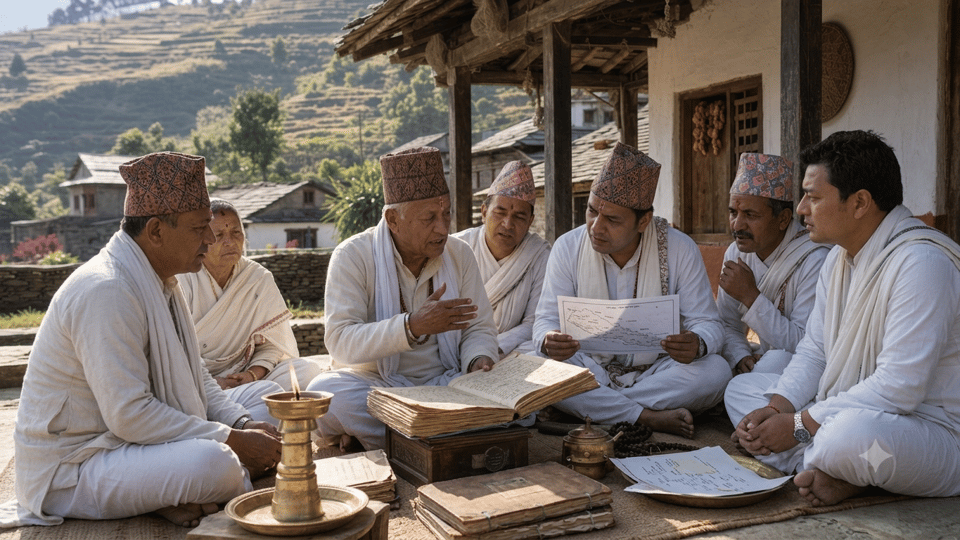
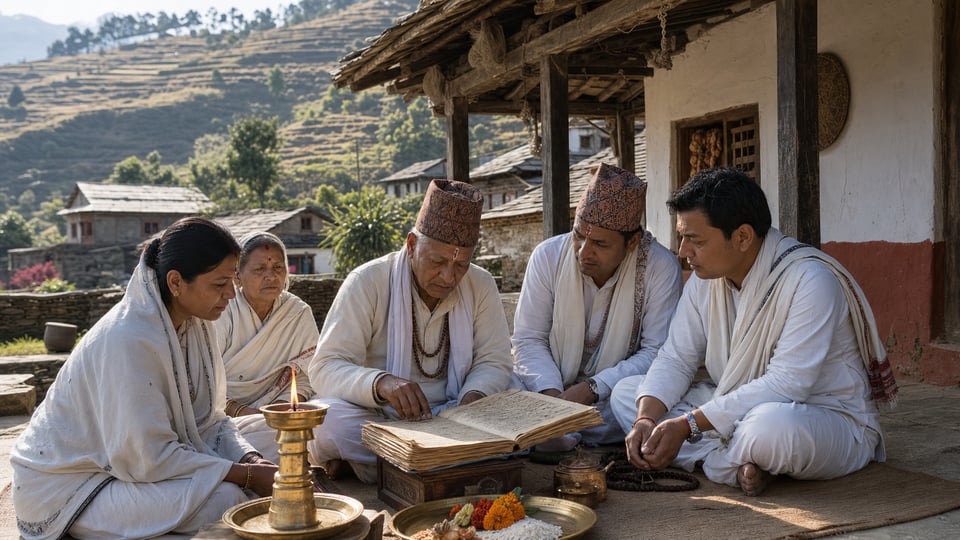
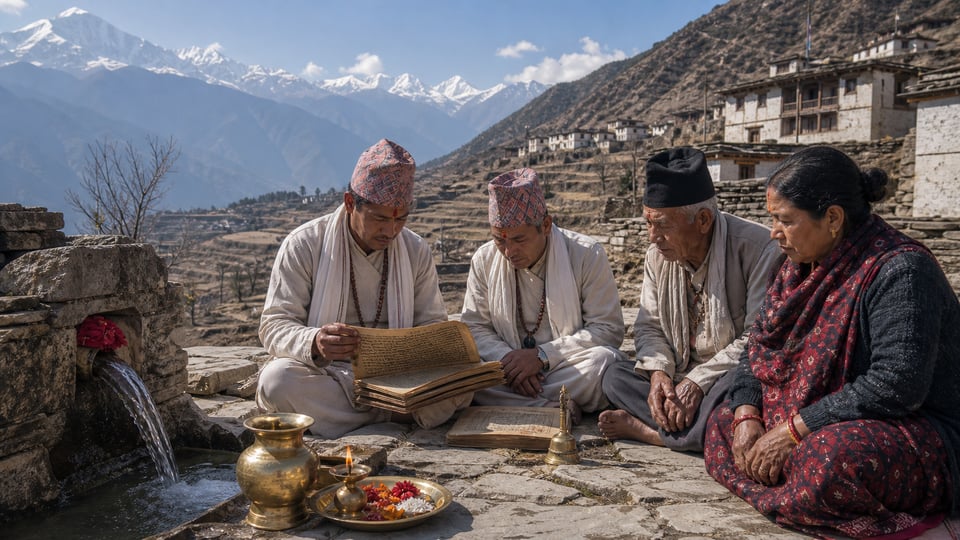
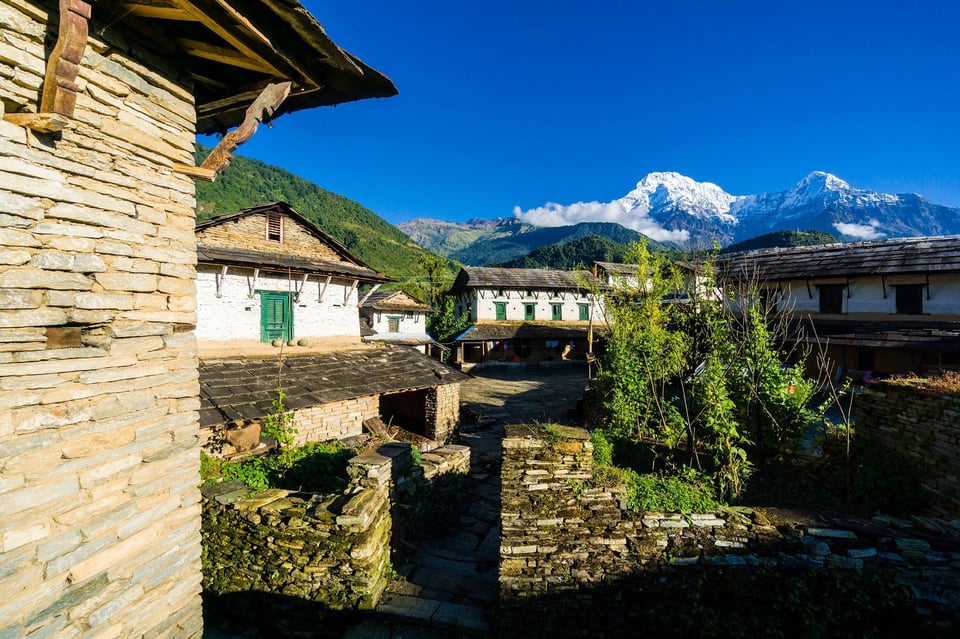
The Kafle surname is a quintessential example of Nepali history rooted in both Vedic tradition and local landscape.
19 June 2026 · 14 min read
Did you know that the Kafle surname is generally understood as a surname formed inside Nepal?
Many Nepali surnames remember a place. Some remember a profession. Some preserve a title earned by an ancestor. The Kafle surname is especially interesting because it carries all the signs of a mountain memory: a forest of kafal, a settlement cleared for farming, a Shandilya-gotra lineage, and a ritual tradition that still distinguishes Saji and Basi Kafle families.
In Bamsawali's "Surname Journey" series, we explore the roots of Nepali surnames: where they came from, how they formed, and what kinds of ancestors, places, and memories they carry. This journey is about the Kafle surname.
One thing should be said carefully at the beginning. Kafle history, like many family histories, comes through genealogies, oral traditions, ritual memory, local place names, and scholarly interpretation. Some details are strongly repeated across sources; others remain open for further research. This article presents the available traditions with respect, without forcing every memory into a single final answer.
Let us begin from the root.
When we trace the Kafle surname backward, we arrive at Shandilya gotra.
The Kafle genealogical tradition identifies Kafles as descendants of the Shandilya lineage. In the traditional account, Sage Shandilya belongs to the Kashyapa line. The lineage is remembered in this order:
Brahma → Marichi → Kashyapa → Asita → Devala → Shandilya
This matters because gotra is not just a label. In Hindu family tradition, gotra carries a memory of the sage-line through which a family understands its ritual identity. Birth rituals, marriage considerations, death rites, shraddha, and many other samskaras have traditionally referred to gotra and pravara.
Kafle sources commonly describe Sage Shandilya as the son of Devala and the grandson of Asita. For this reason, many Kafle traditions remember the tripravara as Asita, Devala, and Shandilya. Some places and priests have used other pravara forms, and a few branches have preserved different practices, but Shandilya remains the central and most widely accepted gotra identity of the Kafle lineage.
Within the traditional memory, Sage Shandilya is not a minor figure. He is associated with ancient scriptural references, the Shandilya Bhakti Sutra tradition, and the wider Kashyapa-descended sage lineage. Whether we read these as sacred history, genealogical memory, or cultural identity, the meaning for Kafle families is clear: the surname is tied to a long Vedic and ritual tradition.
The most widely repeated explanation is that Kafle is a place-based surname.
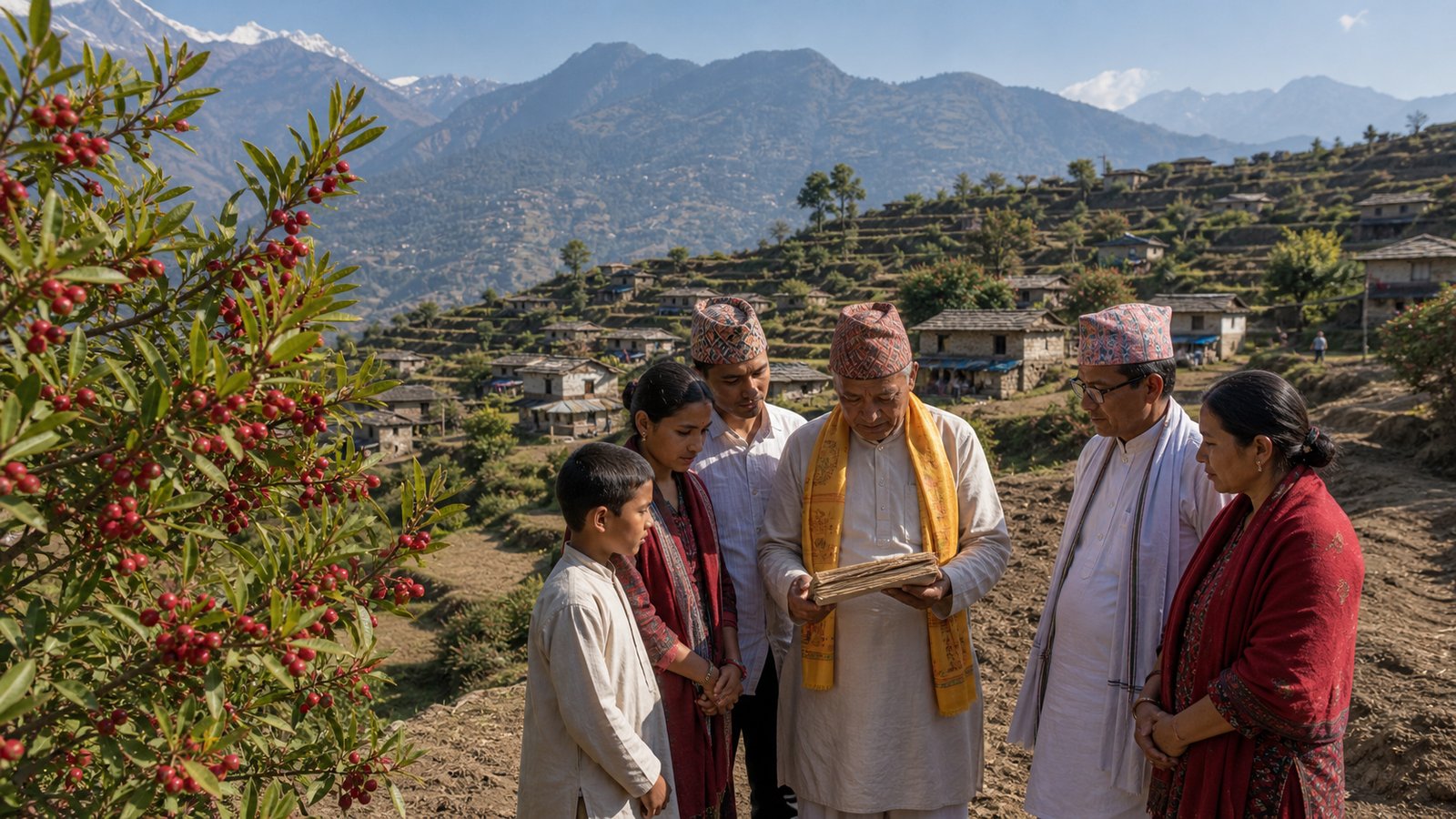
According to Kafle genealogical tradition, Shandilya-gotra ancestors entered the hill region of Nepal and settled in places where kafal trees, kafal forests, kafal slopes, or kafal-seri fields were found. They cleared the forest, dug khoriya fields, began cultivation, raised cattle, and made those hills their home.
Over time, the people living in those kafal-linked settlements came to be known as Kafle.
In simple form, the memory is this:
kafal place → kafale → Kafle
This kind of surname formation is very common in Nepal. A family that lived in a certain village, hill, field, or region often became known by that place. Over generations, a descriptive word became a formal surname.
There is another interpretation that connects the word with the phrase "ka phal," meaning one who performs work without expectation of fruit. That is a spiritually meaningful explanation, and it appears in some discussions. But the more widely accepted explanation treats Kafle as a surname born from settlement in a kafal forest or kafal region.
This makes the Kafle surname deeply Nepali. The source traditions themselves note that while Shandilya lineages are found beyond Nepal, the surname "Kafle" does not appear as an old surname outside the Nepali context in the same way suggesting the gotra may be ancient and broad, but the surname Kafle formed in the hills of Nepal.
Where exactly did the Kafle surname begin?
The sources do not give one uncontested answer. Different traditions mention Sinja/Jumla, Dailekh, Jajarkot, Palpa, Syangja, Tanahun, and other places. But one line of research gives special attention to Bajhang and the old Sinja region.
Because several place names there seem to echo the early Kafle memory:
Kafalseri
Shandil Kot
Shandeli Gad
Shandeli Triveni
These names connect three important clues at once: kafal, Shandilya, and an old western hill settlement zone. The sources also point out that when the Kafle surname was beginning, Bajhang could have been understood within the wider influence of the powerful Sinja kingdom. So even if a tradition says "Sinja," the actual early settlement may still have been in a larger western region that included parts of present-day Bajhang.
This is why Kafle sources suggest that future research should focus especially on Bajhang and Jumla. Other regions are important in Kafle migration history, but Bajhang-Sinja-Jumla appears to be the most promising zone for the earliest formation of the surname.
The Kafle genealogical material connects the arrival of Shandilya-gotra ancestors in Nepal with a wider historical movement around the middle of the thirteenth century of the Bikram Sambat calendar.
Around B.S. 1249–1250 (1192 CE), Sultan Shahabuddin Ghori's victory over the region of Kannauj and the death of Prithviraj Chauhan are remembered in many historical traditions as a major turning point. In the aftermath, many Hindu families, scholars, priests, and householders moved away from areas affected by violence, pressure, and religious disruption.
According to Kafle tradition, some of these displaced groups crossed the Mahakali and entered Nepal. They found shelter within the powerful Sinja kingdom, associated in the source with King Ashok Malla.
Among these migrating groups were Shandilya-gotra Brahmins. The tradition suggests that early ancestors such as Kalidas, Bhujang, or Padmaksha may have been among the first Shandilya-line figures to settle along the western hill route. They may have cleared kafal forest somewhere between Bajhang and Jumla and formed the early settlement from which the Kafle surname grew.
We should be cautious here. The exact names and sequence cannot be proven with complete certainty from the surviving evidence. But the general pattern is meaningful:
western entry → Sinja shelter → kafal-region settlement → Kafle identity
That is the broad migration memory carried by the lineage.
After the early western settlement, Kafle families did not remain in one place. Like many hill lineages, they moved gradually as families grew, land became limited, and new opportunities opened.
The source tradition describes movement through Sinja/Jumla, Kalikot, Achham, Humla, Dailekh, Gulmi, Parbat, Palpa, Syangja, Kaski, Tanahun, and eventually Kathmandu and the eastern districts of Nepal.
Some memories are especially important:
By around B.S. 1600, Kafle families appear to have already reached Palpa, according to local oral memories connected with land grants. Later records mention Govindamani Kafle receiving birta in Palpa during the period of King Gandharva Sen.
Around B.S. 1650, two brothers, Somdatt and Devdatt, are remembered as having reached Kantipur. King Shiva Singh Malla is said to have invited them and accepted them as royal priests, granting them land in the Kanpur-Khaldebesi area of present-day Kavre. Somdatt and Devdatt therefore become very important figures for the Kafle lines connected with Kathmandu, Kavre, Dolakha, and eastern Nepal.
The tradition says Devdatt's line did not continue, while Somdatt's descendants spread widely. Somdatt later received another birta in Bhirkot of Dolakha after the conquest of Dolakha. From these branches, Kafle families expanded into Kavre, Sindhupalchok, Bhaktapur, Kathmandu's Jhor Mahankal area, and beyond.
Around B.S. 1680, Somdatt's great-grandson Vasudev Kafle is said to have received birta in Salu, Ramechhap making him an important figure in the eastward expansion of Kafle families.
Around B.S. 1820–1850, some Kafle families moved from Jumla toward Syangja, Tanahun, and Kaski. Some branches are also connected with Gorkha service during the time of Prithvi Narayan Shah.
In other words, the Kafle surname began as a western hill identity, but it became a Nepal-wide surname through centuries of migration.
One of the most distinctive parts of Kafle tradition is the distinction between Saji Kafle and Basi Kafle.
This distinction is often misunderstood. It is not a separate caste. It is not a separate gotra. It does not mean that one group is higher and the other is lower.
The source tradition says the practical difference is narrow and ritual-based. It is connected especially with what happens when a cow gives birth. Until the cow is ritually purified, the handling of milk and milk products differs:
Saji Kafle are associated with eating the milk products fresh.
Basi Kafle are associated with keeping or eating them after they have become basi next-day/stale in the ritual sense.
The source itself says that beyond this milk-related practice, there is no major practical difference between Saji and Basi Kafle.
There are oral legends explaining how this began. One story tells of two brothers, Dharmapani and Shulpani. A cow calved in the goth, and bigauti the first thick milk after calving was prepared. Dharmapani ate it in the evening, while Shulpani ate it the next morning. From that memory, Dharmapani's descendants came to be called Saji and Shulpani's descendants Basi.
Another legend connects the Basi Kafle practice with a siddha or ascetic figure and the ritual of goth-dhup the worship connected with the cattle shed and the cow.
The important point is this: Saji and Basi Kafle are branches within the same broad Kafle identity. The distinction preserves a ritual habit around cattle, milk, purification, and goth worship. It should not be treated as a social division of superiority.
Kafle tradition remembers the ancestors not only as priests and scholars, but also as gocharak and agricultural people: cattle-keeping farmers who treated the cow as sacred and useful.
This fits the story of the surname itself. The early Kafle ancestors are remembered as clearing kafal forest, cultivating fields, keeping cows, and preserving Vedic ritual life in the hills. Milk, curd, ghee, cow dung, the cattle shed, and the yearly rhythm of worship all appear in the tradition.
The practice of goth-dhup is especially meaningful. In many Kafle and related hill traditions, the cattle shed is not merely a place for animals. It is tied to prosperity, purity, livelihood, and family continuity. Some traditions speak of goth worship during Udhauli and Ubhauli seasons, while Basi Kafle branches in eastern Nepal are remembered as performing a shorter goth-dhup ritual especially when the cow gives birth and the calf is named.
This is why the Saji-Basi distinction should be understood inside a cattle-centered ritual world. It is not just about food. It is about how a family preserved sacred order around birth, milk, the cow, and the household.
Most Kafle families identify as Shandilya gotra. However, the sources also mention that a small number of Kafle families from Armadi and Samadi of Syangja, and some families who later moved toward Bhairahawa and Butwal, have used Savarni gotra. The source does not present this as fully settled it treats it as a matter that needs careful research.
Several points are important:
Shandilya is the dominant and widely accepted Kafle gotra
The traditional Kafle lineage connects Shandilya with Kashyapa, Asita, and Devala
The tripravara Asita, Devala, Shandilya is widely discussed as appropriate for Shandilya-gotra Kafles
Some branches have used different pravara forms because of local priestly practice or inherited custom
The Savarni usage appears in a few local branches and remains a subject for study
This is a good reminder that genealogical history is not always perfectly uniform. Families migrate. Priests change. Local customs develop. The task of banshawali work is not to erase those differences, but to understand them carefully.
Kafle sources also mention several related or sagotri connections.
Because the Kafle lineage is understood through Shandilya and the wider Kashyapa-descended tradition, names such as Adhikari, Ghimire, Tripathi, and Prasai appear in discussions of related lineages in some contexts.
The Kafle material also mentions possible connections or branches involving Mahat, Prasai, Mankoti, Bista, Joshi, Chandane, Thalal, Shukla, Mishra, Jha, and Tripathi. Some of these are treated as sagotri. Some are discussed as branches or historically related groups. The text also mentions names such as Kafle Raul, Kafolya Bista, and Kafallak.
These connections should be handled with care. A shared gotra does not automatically prove a close blood relationship in the modern sense, and a similar tradition does not always mean a direct branch. But these names show that Kafle history sits inside a wider web of hill Brahmin migration, ritual identity, and local surname formation.
The Kafle lineage is fortunate that many people worked to preserve its records.
Kafle banshawali collection is remembered as beginning in an organized way around B.S. 1977 through a five-person mandali that included Govinda Giri Swami (also remembered as Suryaprasad Kafle), along with Pandit Chudamani Kafle, Ditha Bhojraj Kafle, Mukhiya Kashiraj Kafle, and Pandit Sadananda Kafle. Later, many others continued the work, including Tanka Nath Kafle, Gopal Prasad Kafle, Devi Prasad Kafle, Shiv Prasad Kafle, and several regional contributors.
This matters because a surname history does not survive by itself. Someone has to ask the elders. Someone has to copy the old notebook. Someone has to compare village memories. Someone has to preserve the names before they disappear.
The Kafle story has reached us because generations of family researchers did that work. But the work is not finished. Many links remain uncertain: exact early places, old migration paths, local branches, Saji-Basi origins, Savarni usage, and scattered family records. That means today's Kafle families still have a role to play.
The word banshawali comes from "vansha" and "awali": a sequential record of a lineage.
It is more than a list of names. A banshawali preserves the original ancestor remembered by the family, gotra and pravara, migration routes, villages and settlements, branches of brothers and cousins, kul devata and ritual practices, marriages and kinship links, and stories that explain how the family became what it is.
Without such records, a family can forget its own map. After a few generations of migration, even the name of an ancestral village can disappear. That is why banshawali is not only about the past. It is a gift to the future.
The story of the Kafle surname does not end with Shandilya, kafal forests, Bajhang, Sinja, Somdatt, Devdatt, Saji, or Basi. Every Kafle family has its own branch. Every branch has its own village, migration path, and memory.
In the past, genealogies were preserved in handwritten ledgers, family notebooks, and oral recitation. Many were lost to time, rain, fire, insects, migration, and neglect. Today, we have a better way to protect them: digital preservation.
Take Action: Share this article with your family members, especially elders who still remember old village names, branch names, and rituals. The next missing link in Kafle history may be sitting in your own home.
At Bamsawali, we are working to make family history easier to preserve, organize, and share. A digital family tree can help children and grandchildren even those growing up far from Nepal understand where their family came from and how they are connected.
Your surname carries a story. Let us write that story together.
The most widely accepted explanation is that Kafle is a place-based Nepali surname. Shandilya-gotra ancestors are believed to have settled in kafal forests, kafal slopes, or kafal-seri areas, cleared land for cultivation, and gradually came to be known as Kafle.
Most Kafle families identify as Shandilya gotra. The lineage is traditionally connected with Kashyapa, Asita, Devala, and Shandilya. The tripravara is remembered as Asita, Devala, and Shandilya. Some local branches near Syangja have preserved Savarni usage, but this remains a matter of further research.
Saji and Basi Kafle are not separate castes or separate gotras. The distinction is mainly ritual and is connected with milk practices when a cow gives birth. Saji is associated with fresh use of milk products, while Basi is associated with keeping or eating them as basi in that ritual context. Both are branches within the same broad Kafle identity.
Some Kafle sources discuss a possible connection between Kafle and Prasai through older family branches, and Prasai is also mentioned in wider Kashyapa/Shandilya-related discussions. This should be treated as a genealogical tradition that needs careful branch-level verification.
Important places include Bajhang, Sinja/Jumla, Kalikot, Dailekh, Palpa, Syangja, Tanahun, Kavre, Kathmandu, Dolakha, Bhirkot, and Salu of Ramechhap. Bajhang and the old Sinja region are especially important for research into the earliest formation of the surname.
Preserving banshawali helps Kafle families protect their ancestor names, gotra, pravara, migration history, Saji-Basi practices, kul traditions, and branch connections. It also helps future generations understand their place in a long family story.
While the Shandilya gotra is found across South Asia, the specific surname "Kafle" is understood to have formed inside Nepal making it a distinctly Nepali surname rooted in the kafal forests of the western hills.
See its gotra, kuldevata, origin and the other surnames that share its gotra.
Surname History
23 June 2026 · 11 min read
Surname History
18 June 2026 · 11 min read
Surname History
17 June 2026 · 13 min read
Surname History
17 June 2026 · 14 min read
Gotra
22 July 2026 · 13 min read
Gotra
21 July 2026 · 9 min read