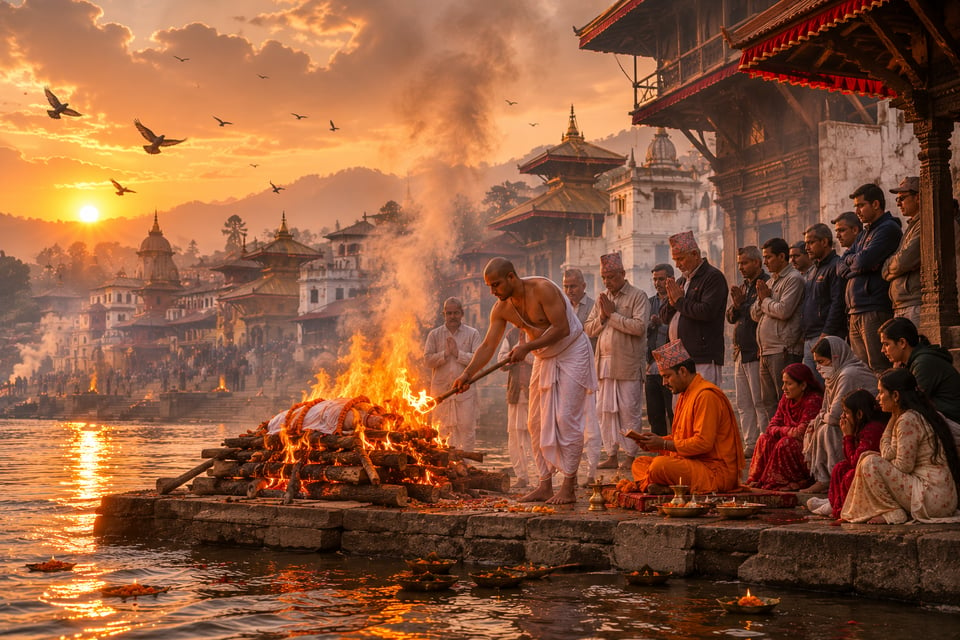
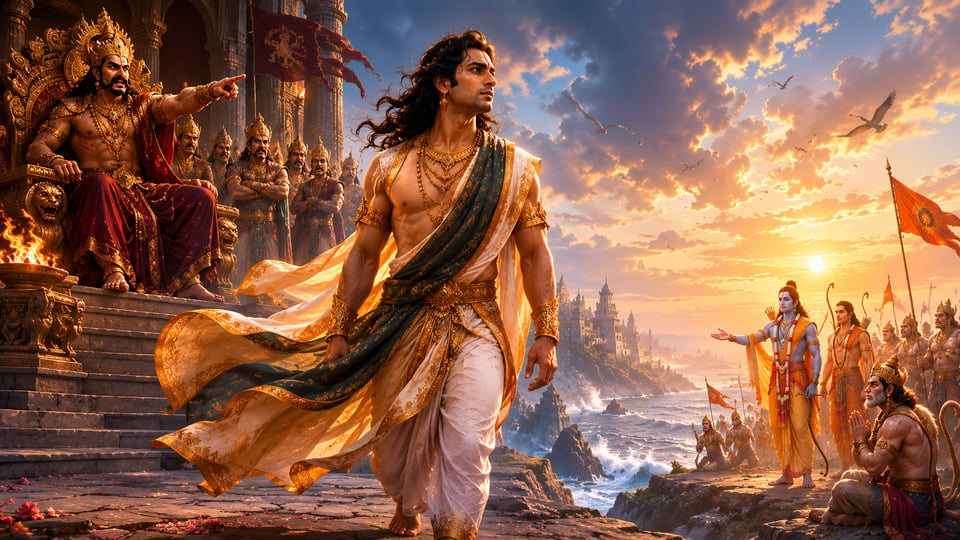
Sent to Death in his father's anger, Nachiketa waited three nights and asked what happens after death. Yama offered wealth; the child kept the harder question.
26 June 2026 · 12 min read
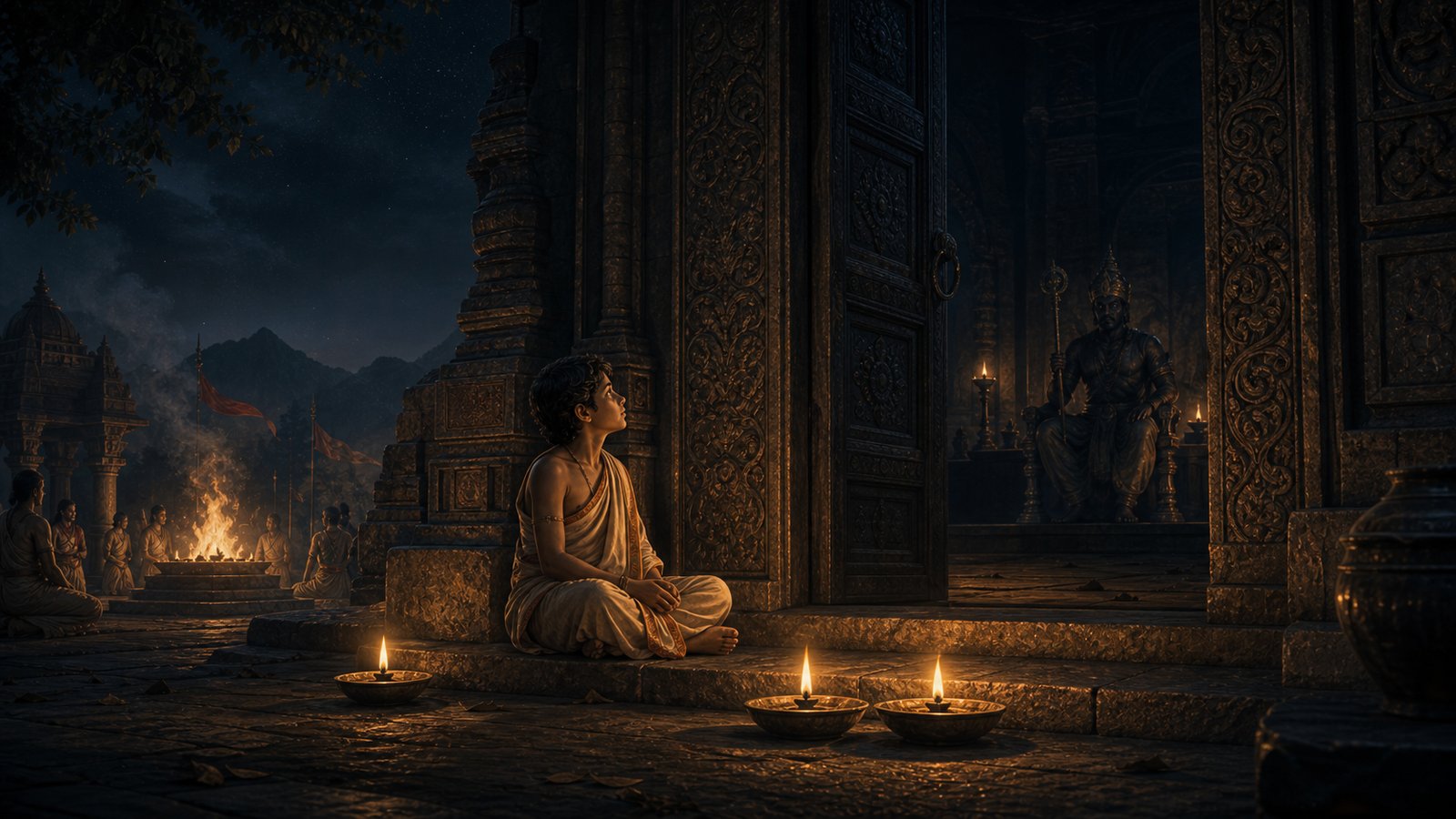
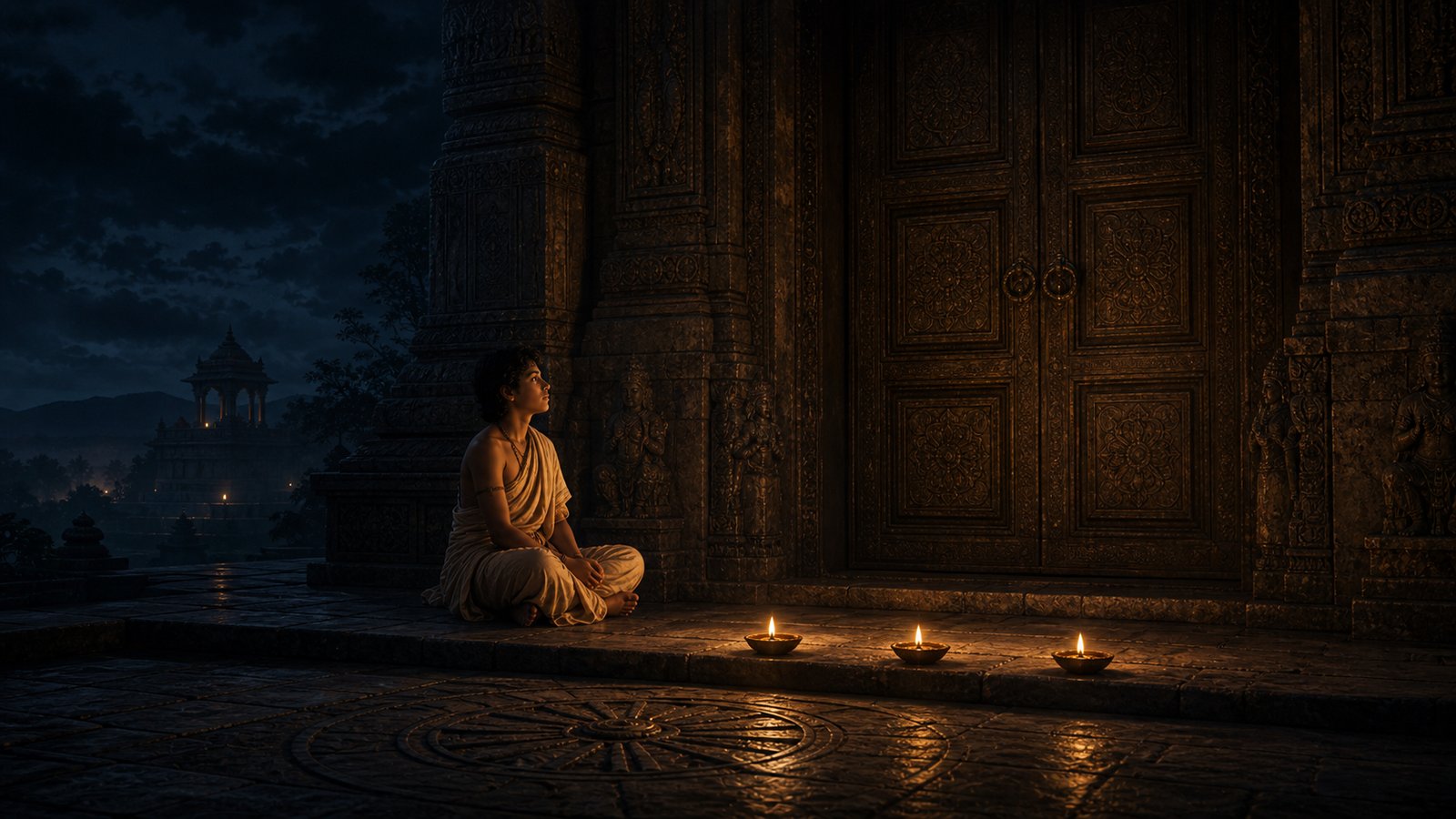
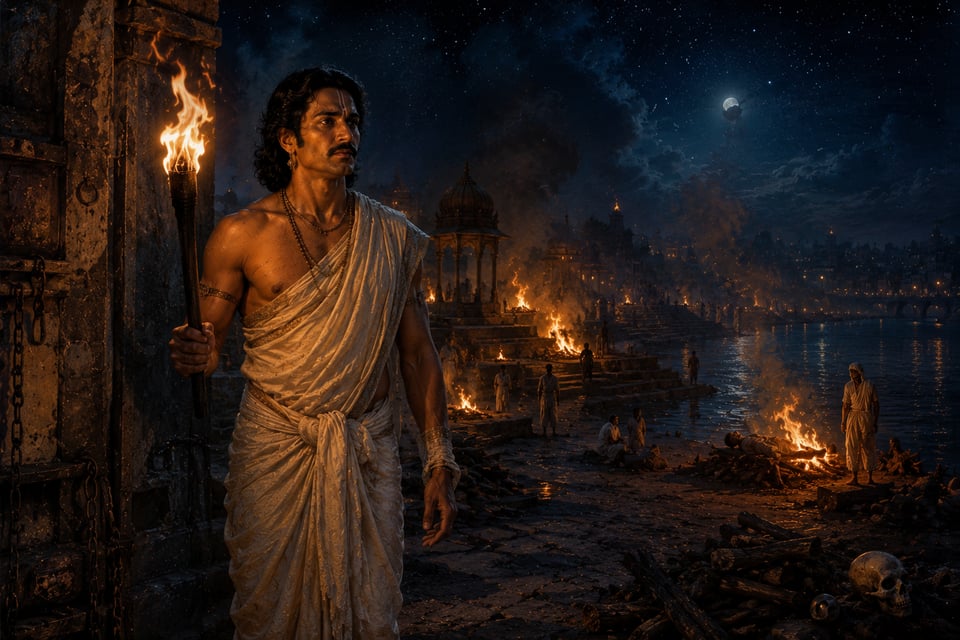
No one welcomed Nachiketa when he reached the house of Death.
He had come because his father, angry at being questioned, had said, "I give you to Yama." Whether the sentence was an impulsive curse, a ritual declaration, or both, the boy treated words as if they carried weight.
Yama was away. Nachiketa waited without food or hospitality for one night, then two, then three.
When Death returned, he did not find a frightened child asking to go home. He found a guest with three questions—and a final question no treasure could persuade him to abandon.
The Katha Upanishad begins with Vajasravasa performing a sacrifice in which all possessions are to be given away. The public act appears grand. Gifts move before priests and observers. Religious merit is at stake.
Nachiketa watches the cows being offered.
They are old. They have drunk their last water, eaten their last grass, given their last milk, and lost the strength to bear calves. The gifts satisfy the outer shape of generosity while withholding what has living value.
The boy feels concern—not merely embarrassment. A sacrifice creates obligations, and gifts that are useless to their recipients may lead the giver away from the good he seeks. The child sees a contradiction adults around him have normalized.
He asks his father, "To whom will you give me?"
At first the question may sound strange. If everything is being given, where does the son stand within the father's possession and duty? It may also be an escalating challenge: if generosity is genuine, what precious thing will the giver release?
Vajasravasa does not answer. Nachiketa asks again. Then again.
The third repetition breaks the father's restraint. In anger he says, "I give you to Death."
The sacrifice meant to display control has exposed a household where a child's truthful question can provoke a devastating sentence.
Nachiketa does not respond like a reckless child eager to die. He reflects.
He considers his place among his father's students or sons: perhaps first among many, perhaps in the middle, but not worthless. What purpose can his father serve by giving him to Yama? He thinks of generations like grain—people ripen, die, and arise again.
The imagery places his family quarrel inside mortality. The father spoke Death's name in anger; the son asks what that word actually means.
Some readers understand the journey to Yama literally within the sacred narrative. Others attend to its initiatory or philosophical dimensions. The Upanishad does not need to be flattened into a modern realistic event to retain its force. A boy crosses from household conflict into the dwelling of the reality adults most avoid discussing.
Before leaving, later interpretive traditions often imagine efforts at reconciliation, but the baseline text moves with severe economy. The father's word stands. Nachiketa goes.
That economy makes the anger frightening. Adults sometimes speak as if words vanish after the room cools. For a child, one sentence can become architecture. "You are a burden." "You are no son of mine." "I wish you had never been born." The adult may remember a bad evening. The child may build an identity around it.
The Upanishad does not turn Vajasravasa into a monster. It shows a respected ritual actor failing in the intimate discipline his sacrifice should embody.
Nachiketa carries that failure to Death's door.
Hospitality is a sacred obligation. A guest, especially a Brahmin guest in the text's ritual world, is compared to fire entering a house. To leave such a guest unfed brings danger to the host's hopes, merits, relationships, and prosperity.
Yama is absent when Nachiketa arrives. No one receives the boy. He waits for three nights.
The text says little about those nights, and that silence is powerful. There is no feast, parent, teacher, or distraction. The child sits at the threshold of Death with the question opened by his father's anger.
What does he fear during the first night? Does confidence weaken during the second? By the third, has waiting become its own instruction? The Upanishad does not tell us, so a responsible retelling should not fabricate certainty. It gives us the image and lets the threshold work.
When Yama returns, members of his household warn him that an honored guest has waited unfed. Yama approaches Nachiketa with respect and offers three boons, one for each night.
The neglected child is suddenly placed in the position of choosing.
He does not begin with wealth or revenge. His first request turns back toward the father whose anger sent him there.
Nachiketa asks that Vajasravasa's anger be calmed, that his father recognize him, sleep without anxiety, and welcome him lovingly when he returns from Death.
The request is precise. He does not ask Yama to punish his father or prove the boy right before the community. He asks for the relationship to become habitable again.
Yama grants it. The father will know him and be freed from anger; the son can return without remaining trapped inside the sentence that expelled him.
This is not permission to minimize parental harm. Reconciliation is meaningful because the harm was real. Nor does the text require every child to return to an unsafe home. Nachiketa's sacred story moves toward restored recognition; modern safety cannot be decided by analogy.
Within the narrative, the first boon reveals his order of concern. Before asking about heaven or death, he repairs the human bond left behind. A philosophical seeker is still a son.
The request also answers his father's ritual failure. Vajasravasa was giving away exhausted cows while rage endangered his living child. Nachiketa asks for a gift with actual value: anger transformed into recognition.
When he returns, he wants his father not merely to see a body that survived. He wants to be known again.
The first boon opens the door home. The next opens a path beyond ordinary hunger and fear.
For his second boon, Nachiketa asks to know the sacrificial fire leading to heaven, a realm described as beyond fear, hunger, thirst, old age, and sorrow.
Yama is pleased. He teaches the construction and knowledge of the fire sacrifice, including its arrangement. Nachiketa understands and repeats the teaching accurately.
Yama honors him by naming the fire after him: the Nachiketa fire.
This episode can feel distant to readers unfamiliar with Vedic ritual, but dramatically it shows the child's capacity. He is not brave merely because he arrived. He can listen, remember, and master complex instruction. Yama recognizes him as a serious student.
The second boon also moves from a single household toward cosmic order. The first heals father and son. The second teaches a disciplined path toward a death-transcending good understood through the text's ritual language.
Yet Nachiketa is not satisfied.
He has one boon left, and it concerns the disagreement beneath every funeral. Some say a person continues after death; others say the person does not. What is true?
The question is direct. Yama, who answered the first two requests readily, hesitates.
The lord of Death tells the boy that even the gods once doubted about this. The matter is subtle and difficult. Choose another boon.
The teacher's reluctance reveals the scale of the question.
Yama does not merely refuse. He offers alternatives.
Ask for sons and grandsons who live a hundred years. Ask for cattle, elephants, gold, horses, and vast land. Ask for long life. Become a king. Choose pleasures difficult for mortals to obtain. Accept chariots, music, and beautiful attendants. Take everything that makes ordinary life desirable.
Only do not ask what follows death.
The offer is not cartoon temptation. These are genuine goods: family continuity, security, pleasure, status, and time. Many prayers ask for exactly these things. Yama places before Nachiketa the entire architecture of a successful mortal life.
The boy looks at the gifts from the perspective of the question they are meant to replace.
Pleasures wear out the senses. Wealth does not satisfy a human being permanently. Even the longest life remains short before Death. Chariots and songs may stay with Yama. If Nachiketa accepts them, he will possess more things inside mortality while still not knowing what mortality means.
He refuses.
This is the story's turn. Courage is not only waiting at the door. It is recognizing when an impressive answer does not answer the question asked.
Children are often redirected this way in gentler forms. "Don't think about death." "You will understand when older." "Study hard and enjoy life." Sometimes redirection protects a child from information they are not ready to carry. Sometimes it protects adults from admitting their own uncertainty.
Nachiketa demonstrates readiness by refusing distraction without contempt for life.
Yama accepts him as a worthy student and begins by distinguishing shreyas from preyas.
Both approach the human being. Preyas is the pleasant—the immediately attractive, comfortable, gratifying choice. Shreyas is the better or truly beneficial, which may be difficult and demand discernment. The wise examine and choose the better; the unwise, attached to gain and security, choose the pleasant.
The contrast should not be flattened into "all pleasure is bad." The Upanishadic teaching concerns orientation. A pleasant thing can be harmless or good. The danger is allowing immediate desire to decide every question, especially questions about what is lasting.
Nachiketa has enacted the distinction before receiving its name. Old cows allowed his father to preserve valuable possessions while appearing generous: pleasant advantage disguised as sacred good. Anger allowed the father to silence discomfort. Yama's treasures offered Nachiketa a magnificent escape from inquiry.
Each time, the easier surface competed with the harder truth.
The boy chooses the better not because he hates the world, but because he wants to know what wealth cannot secure. Yama leads him toward teachings about the Self, the relation of senses, mind, intellect, and the deepest reality, and the path beyond death.
Interpretations vary across Vedanta traditions and scholarship. A short article cannot pretend to settle every metaphysical question the Katha Upanishad has generated. Its narrative clarity remains: a student must learn to distinguish a satisfying diversion from an answer that transforms understanding.
The question at Death's door becomes a discipline of attention.
One of the Upanishad's memorable images compares the body to a chariot, the Self to its lord, intellect to the charioteer, mind to the reins, senses to horses, and sense objects to roads.
The image does not appear as a productivity trick. It describes the need for integration. Horses without trained direction scatter. Reins without a discerning driver cannot choose the path. A person whose senses, mind, and understanding are undisciplined does not reach the highest goal.
For Nachiketa, the metaphor answers the deeper version of his father's failure. Vajasravasa performs a great sacrifice but loses the reins when challenged. Public ritual and inner governance have separated.
Nachiketa, by contrast, waits, asks, learns, and declines seduction. His chariot is not emotionless. He wants reconciliation with his father and asks about freedom from sorrow. Discipline means desire is examined, not erased.
The chariot also returns us to the gifts Yama offered. Literal chariots were among the pleasures. Nachiketa rejects those and receives a chariot of understanding.
That reversal is characteristic of the Upanishad. The boy asks Death about what survives possession. The teacher uses ordinary images—fire, seed, chariot, path—to point beyond ordinary measurement.
Modern reflection should stop before turning the Self into a family-memory metaphor. Preserving names does not grant immortality in the Upanishadic sense. A remembered story and the doctrine of Atman belong to different levels.
Still, the family scene matters. The highest teaching begins because a child notices that a sacred act at home has become hollow.
Nachiketa's journey is often remembered as a brave boy meeting Death, but the first and last human threshold is his father's house.
He leaves because Vajasravasa cannot tolerate the question. He uses his first boon to make return possible. The philosophical ascent does not erase the domestic wound; it passes through its repair.
This gives the story a difficult tenderness. A parent can perform respected religious acts and still fail a child in anger. A child can recognize that failure without becoming defined only by accusation. Reconciliation may require the parent's heat to cool and the child's identity to be received again.
It also shows why youth questions matter. Nachiketa is not right merely because he is young, and adults are not wrong merely because they are adults. His question has force because he observes carefully and persists. Yama tests him rather than flattering him. Respect for a child's voice includes taking it seriously enough to answer rigorously.
Families often preserve dates of birth and death while avoiding what people believed about living and dying. What did grandmother fear? What did grandfather think made a life good? Did a parent want elaborate rites, quiet remembrance, charity, or reconciliation? Which questions remained unresolved?
Nachiketa eventually receives Yama's teaching and, the Upanishad says, attains the knowledge that frees him from the bonds of death. He also returns to a father prepared to welcome him.
But the image that lingers is earlier: a child waiting at a closed door.
The first night tests whether he will flee. The second deepens the silence. By the third, waiting itself has made him impossible to dismiss. When Yama arrives, the boy has earned boons through a hospitality failure, but he uses them to ask what matters.
His story is not an invitation for children to seek danger or romanticize a parent's curse. It is a challenge to adults who prefer ceremonial goodness to honest response. If a child sees the exhausted cows, will the household answer the question or send the child away with anger?
Nachiketa does not defeat Death. He becomes Death's student. That may be the more radical courage. He does not demand comforting assurance; he asks for truth difficult even for gods.
Yama offers him a whole lifetime of pleasant distractions. Nachiketa looks past them toward the unanswered thing.
Three nights at the door become three boons. The first heals a relationship. The second teaches disciplined ascent. The third opens the question of who we are when possessions, praise, and even the body can no longer answer for us.
The door closes behind every generation eventually. Before it does, families can decide whether their deepest questions will be silenced, decorated, or spoken.
Katha Upanishad 1.1–1.3 and 2.1–2.3, using Max Müller's public-domain translation for citation.
Modern scholarly translations, including Patrick Olivelle, for cross-checking terms and structure without extended quotation.
Gotra
22 July 2026 · 13 min read
Gotra
21 July 2026 · 9 min read
Mythological
20 July 2026 · 5 min read
Mythological
15 July 2026 · 6 min read
Mythological
14 July 2026 · 4 min read
Mythological
13 July 2026 · 6 min read