Karna's hidden birth tied him to Kunti, Surya, Radha, Adhiratha, and Duryodhana. When the truth emerged, it could not erase a lifetime of love and loyalty.
26 June 2026 · 12 min read

On the eve of a war that would kill nearly everyone he loved, Karna learned that the enemies he had sworn to defeat were his younger brothers.
The truth came first from Krishna, then from Kunti herself. It was the truth of his birth but not the whole truth of his life. Kunti had borne him. Surya was named in his divine birth story. Radha and Adhiratha had raised him. Duryodhana had given him honor when a royal arena demanded pedigree before merit.
Karna's tragedy is not that one "real family" was hidden behind a false one. It is that several real bonds were forced into conflict because the oldest truth arrived when almost no choice remained innocent.
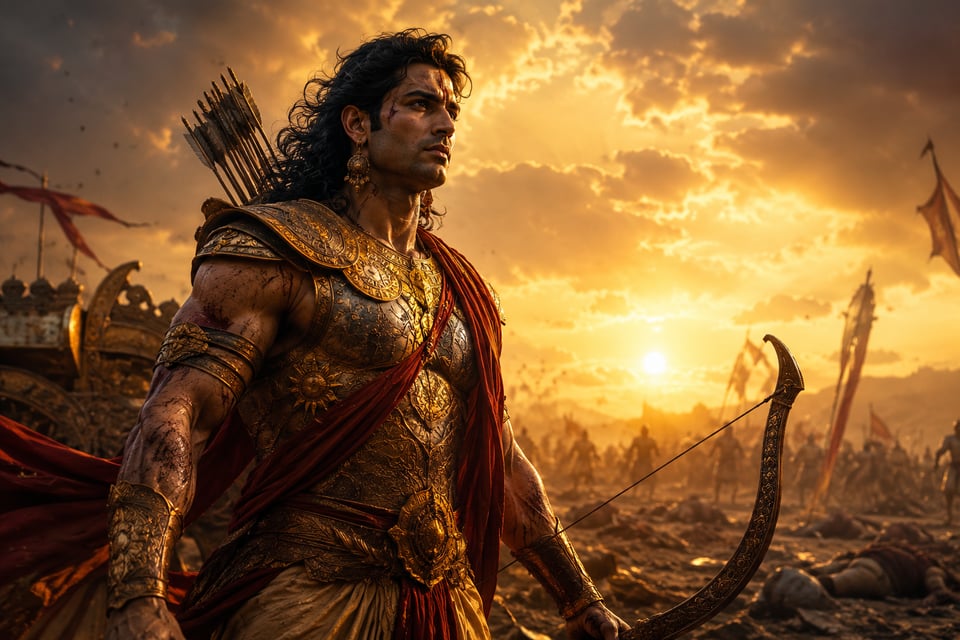
The princes have displayed their skill before teachers, elders, and the people of Hastinapura. Arjuna stands at the center of admiration when an unknown warrior enters and repeats his feats. Karna's armor catches the light. His earrings mark him as extraordinary. His confidence turns the exhibition into a challenge.
Then Kripa asks the question that changes everything: name your lineage.
The demand is not idle curiosity. In the arena's social order, birth determines whether Karna may formally challenge a prince. His body has already shown skill; the court asks for ancestry before it will recognize equality. Karna lowers his head because the answer available to him son of the charioteer Adhiratha will be used to close the contest.
Bhima does exactly that, insulting him through the occupation of the family that raised him. The blow is public. Karna has arrived to test weapons and is instead made to defend his right to stand among warriors.
Duryodhana responds with a political act. If rank is the obstacle, he will create rank. He crowns Karna king of Anga. The gesture is generous, strategic, defiant, and binding all at once. Duryodhana gains a formidable ally; Karna receives the recognition denied by the court. Gratitude hardens into loyalty.
Then Adhiratha enters. Karna bows to him with the tenderness of a son. The newly crowned king does not hide the man who raised him, even when that relationship is being used to shame him.
The arena contains the whole tragedy in miniature: ability, stigma, friendship, ambition, foster love, and a birth secret silently watching from the royal seats. Kunti sees the son she abandoned, recognizes the signs, and faints. She does not speak.
The Adi Parva tells of young Kunti serving the irascible sage Durvasa and receiving a mantra by which she could summon a deity. Curious about its power, she invokes Surya. The encounter leads to the birth of a child already bearing armor and earrings.
Retellings differ in tone and theological emphasis, and modern readers rightly feel the difficulty of the episode. Kunti is unmarried in a world where pregnancy could bring devastating shame. She fears her father's household, public judgment, and the collapse of her future. The divine assurance surrounding the event does not remove the social danger she perceives.
She places the infant in a protected basket and sets him upon the river.
The image is often told quickly, as if it were only the first movement of a hero's destiny. It should hurt. A newborn is separated from the mother who has no safe language for his existence. A young woman survives by making a choice that will haunt several generations. Neither the baby's future greatness nor the mother's later grief makes the abandonment painless.
Adhiratha, a charioteer associated with the royal household, and his wife Radha find the child and raise him. Radha's name becomes so deeply joined to his identity that Karna is often called Radheya. That name is not a disguise covering the "real" mother. It is evidence of lived motherhood—feeding, protecting, naming, worrying, and belonging through ordinary years the epic cannot narrate one by one.
Karna grows without knowledge of Kunti's secret. The absence is not empty. It is filled by another household.
Stories about hidden birth often create a cheap hierarchy. The birth parent is treated as truth; the parents who raised the child become a preliminary chapter to be discarded once the revelation arrives.
Karna refuses that hierarchy.
When Krishna later tells him that he is Kunti's firstborn and therefore the eldest Pandava, Karna does not suddenly reinterpret his childhood as fraud. He speaks of Adhiratha as father and Radha as mother. He remembers the bodily intimacy of care, the rites performed for him, the marriage and social world arranged around him, and the obligations formed across a lifetime.
His response matters because biology answers one question who gave birth but cannot answer every question of parenthood. Who held the feverish child? Who taught him the household's ways? Who endured insult with him? Whose old age does he feel bound to protect? Which name shaped his earliest sense of being wanted?
Radha and Adhiratha do not need to be made noble by pretending birth is irrelevant. Kunti's relationship is real, painful, and consequential. Surya's place in the epic's divine account is real within that narrative world. The point is not to choose one and erase the others. Karna stands at the crossing of birth, divine origin, nurture, caste location, friendship, marriage, and political allegiance.
The arena proves where his emotional reflex lies. When Adhiratha appears, Karna bows. He does not calculate whether acknowledging a charioteer will weaken his new crown.
That gesture is one of the clearest answers the epic gives: love that raised a child is not cancelled by a secret carried elsewhere.
Karna's loyalty to Duryodhana is often explained as blind friendship or moral weakness. It is more dangerous than that because it grows from a genuine act of recognition.
At the arena, Duryodhana does not ask Karna to prove a royal father before treating him as a warrior. He sees talent and gives it public standing. For a man whose ambitions have repeatedly collided with stigma, that moment is not a minor favor. It is the day someone powerful says, in front of everyone, that Karna belongs.
But gifts can create chains.
Duryodhana's cause is increasingly shaped by envy, the humiliation of the Pandavas, the dice game, and refusal to restore their share. Karna becomes one of his fiercest defenders. In the dice hall, he speaks with cruelty toward Draupadi. His own experience of public shaming does not automatically make him compassionate toward another person under attack.
That contradiction prevents the story from becoming sentimental. The wounded are not always just. A person can suffer exclusion and later help exclude someone else. Gratitude can be honorable while the actions performed in its name become destructive.
Karna knows Duryodhana's trust has transformed his life. Leaving him just before war would feel like using friendship until a more prestigious family appeared. Yet remaining means fighting for a side whose wrongs he cannot entirely deny.
The secret of his birth intensifies this trap. Had he known earlier, before the arena, before Anga, before the dice hall, before oaths and insults accumulated, another life might have been imaginable. By the time truth arrives, it competes with decades of enacted relationship.
Timing does not change whether a fact is true. It changes what the truth can repair.
After the peace mission fails, Krishna takes Karna aside. The conversation in the Udyoga Parva is intimate and strategic. Krishna tells him that Kunti is his mother and that, by birth, he is the eldest of the Pandavas.
He offers a transformed future. Karna can cross to the Pandava side. Yudhishthira and the brothers will honor him. Kingship can be his. Draupadi, in the social terms of the proposal, will also accept him within the shared marriage. The man once refused a duel for lack of lineage is being offered the highest lineage and sovereignty.
The offer also rewrites the past with astonishing speed. Yesterday he was Radheya, ally of Duryodhana, rival of Arjuna. Today he is invited to become Kaunteya, Kunti's son, eldest brother, rightful king.
Karna believes Krishna's disclosure. He also refuses.
He says, in substance, that Radha and Adhiratha's claims cannot be erased. He cannot betray Duryodhana after receiving kingdom and friendship from him. He understands the likely result of war and seems to recognize that the Pandavas' side will prevail. His refusal is therefore not based on easy hope.
Krishna's purpose is peace and the weakening of a disastrous war party. Yet the timing gives the revelation an unavoidable edge: truth is also being used as leverage. Karna is not simply invited to know himself. He is asked to change sides because of what he now knows.
The offer exposes an old injustice in a new form. Karna is suddenly welcomed as worthy of the highest crown because a royal mother can now be named. The skill visible in the arena has not changed. The man has not become braver overnight. Only the pedigree hidden from him has entered the room. Accepting could therefore feel like accepting the same rule that once humiliated him: honor becomes available when society can attach a prestigious parent.
This does not make disclosure wrong. It makes motive part of the scene. A family truth revealed only when someone needs allegiance, property, forgiveness, or silence will be heard through that need.
Karna receives a birthright and a demand in the same breath.
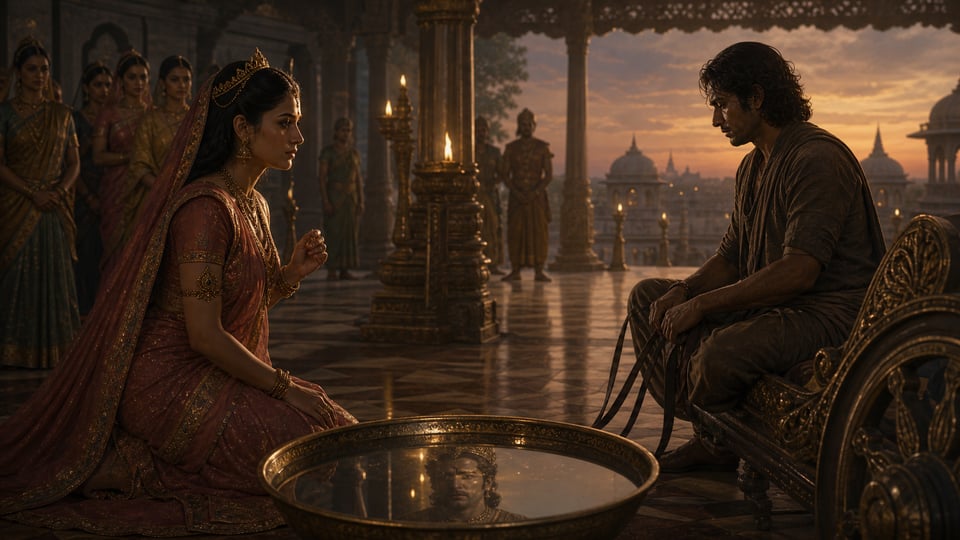
Kunti meets Karna near the river as he completes his morning worship. She waits until the sun's heat becomes severe, standing behind him, then tells him the truth herself. The mother who remained silent in the arena now speaks before battle.
Her appeal is unbearable because every side of it is human. She wants her sons to live. She wants Karna to join his brothers. She may long to recover the child she abandoned, but she also arrives when his identity can change the military balance. Love, fear, guilt, and strategy occupy the same words.
Karna's answer is not the reunion she seeks.
He accuses her, with reason, of abandoning him without the rites and protection owed to a child. He says that acknowledging him now serves her interest. He cannot return to her as though the intervening life did not happen.
Yet he does not answer only with rejection. He grants a terrible mercy. He promises not to kill any of the Pandavas except Arjuna. Kunti will still have five sons, he says in effect: either Arjuna will survive, or Karna will.
It is one of the saddest bargains in the epic. Kunti comes hoping to prevent a brother from killing brothers. She leaves with a limit placed upon the catastrophe, not its removal. Karna accepts the biological bond enough to spare four men, but not enough to abandon the friend and life that formed him.
Neither receives what a simpler story would give. There is no embrace that heals the river. No revelation restores infancy. No apology returns the years.
The sun rises upon recognition without reunion.
Hidden-parentage stories often promise liberation: once the secret is known, confusion ends. Karna's knowledge creates new clarity and deeper anguish at the same time.
He now understands Kunti's fainting in the arena, his armor and earrings, and the uncanny bond of rivalry with Arjuna. He knows that the people he has spent years opposing are linked to him by birth. But knowledge does not tell him which duty should rule.
Should he honor the mother who bore him or the mother who raised him? Should he accept elder-brother status or remain loyal to the friend who recognized him? Should he prevent war by defecting, even if the defection feels like betrayal? Can he seek justice for the stigma he suffered while acknowledging the harm he helped inflict?
The epic does not present his choice as morally pure. Karna fights for Duryodhana and dies in that cause. His generosity, courage, resentment, pride, loyalty, and cruelty coexist. The late truth explains part of his tragedy; it does not absolve every action.
Nor should Kunti be reduced to a heartless mother. She was once a frightened unmarried girl constrained by severe social danger. Later she becomes a widow protecting five sons in a hostile court. Her silence causes immense harm, but the conditions around that silence matter.
Compassion is not acquittal. We can understand why she hid the birth and still grieve what secrecy did. We can honor Karna's loyalty and still judge the side he supported. We can affirm Radha and Adhiratha's parenthood without denying Kunti's wound.
The story becomes smaller whenever one relationship is declared the only real one.
Karna dies fighting Arjuna, still publicly known as the Pandavas' enemy. Only after the war does Kunti reveal to her surviving sons that he was her firstborn.
The knowledge changes victory into another form of mourning. Yudhishthira realizes that the brother he hated and helped destroy was the eldest among them. The revelation cannot alter the battlefield. It can only alter the meaning of what has already happened.
This is the final cost of the secret: truth survives, but arrives too late to guide action. It becomes grief's evidence.
Karna's story does not demand that every private fact be announced publicly. Disclosure can involve safety, consent, maturity, and the rights of several people. Some truths require protection from gossip or exploitation. The epic is not a modern policy for adoption, donor conception, assault, or parentage.
But it does show the danger of confusing privacy with permanent erasure. A secret held by one generation can become a weapon in the next. If the affected person learns only during conflict, the revelation may feel less like belonging than recruitment.
The humane memory of Karna must therefore hold all his names without ranking away his life: Vasusena, born with armor; Radheya, son of Radha; the child raised by Adhiratha; king of Anga; friend of Duryodhana; rival of Arjuna; Kaunteya by hidden birth; elder brother recognized after death.
No single name contains him. Together they reveal why the truth hurt.
Preserve a complex parenthood story with consent, tenderness, and room for every bond in Bamsawali because discovering an origin should deepen a life, not erase the people who made that life possible.
Mahabharata, Adi Parva, for Kunti's mantra, Karna's birth, foster upbringing, and the arena episode.
Mahabharata, Udyoga Parva 140–145, for Krishna's disclosure and Kunti's meeting with Karna.
Mahabharata, Stri Parva and Shanti-related aftermath passages, for Kunti's postwar revelation and the Pandavas' grief.
Mythological
15 July 2026 · 6 min read
Mythological
13 July 2026 · 6 min read
Mythological
1 July 2026 · 12 min read
Mythological
30 June 2026 · 12 min read
Mythological
30 June 2026 · 12 min read
Mythological
26 June 2026 · 11 min read