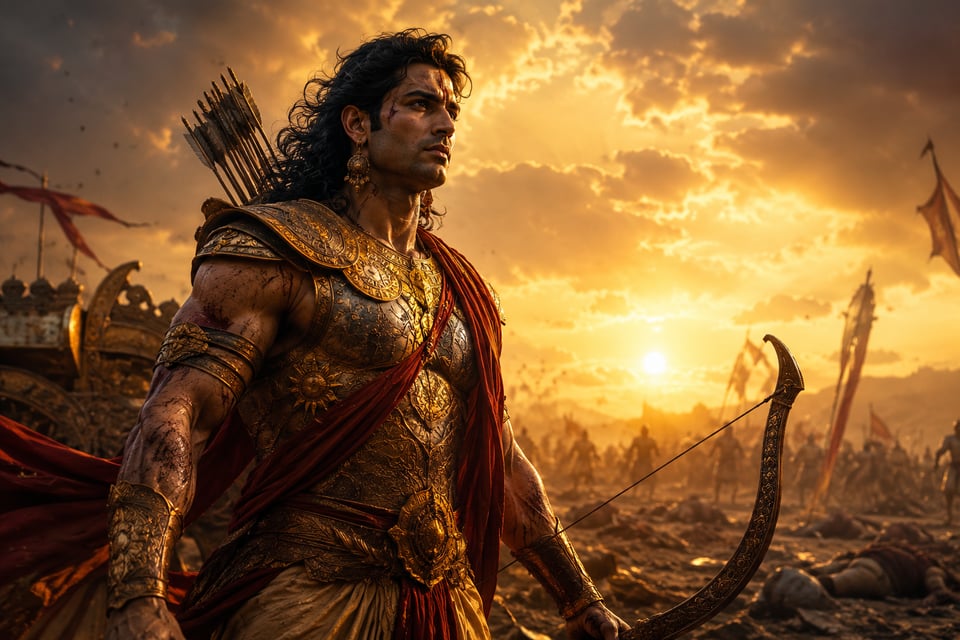
Kartikeya raced around the world while Ganesha circled his parents. But was the winner truly the wisest? A deep look at the Shiva Purana's original contest.
26 June 2026 · 12 min read

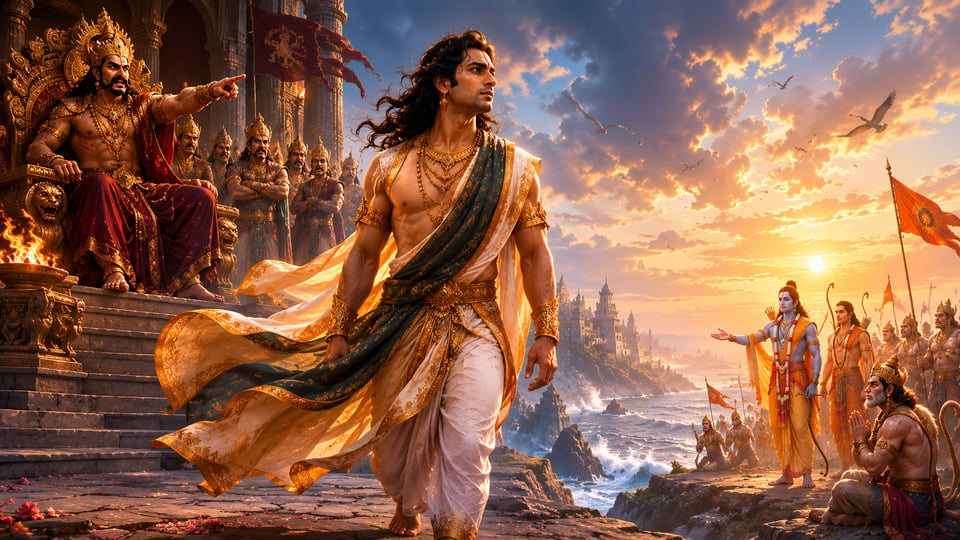
Kartikeya's peacock launched into the sky while Ganesha remained beside his parents.
The challenge appeared simple: whoever traveled around the earth and returned first would be married first. Kartikeya had speed, a warrior's body, and a mount made for distance. Ganesha had a mouse, a broad form, and no obvious chance in a race designed around movement.
So one brother obeyed the surface of the command. The other asked what "the world" meant.
Ganesha won. But the story does not end with a clever child receiving praise. Far away, another child completed the harder physical journey and returned to discover that the family had changed the meaning of victory while he was gone.
Many people know a version in which Shiva and Parvati possess a divine fruit—often called a mango of knowledge—and offer it to whichever son circles the world first. Kartikeya flies around the earth; Ganesha circles his parents and wins the fruit.
That is a beloved popular telling, but it should not be silently called the only or earliest textual form.
In the Shiva Purana's Rudra Samhita, Kumara Khanda chapters 19–20, the dispute concerns marriage. Ganesha and Kartikeya each wish to marry first. Their parents, reluctant to favor one openly, propose a contest: the son who travels around the earth and returns first will have his marriage arranged first.
The distinction changes the emotional stakes. A fruit can be divided only in some versions, but its loss is momentary. Marriage order touches adulthood, status, parental promise, and the feeling of being recognized. Kartikeya does not merely lose a prize; he returns to discover that Ganesha has married Siddhi and Buddhi and that children are already associated with those unions in the Purana's account.
Popular retellings often compress the ending into applause for intelligence. The older episode leaves a sharper residue.
Before choosing a moral, it is worth watching both brothers leave the starting line one through the sky, one toward the two people who gave the challenge.
Kartikeya does not misunderstand the rule. He takes it seriously.
He is Skanda, Kumara, the youthful commander associated with martial power. His peacock carries him across the earth. The story does not describe him as foolish for beginning the journey. By the ordinary meaning of the command, he chooses the direct, demanding path.
Imagine the labor hidden inside the simple phrase "circled the earth." Mountains, rivers, forests, kingdoms, weather, distance, and time pass beneath him. Even for a divine warrior, the circuit represents effort. He trusts that effort will be measured by the rule announced before departure.
That trust is central.
Sibling comparisons often become cruel because adults remember only the result. "One child understood immediately." "The other always works hard but misses the point." "This one is practical." "That one is slow." Labels take a single event and turn it into permanent identity.
The Purana does not require such a reading. Kartikeya's strategy displays courage, energy, obedience, and endurance. In another kind of challenge, those qualities would be exactly what the family praised.
Nor does speed make him shallow. He chooses the world outside the home because that is where the task appears to lead. He does not know that while he is traveling, Ganesha will transform a geographic contest into a sacred interpretation.
Kartikeya's tragedy is not lack of intelligence. It is that he commits fully to one valid meaning of the rule.
Ganesha looks at the earth-race and recognizes his disadvantage. His mouse cannot compete with the peacock over such distance. But the story does not show him complaining that the contest is unfair. He bathes, worships Shiva and Parvati, seats them together, and circumambulates them seven times.
Then he claims completion.
His reasoning draws upon the sacred place of parents. To honor and circle one's parents is equivalent, in the logic he presents, to circling the earth. Mother and father contain the pilgrim's world; reverence toward them carries the merit of vast journeys.
This is not merely a loophole invented after refusing effort. Ganesha performs a different kind of task. He identifies the symbolic meaning beneath the literal command and supports it through religious reasoning. He changes the frame without abandoning reverence.
Shiva and Parvati accept his argument. They arrange his marriages before Kartikeya returns.
The episode explains why Ganesha becomes associated with intelligence and wise beginnings. He does not let an apparently unfavorable structure define the limits of his response. He asks which value the contest is actually meant to honor.
But clever interpretation also depends on authority recognizing it. If the parents had rejected the equivalence, his circles would not have won. Their judgment creates the result.
That means the story concerns not only two brothers' abilities. It concerns the fairness and consequences of parental decision.
Shiva and Parvati face a real problem: two sons each want precedence. A contest seems neutral. Instead of choosing directly, they let a rule decide.
Yet the rule is less neutral than it appears. It favors mobility and speed. Ganesha's body and mount make literal victory unlikely. His reinterpretation solves that inequity, but the solution creates another: Kartikeya is not present when the meaning of the task is reconsidered.
The parents accept symbolic completion while the other competitor is still performing literal completion. They do not send a message, pause the outcome, or allow him to respond. By the time he returns, the promised benefit has already been given.
This does not make Shiva and Parvati villains. Puranic family stories often place divine figures inside recognizably human tensions. Parents try to be fair, choose a mechanism, and discover that mechanisms carry hidden values. The sacred household becomes a place where love does not automatically prevent hurt.
Modern parents do something similar when they say, "Whoever gets the highest marks may choose first," then praise a different achievement after one child has spent months preparing. Or they compare income, marriage, migration, religious devotion, caregiving, or public success without noticing that each child began with different capacities and burdens.
Rules can be technically clear and emotionally unfair. They can also be technically unfair and wisely reinterpreted. The difficult part is that both truths may exist at once.
Ganesha deserved recognition for insight. Kartikeya also deserved recognition that the standard had shifted.
In the Shiva Purana account, Ganesha's marriages to Siddhi and Buddhi are arranged, and sons associated with prosperity and gain are born. The household celebrates. Time passes.
Then Kartikeya returns.
The scene is easy to skip because the contest's famous twist has already occurred. Yet this is where the emotional consequence appears. Kartikeya has completed the world journey. He comes home expecting the promise to be honored and learns that his brother has already received what they both sought.
Narada informs him of what happened. The messenger's role intensifies the wound: Kartikeya does not first hear a careful explanation from his parents. News reaches him as a completed fact.
He becomes angry and leaves for Mount Krauncha. His withdrawal is not proof that he is a poor loser. It is the response of someone who believes the agreement under which he labored was changed in his absence.
The Purana links this departure to sacred geography and to Kartikeya's continued celibate form in that tradition. Other regional traditions understand Kartikeya, Skanda, or Murugan differently, including traditions with consorts. A source-aware telling should not force all of India's rich traditions into one uniform biography.
Within this episode, however, his distance matters. The household gets a winner, but loses closeness with the returning son.
Parents may resolve a competition and still fail the relationship.
The simplest moral says, "Intelligence is better than speed." It sounds elegant and does damage.
Ganesha's action is intelligent. It is also devotional, interpretive, and adapted to his circumstances. Kartikeya's action is energetic, brave, disciplined, and faithful to the obvious instruction. Neither set of qualities needs the other to become worthless.
When a story is told to children as proof that one brother was smart and the other was merely fast, it turns a moment into a hierarchy. The listener who resembles Ganesha may learn to mock effort. The listener who resembles Kartikeya may learn that sincere labor can be dismissed if someone else finds a more admired frame.
A richer reading asks what kind of intelligence each brother demonstrates.
Kartikeya understands terrain, movement, endurance, and mission. Ganesha understands symbol, relationship, and reframing. One meets the world by crossing it. The other locates the world inside a bond.
The contest produces one official winner because the reward requires order. Human development does not.
Children in the same family may excel through different rhythms. One speaks quickly; another notices what others miss. One leaves home to build a distant life; another remains and cares for parents. One preserves ritual; another questions and renews it. Ranking them with one measure can make every difference feel like deficiency.
The story gives Ganesha the victory. It need not give us permission to belittle Kartikeya.
Ganesha's central move rests on a profound question: is the world only distance?
For a pilgrim, circling sacred parents can symbolize circling all places of value. For a warrior, the world may be the actual earth requiring protection, knowledge, and travel. Both meanings belong within Hindu imagination. Home can be cosmos; cosmos can also call someone far from home.
This tension appears in many families. A migrant child crosses oceans and sends resources home. A sibling who stays performs daily care. One has traveled the visible world; the other has circled the intimate one. Conflict begins when either path is treated as the only proof of love.
Kartikeya's journey should not be used to shame the child who stays. Ganesha's circles should not be used to shame the child who leaves. Their actions answer different dimensions of belonging.
The parents' challenge forced those dimensions into competition. That is the warning beneath the charm.
The episode also asks what happens after adults discover that a "fair" test was not fair in the same way to everyone. They can defend the rule, dismiss the hurt, or acknowledge that the outcome carried an unintended cost. The Purana preserves Kartikeya's departure rather than editing it out. The family's sacred status does not make the wound unworthy of memory.
For children hearing the tale, that matters. Anger after a loss is not automatically disrespect. Sometimes it is information: the child believed the promise meant something different. The answer need not reverse every decision, but it should begin by naming the difference honestly.
Ganesha's victory can inspire people whose bodies, resources, or circumstances make the obvious race unequal. He demonstrates that adaptation is not cheating merely because it refuses another person's measure. The danger appears when admiration for adaptation becomes contempt for the person who undertook the literal work.
Kartikeya's withdrawal should not be celebrated as the only dignified response either. Leaving can protect a wounded person, but distance can harden pain. Regional traditions continue to hold him close through worship and sacred geography. The broken household bond becomes another form of presence rather than total disappearance.
Not every valuable difference needs a race. If two children seek the same limited opportunity, adults may need a decision, but the criteria should be stated clearly, adjusted openly, and followed by honest acknowledgment of the cost. Otherwise the winner inherits guilt or entitlement while the other inherits a label.
The question "Who came first?" may be easier than "What did each one carry?"
The second question preserves a family.
In the popular fruit version, the ending often freezes at the triumphant reveal: Ganesha circles his parents, explains his wisdom, and receives the mango. It is compact, delightful, and ideal for children.
The marriage-contest version refuses to freeze there. It follows the brother who was still traveling.
This difference shows why naming a source matters without turning storytelling into a lecture. Versions do not merely change props. A mango makes the tale about indivisible reward and cleverness. Marriage order makes it about adulthood, parental promises, and the lasting consequence of comparison. Kartikeya's departure gives the older episode an ache the shorter version may omit.
Living traditions also shape the brothers differently across regions. In much of South India, Murugan is worshiped with distinct stories, sacred landscapes, and consorts. In other settings, Kartikeya is remembered as celibate. Ganesha's family too appears differently across textual and regional traditions.
There is no need to force every household of story into one chart. The emotional truth of this episode can remain specific: two brothers wanted the same precedence; their parents designed a test; one reinterpreted it; the other completed it literally; joy for one became hurt for the other.
That pattern is recognizable even where the divine biographies vary.
Imagine the final sound not as applause, but wings.
The peacock lands after circling the earth. Kartikeya steps down carrying the exhaustion and certainty of someone who completed exactly what was asked. The house looks familiar. The news is not.
Ganesha is not wrong to have won. Kartikeya is not wrong to feel wounded.
The mature ending holds both.
Families often preserve the winner's photograph and forget the journey of the person who did not receive the prize. "She was the successful one." "He was always difficult." "This branch stayed close." "That branch went away." Repetition turns interpretation into inheritance.
The contest invites a better memory. Record the circles and the flight. Record why each choice made sense from inside that child's world. Record the joy without hiding the hurt that followed.
The story's most useful question is not which brother was smarter. It is whether a family can celebrate one child without making another child's effort disappear.
Kartikeya crossed the world and returned. Ganesha found the world at his parents' feet. The family needed language large enough for both journeys.
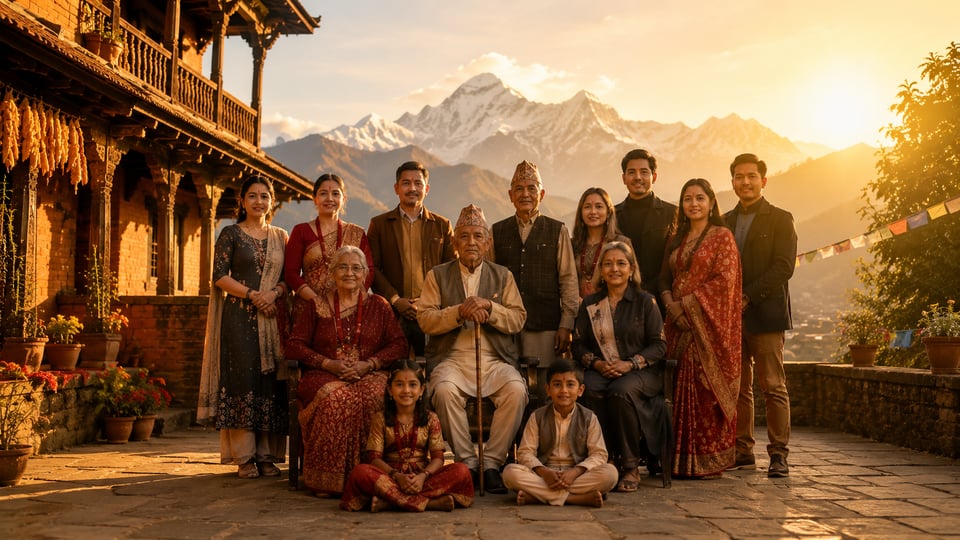
Preserve each child's distinct journey through Bamsawali without turning siblings or family branches into a ranking—especially when one visible victory has hidden another person's effort.
Shiva Purana, Rudra Samhita, Kumara Khanda 19–20, J. L. Shastri translation, for the marriage-priority contest.
Mango or fruit-of-knowledge forms are treated as later popular retellings unless tied to a separately named source.
Gotra
22 July 2026 · 13 min read
Gotra
21 July 2026 · 9 min read
Mythological
20 July 2026 · 5 min read
Mythological
15 July 2026 · 6 min read
Mythological
14 July 2026 · 4 min read
Mythological
13 July 2026 · 6 min read