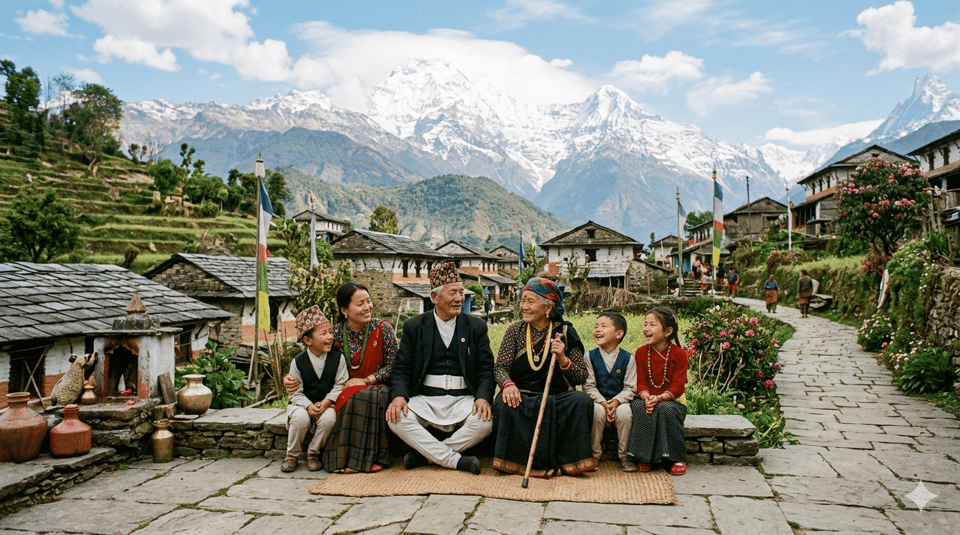
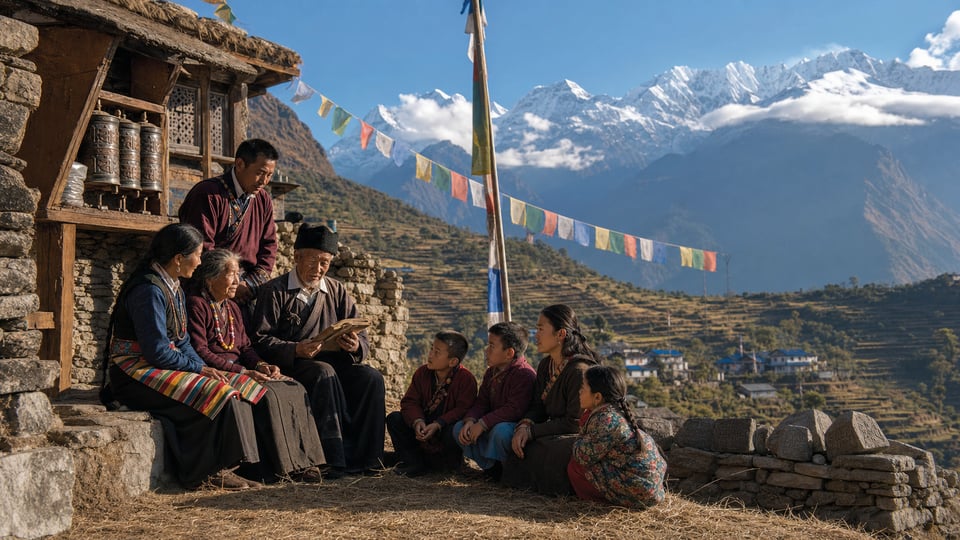
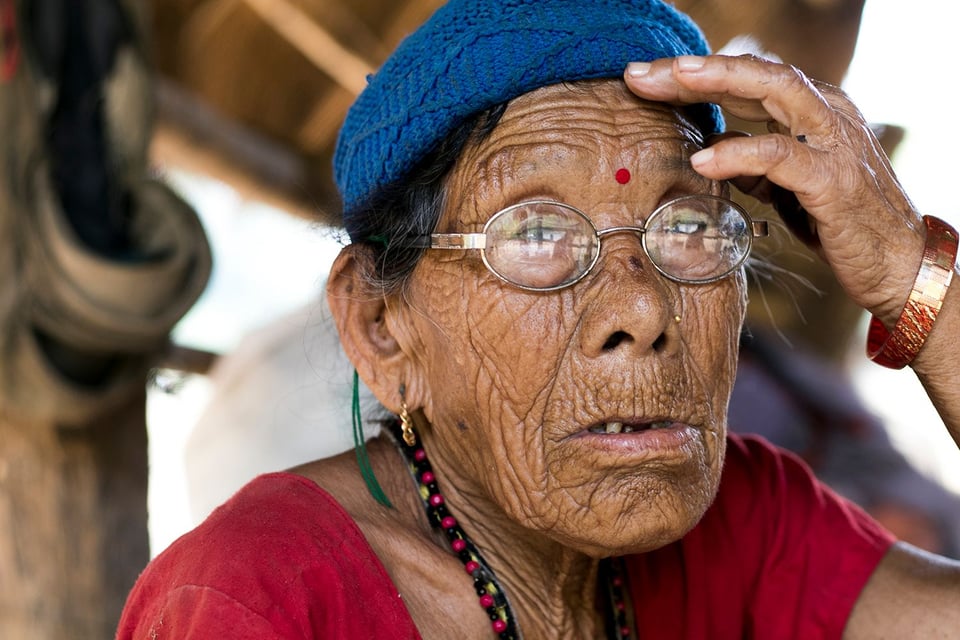
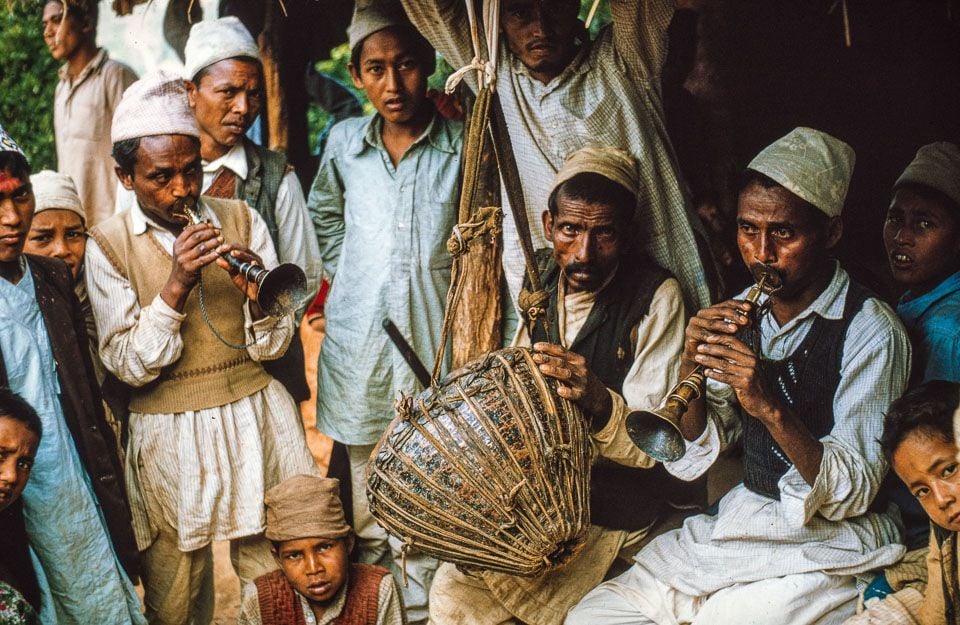
Discover the deep history of the Magar people Nepal's largest recognized indigenous nationality.
18 June 2026 · 16 min read
Did you know the Magar people may have been living in their homeland in Nepal since as far back as 2300 BCE making them among the oldest continuously documented inhabitants of the Himalayas?
Most of us know the Magar as one of Nepal's most prominent indigenous communities, celebrated for their martial courage and their deep presence in the Gurkha regiments that shaped world history. But behind the uniform, behind the khukuri, there lies a civilization of extraordinary antiquity a world of seven great clans, three distinct languages, shamanic priests older than written history, and a homeland so vast it once covered much of the mid-western hills of Nepal.
In Bamsawali's "Clan Journey" series, we are exploring the roots of Nepal's indigenous communities not just their surnames, but their clans, their social architecture, their origin stories, and the living traditions they carry into the modern world. Today, we travel deep into the world of the Magar also known by their own name, Mangar.
One thing should be said carefully at the beginning. Magar history is an ancient, orally transmitted, and regionally varied tradition. What is recorded here is based on ethnographic research, oral histories, comparative linguistics, and genealogical traditions. Different regions and different Magar communities preserve different details. This article presents the available knowledge with respect, without forcing any single narrative as the only truth.
Let us begin from the roots.
The Magar who call themselves Mangar in their own language are by population the third-largest ethnic group in Nepal and the largest among the country's 59 recognized indigenous nationalities. By some estimates, their population in Nepal and the diaspora exceeds two million.
Their homeland, known as Magarant, spans a broad and rugged sweep of Nepal's mid-western hills. In the traditional geographic imagination, Magarant is bounded roughly by the Trishuli River to the east, the Kali Gandaki to the west, the Chure ranges to the south, and the high Himalayan peaks to the north a world of forest ridges, river valleys, terraced fields, and high pastures.
But the Magar are not merely numerous. They are old. Genetic research and archaeological analysis have placed early Tibeto-Burman-speaking groups in the Nepal hills significantly before the Christian era. Some historians, drawing on both linguistic and material culture evidence, date the presence of proto-Magar groups in their homeland to around 2300 BCE nearly four and a half thousand years ago. If this estimate is even approximately correct, the Magar were living in these hills long before the ancestors of most modern South Asian kingdoms arrived on the scene.
Genetically, the Magar are Mongoloid related to the great Tibeto-Burman language family that stretches from Nepal through Tibet, through much of mainland Southeast Asia, and across the ranges of Yunnan. Their facial features, their physical build, their languages, and their oral traditions all point north and east, toward a common Tibetan-Himalayan root.
One of the most remarkable things about the Magar is that they speak not one but three distinct languages so different from one another that speakers of one cannot readily understand the others.
Spoken primarily in the eastern and southern parts of Magarant districts like Palpa, Gulmi, Baglung, Parbat, and Syangja. This is the most widely spoken Magar language and the one most often encountered in educational materials.
Spoken in the northern and western parts primarily in Rolpa, Rukum, Baglung, and Myagdi. Kham is linguistically distinct enough that it is sometimes considered a separate language rather than a dialect. The Kham Magar, who speak this language, represent a particularly archaic cultural layer of the Magar world.
Perhaps the most linguistically astonishing of the three. Kaike is spoken only by the Magar communities of Tichurong in the Dolpa district. Linguists who have studied Kaike note that it retains archaic features linking it to very early Bodish languages features that were lost in other related languages thousands of years ago. It is spoken nowhere else on earth.
This extraordinary linguistic diversity within a single community reflects two things. First, the great antiquity of the Magar people different communities diverged linguistically over thousands of years. Second, the vast geographic spread of Magarant Kham-speaking Magars in Rolpa and Kaike-speaking Magars in Dolpa lived in relatively isolated worlds, developing their languages independently over centuries.
When you speak with a Magar elder, you are speaking with a living descendant of a linguistic tradition older than most of the world's recorded languages.
Unlike some other Nepali indigenous communities where clan groups are hierarchically ranked, the traditional Magar clan system at its highest level is broadly egalitarian. There are seven major clans sometimes called "septs" in anthropological literature and all seven are considered socially equal. A Thapa Magar does not outrank a Gharti Magar. An Ale does not hold authority over a Pun. Inter-clan marriages are normal, common, and accepted.
This is itself a remarkable cultural feature. In many neighboring communities, marriage and social rank are tightly controlled by hierarchical clan divisions. Among the Magar, the seven-clan system is a regulator of kinship and identity, not of social superiority.
The seven major clans are:
Among the most widespread of all Magar clans, the Thapa are historically associated with military leadership and local governance. In the pre-unification era, Magar Thapas held roles as chiefs, commanders, and administrators in the loose confederations that governed Magarant. They were the warriors and rulers of the local political world.
The Thapa clan is further subdivided into major sub-clans including Sinjali, Makkim, and Sunari, each of which maintains its own lineage identity and kinship reckoning. A Thapa Sinjali and a Thapa Makkim, while sharing the same top-level clan identity, maintain distinct social identities at the sub-clan level.
One of the most historically significant aspects of the Thapa clan name is the way it appears across community boundaries. The name "Thapa" exists in both the Magar and Chhetri (Kshatriya) traditions, bearing witness to centuries of political entanglement, intermarriage, and cultural exchange between Nepal's indigenous communities and the Hindu kingdoms that expanded across the hills.
A clan concentrated primarily in the southern and western parts of Magarant, the Magar Rana are considered among the oldest lineages of the community. Like the Thapa, the Rana name appears across both Magar and Chhetri traditions a reminder of the complex, centuries-long relationship between indigenous clan systems and the expanding influence of Khas and Shah kingdoms.
The Rana sub-clans have particular strength in districts like Palpa, Gulmi, and Arghakhanchi. They are Dhut-speaking communities who have maintained their cultural traditions alongside participation in the broader economic and political life of Nepal.
Predominantly found in the southern parts of Magarant particularly in Palpa, Gulmi, and Syangja the Ale are considered by some historians to be among the most culturally "core" Magar clans, in the sense that they have maintained the oldest features of Magar social practice. The Ale lineage is closely associated with Magarkura (Dhut) speaking communities and has a strong cultural presence in the Gandaki hills.
A northern Magarant clan, the Pun are primarily associated with the Kham Magar cultural zone the Khamkura-speaking communities of Rolpa, Rukum, and adjacent districts. Pun Magars are among the communities that retained the most archaic forms of Magar shamanism and animist religious practice. They had extensive historical contact with the Tamang and Gurung zones to the north and east.
The Pun sub-clans are numerous, reflecting the great spread of Pun communities across the northern hills. Among the Kham Magar Puns, oral traditions describe ancient migrations from an icy northern homeland oral histories that some scholars link to a memory of the proto-Tibetan world that existed before the expansion of Tibetan kingdoms around 600 CE.
Found primarily in the Baglung region and adjoining areas, the Roka clan was historically among the Magar clans. Nineteenth-century colonial-era records sometimes raised questions about whether the Roka were "original" Magars a debate that modern Magar scholars and community leaders have firmly resolved in the affirmative. Today the Roka are universally recognized as a full Magar clan, participating in normal inter-clan marriages and sharing cultural practices with the other six.
A clan whose very name means "elder" or "ancient" the Budha are Khamkura-speaking communities of the northern Magarant, sharing the archaic cultural layer of the Kham Magar world. Their traditions preserve some of the oldest shamanic and animist practices in the Magar universe.
The Budhathoki form of the name is more common in southerly communities a linguistic evolution that reflects the long process of interaction between northern and southern Magarant. Despite the different names, Budha and Budhathoki are understood as branches of the same ancestral root.
The seventh of the great Magar clans, Gharti are primarily northern Kham Magar communities. Each Kham Magar clan including Gharti is associated with a geographic Bapsa: a "place of belonging," a specific ancient landscape from which the clan traces its origin. This concept of Bapsa ancestral homeland embedded in the clan identity is one of the most beautiful and distinctive features of the Kham Magar world. It says: we are not just related by blood; we are also related by ground.
The anthropologist John Hitchcock, who conducted landmark fieldwork among the Magar in the 1960s, proposed one of the most influential theories about the tribe's internal diversity: that the Magar represent two distinct streams of Mongoloid migration into the Nepal hills from the north and from the east.
This theory aligns beautifully with the observable cultural differences within Magar society:
Includes clans like Ale, Rana, Thapa, and Budhathoki, concentrated in the southern and eastern parts of Magarant. These communities speak Dhut/Magarkura and have been in more prolonged contact with Indo-Aryan cultures to the south. Their social practices show greater absorption of Hindu ritual elements while retaining their core Magar identity.
Includes clans like Pun, Gharti, Bura, and Roka, concentrated in the northern hills of Rolpa, Rukum, Myagdi, and Baglung. These communities speak Kham and preserve a strikingly more archaic cultural layer one that predates Buddhism's arrival in the hills and retains elements of an older shamanic and nature-worship tradition.
The Kham Magars of Rolpa and Rukum are particularly fascinating in this regard. Their oral traditions transmitted through the Bon-influenced shamanic practice of their priests describe a migration from an icy northern homeland. Some scholars link this to a possible memory of the Kham region of Tibet, or to early proto-Tibetan cultures that were disrupted by glacial advances or political upheaval around 200 CE. After this displacement, the northern stream moved through the Karnali zone and settled the western hill districts of what is now Nepal.
Whether or not these exact migration histories can be archaeologically verified, the cultural evidence is undeniable: the Kham Magar world represents a profoundly archaic layer of Himalayan civilization.
Long before Nepal became a unified state, the Magar people governed themselves through a loose confederation of local chieftaincies across Magarant. Magar Thapas, Ranas, and other clan leaders held authority over specific territories administering justice, managing pasture and forest rights, leading military forces, and maintaining ritual relationships with their ancestral lands.
This political order was not centralized in the way of the great lowland kingdoms. It was a network of autonomous communities, related by kinship, regulated by clan law, and connected by trade routes that threaded through the mountain passes. The Magar had no single king of Magarant, but they had thousands of local authorities who knew their land and their lineage.
The Khas kingdoms that expanded across the western hills in the twelfth and thirteenth centuries came into contact with and eventually absorbed Magar territories. The expansion of Gorkha in the eighteenth century completed this political transformation. When Prithvi Narayan Shah unified Nepal in 1768, he did so in part through alliances with Magar commanders and soldiers. The Magar were among the very first communities recruited into what would become the Gurkha regiments not as outsiders brought in to serve, but as people who had already been warriors in their own right for centuries.
The British later formalized this in their famous "Martial Races" doctrine, listing the Magar among the prime communities for Gurkha recruitment. This military heritage continues to define the Magar's presence in world history with Magar soldiers serving in the armies of Britain, India, Singapore, and Brunei, earning some of the highest military honors in the world.
Before Buddhism arrived in the Nepal hills and in many communities, still today the Magar religious world was a universe of shamanism, animism, and ancestor worship.
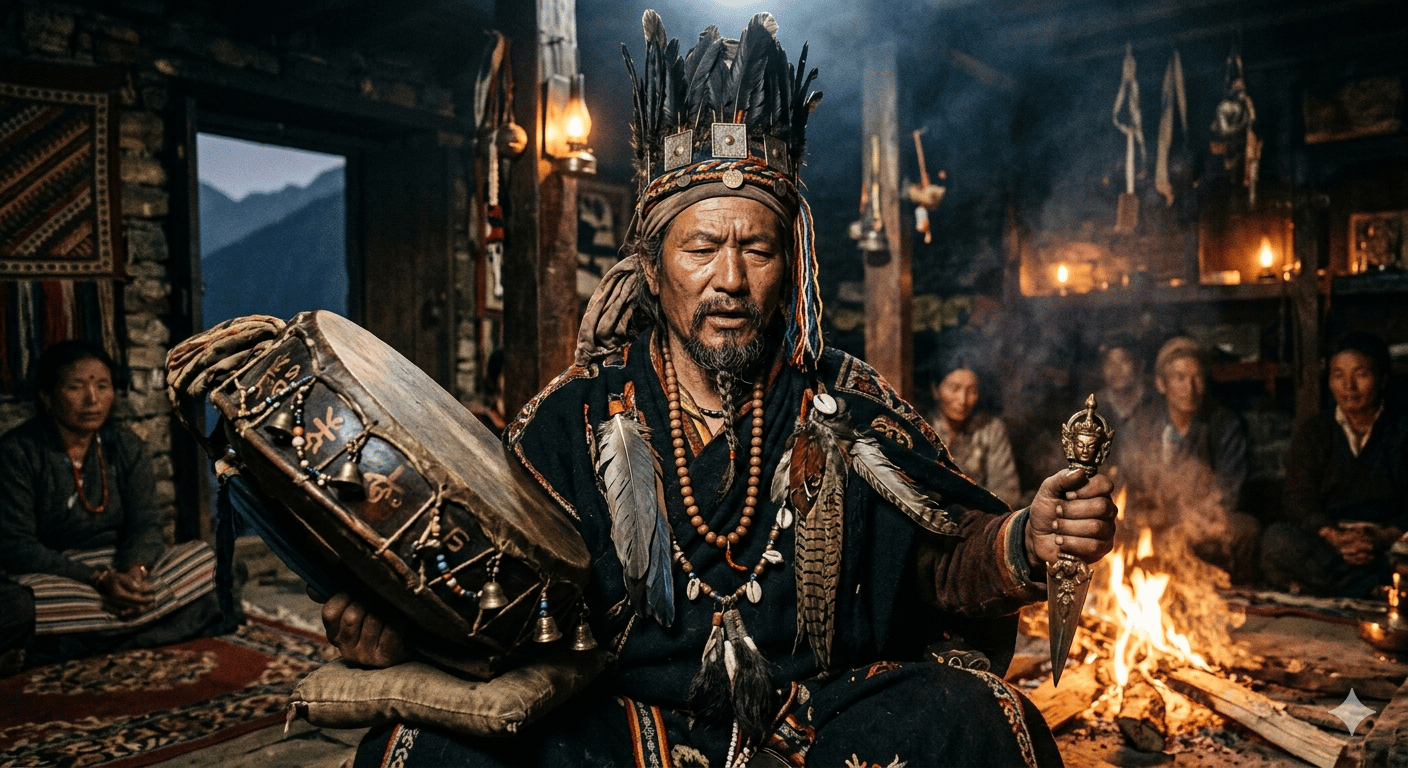
The Magar shamanic tradition centers on the Bon-po (sometimes called Ramite or Karmite in different regions) a ritual specialist who mediates between the living world and the world of spirits, ancestors, and natural forces. The Bon-po tradition in the Kham Magar world predates the arrival of Tibetan Buddhism by centuries, preserving ritual elements that have now vanished from most of the Himalayan world.
The spirits of the Magar cosmos include ancestor spirits (phekpe), nature spirits associated with rivers, mountains, and forests, and powerful deities connected with clan identity and territory. Clan-specific deities and clan-specific ritual obligations are a core part of Magar religious life meaning that your clan membership shapes not just your marriage options but your relationship with the sacred.
In recent centuries, many Magar communities particularly in southern Magarant have adopted Hindu practices or become Buddhists. Some have converted to Christianity. This religious diversity within the community reflects their long history of contact with multiple cultural worlds. But in the Kham Magar heartland of Rolpa and Rukum, the ancient shamanic traditions remain most alive.
When a Magar introduces themselves in a traditional context, they do not give just a name and a surname. They give a double identity: clan section and sub-clan lineage.
A man might say: "I am a Thapa Sinjali Magar."
His clan section is Thapa. His sub-clan is Sinjali. This double identity matters because sub-clan names sometimes appear across different clan sections. A "Ramjali Pun" and a "Ramjali Gharti" share a sub-clan name Ramjali but belong to entirely different clan sections and are therefore not considered close kin by that sub-clan identity alone.
This system of dual identification reflects the complexity of Magar genealogical reckoning. It is not enough to know someone's top-level clan; you need to know their sub-clan to understand their ritual obligations, their kinship network, and their ancestral geography.
Among sub-clans, lineage solidarity is expressed through shared birth and death pollution periods. When a member of your lineage is born or dies, all members of that lineage typically observe a period of ritual impurity traditionally eleven days during which they cannot participate in religious ceremonies. This shared ritual life is the living heartbeat of Magar kinship. It makes abstract genealogical connection into a felt, daily reality.
The Magar contribution to Nepali history goes far beyond military service though that contribution alone would be extraordinary.
In governance: Before unification, Magar Thapa and Rana chiefs governed significant territories in Magarant. They were not subjects of a unified Nepal; they were independent rulers of their own lands.
In resistance: The people of Rolpa and Rukum predominantly Kham Magar communities have a long history of resistance against both external domination and internal marginalization. This history contributed to the dynamics that made these districts central to the Maoist conflict of the 1990s and 2000s, which itself reshaped the political landscape of modern Nepal.
In culture: The Magar have produced a rich tradition of music, dance, oral poetry, shamanic literature, and material culture. The Kauda dance, the Jhyauree songs, the distinctive dress styles of different Magarant regions, the architecture of the mountain villages all expressions of a civilization that developed over millennia.
In genetics: The Magar carry genetic markers of deep antiquity in the Nepal hills haplogroups that suggest their ancestors were among the very first Tibeto-Burman speakers to settle the middle Himalayas. They are, in the most literal genetic sense, among the oldest Nepalis.
The clan histories of the Magar are under pressure. Urbanization is pulling young Magar away from their ancestral villages. The Kham Magar shamanic traditions require years of apprenticeship that fewer young people are choosing to undertake. The three Magar languages particularly Kaike, spoken by only a few thousand people are endangered. Sub-clan names, ancestral village identities, and the stories that explain the Bapsa of each clan are slowly being lost as the generation that carries them ages.
This loss matters beyond the Magar community itself. Every Magar oral tradition that disappears takes with it a window into a world that existed thousands of years ago a record of human civilization, migration, ecology, and spiritual life that cannot be reconstructed from any other source.
The work of Magar cultural organizations, Magar language activists, and individual families who still conduct clan rituals and tell clan stories is therefore among the most important cultural preservation work happening in Nepal today.
Take Action: Sit with your elders. Ask them: which sub clan do we belong to? What is our Bapsa? How far has our lineage spread? The answers are part of Nepal's oldest living history.
At Bamsawali, we believe that every family's genealogy is a piece of this larger story. Knowing your clan, your sub-clan, your ancestral Bapsa, and the migration routes your ancestors traveled is not just personal heritage it is a contribution to the collective memory of a people.
Share this article with your family. Your clan carries a story four thousand years in the making. Let us write it together.
The Magar have seven major clans (septs): Thapa, Rana, Ale, Pun, Roka/Rokaya, Budha/Budhathoki, and Gharti. All seven are considered socially equal unlike some other communities where clans are ranked hierarchically.
The Magar speak three distinct languages: Dhut (eastern/southern Magarant), Kham (northern/western Magarant), and Kaike (Dolpa district). These are all Tibeto-Burman languages but differ so much they are largely mutually unintelligible.
Bapsa is the Kham Magar concept of a clan's ancestral homeland a specific place from which the clan's founding ancestors came and to which the clan maintains a spiritual and identity connection. Each Kham Magar clan section has its own Bapsa.
The name "Thapa" appears in both Magar and Chhetri communities. While this reflects centuries of coexistence and cultural exchange in western Nepal, they are genealogically distinct communities. Sharing a name does not necessarily mean sharing a common ancestor.
The Kham Magar are northern Magar communities primarily in Rolpa and Rukum who speak the Kham language. They represent one of the most archaic cultural layers of the Magar world, preserving shamanic traditions, animist cosmology, and a concept of clan-linked ancestral geography (Bapsa) that predates both Buddhism and Hinduism in the hills.
Mangar is the name the Magar use for themselves in their own language. "Magar" is the Nepali/outside-world rendering of the same name. Both refer to the same people and community.
Based on linguistic and material culture evidence, historians estimate proto-Magar groups were present in their homeland as early as 2300 BCE making them among the oldest continuously documented inhabitants of the Himalayan hills. Genetic research supports this deep antiquity.
See its gotra, kuldevata, origin and the other surnames that share its gotra.
Clan Journey
19 June 2026 · 13 min read
Ethnic Groups
17 June 2026 · 12 min read
Ethnic Groups
19 June 2026 · 7 min read
Ethnic Groups
19 June 2026 · 7 min read
Gotra
22 July 2026 · 13 min read
Gotra
21 July 2026 · 9 min read