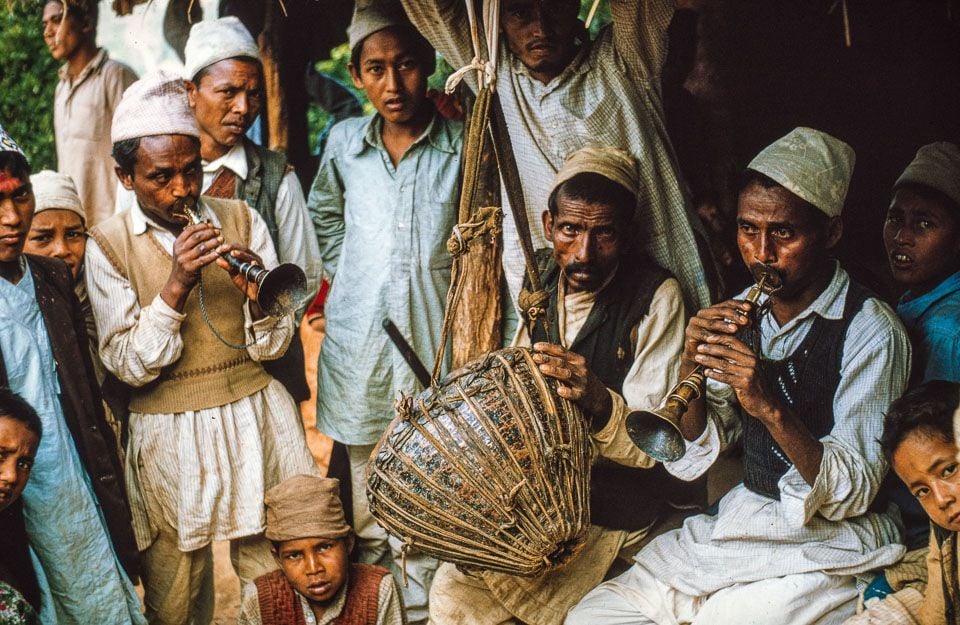
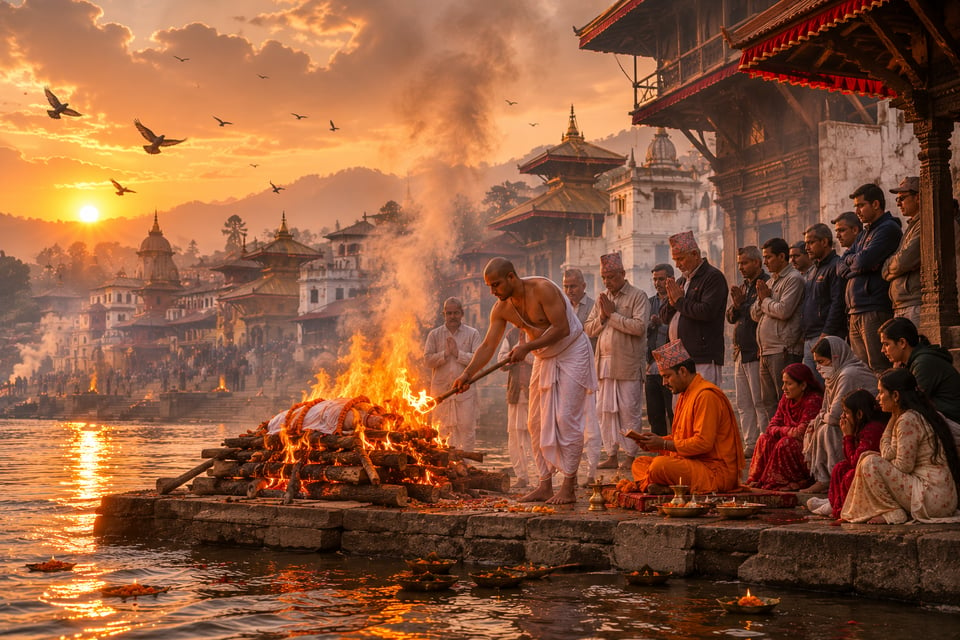
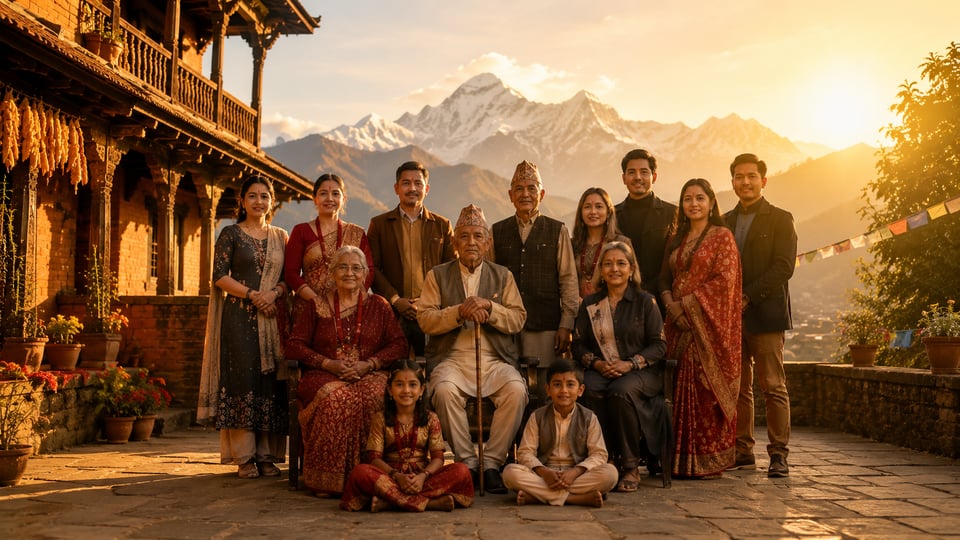
Explore the complete history of the Gurung (Tamu) people their Char Jat and Sorah Jat clan system, royal Ghale lineage, Pachyu shamanism, and Annapurna homeland.
19 June 2026 · 13 min read
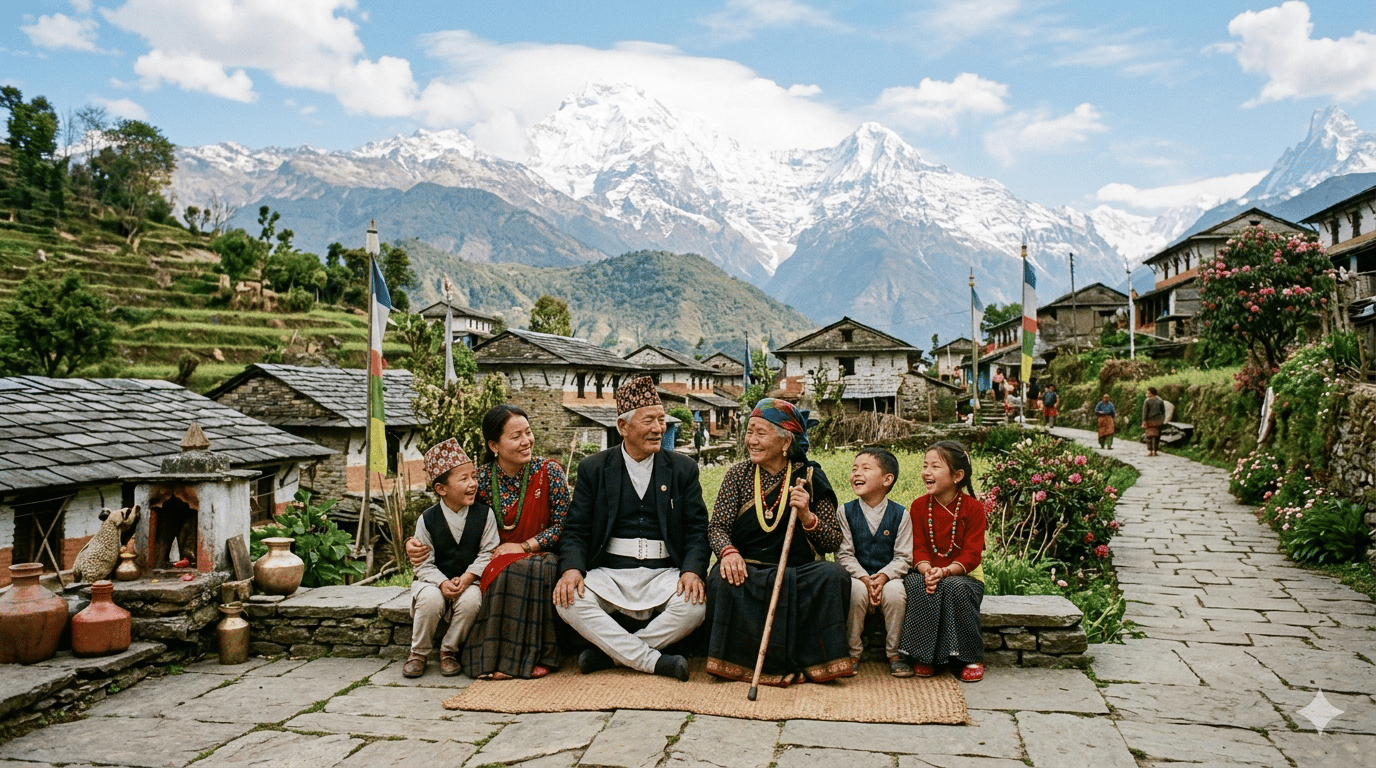
Did you know that the Gurung people had their own independent kingdom in the highlands of Nepal ruled by the Ghale royal clan long before the Shah dynasty unified the country?
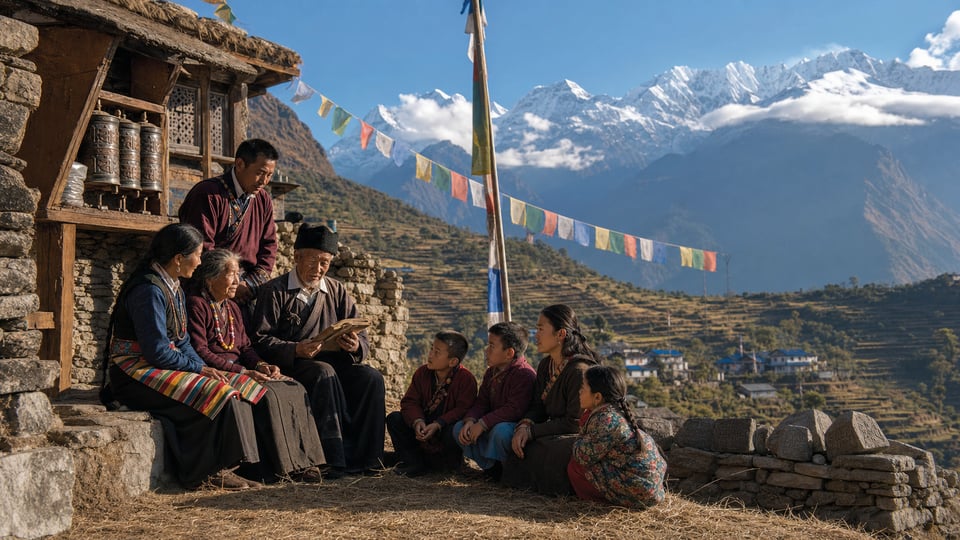
The Gurung, who call themselves Tamu (तमु), are one of Nepal's most storied and culturally rich indigenous communities. Their homeland stretches across the Annapurna and Dhaulagiri regions of Gandaki Province the cloud-laced highlands above the Modi and Madi rivers, where villages like Ghandruk, Sikles, and Ghachok still keep traditions alive that reach back centuries before written Nepali history began.
In Bamsawali's "Clan Journey" series, we explore the roots of Nepal's indigenous communities not just their surnames but their social architecture, their origin stories, and the living traditions they carry. This journey is about the Gurung (Tamu) people.
One thing should be said carefully at the beginning. Gurung history comes through oral tradition, genealogical memory, ritual practice, and a growing body of ethnographic research. Different Gurung communities and scholars preserve different accounts of clan origins and hierarchy. This article presents the available knowledge with respect, without declaring any single account the only truth.
Let us begin from the roots.
The Gurung Tamu in their own language are a Tibeto-Burman people of Mongoloid origin whose ancestral territory lies primarily in the Gandaki Province of Nepal. They inhabit the high-altitude villages of the Annapurna massif: Ghandruk (the cultural capital of Gurung identity), Siklis (one of Nepal's most culturally intact Gurung villages), Ghachok, Barpak, Khoplang, Taprang, and dozens of other mountain settlements perched above the gorges and glaciers.
Linguistically, the Tamu belong to the Tibeto-Burman family, speaking Tamu Khī (also called Gurung language) a language with several dialects depending on elevation and geographic location. Higher-altitude communities like Barpak (above 2,000 meters) speak a form noticeably different from the lowland Gurung villages, reflecting centuries of relative isolation in different microclimates.
Genetic and oral evidence points to a migration from the Tibetan plateau most likely between 500 and 1000 CE during which proto-Gurung groups descended through the highland passes and settled the Annapurna and Dhaulagiri ranges. They were not the first people in these hills, but their culture took hold deeply and durably, creating the distinctive Tamu civilization that exists today.
By population, the Gurung number around 500,000 in Nepal, with significant diaspora communities in India (Darjeeling, Sikkim), Bhutan, the United Kingdom, Hong Kong, and elsewhere. Their global presence is in large part the result of their extraordinary military service in the British and Indian Gurkha regiments where Gurung soldiers have won six Victoria Crosses, the highest military honor in the Commonwealth.
Before understanding the Gurung clan system, one must understand the spiritual world that gave the clans their meaning.
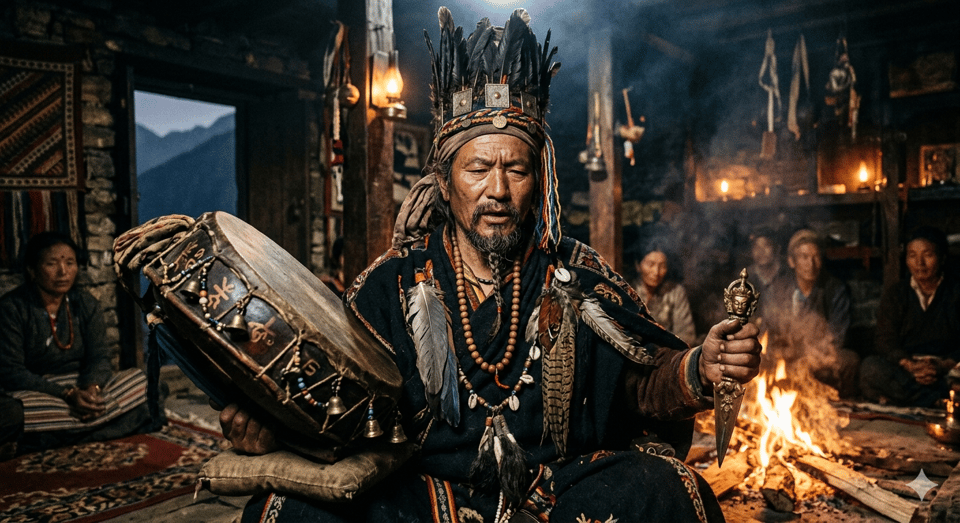
The Gurung traditional religious world is presided over by two distinct types of shamanic priests: the Pachyu and the Kle-bri (also spelled Klehbree or Ghyabri). These are not Buddhist lamas, though Buddhism has been present among the Gurung for many centuries. The Pachyu and Kle-bri predate Buddhism in the Gurung world and represent one of the oldest surviving Bon shamanic traditions in the entire Himalayan region.
The Pachyu are generally associated with "white" or benevolent ritual conducting ceremonies for birth, prosperity, health, and the blessing of the living. They recite ancient oral texts called pye a vast body of oral literature that encodes clan genealogies, origin myths, cosmological knowledge, and ritual prescriptions. These pye texts, which can take many hours or even days to recite in full, are the living archives of Gurung civilization.
The Kle-bri are associated with death ritual. When a Gurung person dies, it is the Kle-bri who guides the soul on its journey reciting the path the spirit must take through the afterlife landscape, naming the obstacles it will encounter, and opening the way forward. This ritual, known as the Pae ceremony, is one of the most complex and beautiful death rites in the Himalayan world.
Both Pachyu and Kle-bri traditions are transmitted hereditarily from teacher to apprentice, often within specific clan lines. The Lama clan (Tamu: Lam) has historically been the primary custodian of these priestly traditions. A Lama clan elder who has completed the full apprenticeship is therefore not just a person with a clan identity but a living library of Gurung knowledge.
The most fundamental social division in Gurung society is between two large groups called moieties (halves): the Char Jat (चार जात, "four clans") and the Sorah Jat (सोह्र जात, "sixteen clans").
Every Gurung person belongs to one or the other. The moiety you belong to determines:
Who you can marry you must marry someone from the other moiety
Your relative status in traditional ceremony
Your ritual role in community events
How your death is handled which type of priest is most appropriate
This moiety system two large exogamous groups between which all marriage must take place is one of the most elegant social technologies for regulating kinship in a relatively small community. It ensures genetic diversity, creates alliances between families, and gives every wedding a structural meaning within the larger community.
The traditional view holds that the Char Jat are of higher status than the Sorah Jat. This hierarchy has a mythological explanation: in the Gurung origin story, different groups were fathered by ancestors of different social standing a Chhetri prince, a Brahmin priest, and a bondsman creating a built-in hierarchy. However, many modern Gurung scholars and community leaders argue forcefully that this hierarchy story was a later imposition by Indo-Aryan kingdoms seeking to map Gurung society onto the Hindu varna framework. In the pre-contact Tamu world, this hierarchy may not have existed in the same form.
Regardless of which account one accepts, the moiety system continues to function as a regulator of marriage and social identity across the entire Gurung world.
The Char Jat consists of four clans, each with a Nepali name and a Tamu (Gurung language) name:
The Ghale are the royal clan of the Gurung world. The kings of the pre-unification Gurung highland kingdom were Ghales. The Ghale Raj the Gurung kingdom ruled over a significant territory in the Gandaki hills before it was absorbed by neighboring principalities in the fifteenth century and ultimately by the Gorkha kingdom in the eighteenth.
The Ghale maintained the highest hereditary status in traditional Gurung society. Some Ghale lineages still observe extraordinarily strict customs around clan purity and genealogical memory a living inheritance from the days when the Ghale were not just a clan but a ruling house. Even today, the name Ghale carries a particular weight in Gurung communities, evoking the memory of an independent highland kingdom.
The word Kle in Tamu is also connected with the Kle-bri priesthood suggesting that the Ghale/Kle lineage has deep roots in the original ritual and governing order of Tamu society.
The Lama clan is the priestly clan of Gurung society. In Tamu tradition, the Lam lineage is the primary custodian of the Pachyu and Kle-bri shamanic traditions. This should not be confused with the Tibetan Buddhist title "lama" the Tamu Lama is a distinct indigenous clan identity that predates Buddhism's influence in the Gurung world.
The Lama clan is further divided into important sub-branches:
Meghi Lam associated with specific ritual territories
Pangi Lam priesthood lineages of the Pangi region
Krogi Lam a branch connected with particular ceremonial roles
Fiuro Lam another sub-lineage of the Lama priestly tradition
Each of these sub-branches preserves slightly different versions of the ritual texts and has historical connections to specific villages or geographic areas.
The Ghotane Kon in Tamu are the administrator clan. In the Gurung kingdom, the Kon clansmen served as chief administrators and village headmen (mukhiya) to the Ghale kings. They managed the distribution of resources, the administration of justice, the maintenance of land records, and the coordination of communal labor without assuming the royal seat itself.
This functional division Ghale as royalty, Lama as priests, Ghotane as administrators reflects an elegant pre-modern governance structure: a separation of political, spiritual, and administrative authority embedded within the clan system itself.
The Lamichhane Lem in Tamu are the fourth of the noble clans. The Lem lineage has historically been associated with supporting roles in both religious and civic life. Some accounts connect the Lamichhane with specific ritual responsibilities and with the original confederacy of Tamu highland chiefs the group of clan leaders who, in the early period of Gurung settlement, established the social order that still structures the community today.
The Sorah Jat literally "sixteen clans" forms the second, larger moiety of Gurung society. Despite the name, the number is not strictly literal; it refers to the broader category of Gurung clans that fall outside the four noble lineages.
The Sorah Jat include many well-known clan names including Gurung (the most common Sorah Jat clan name, also used as the ethnic group name), Tamu, Khati, Rong (found primarily in the Lamjung region), Singjali, Dorje (reflecting Buddhist influence in the naming tradition), and many more with regional variants and sub-clans extending the list.
The distinction between Char Jat and Sorah Jat historically regulated marriage: Char Jat and Sorah Jat were not supposed to intermarry. In practice, this prohibition has weakened in many communities, particularly in urban settings. But in traditional villages like Ghandruk and Siklis, awareness of which moiety one belongs to remains important in marriage negotiations.
The Gurung marriage system is one of the most distinctive in Nepal. Two rules define it:
You cannot marry within your own clan. This is the universal rule across both Char Jat and Sorah Jat. A Ghale man cannot marry a Ghale woman. This rule is enforced firmly violations were historically a matter of community sanction.
Uniquely among Nepal's major communities, the Gurung traditionally practice and encourage cross-cousin marriage. A man may marry his maternal uncle's daughter (mama's chori), and a woman may marry her paternal aunt's son (phupu's choro). These were not just acceptable in traditional Gurung culture, they were preferred.
The logic is elegant: if your father's sister married into another family, then her son from that family is from a different clan (not your father's clan), making him or her a valid marriage partner. This system creates dense networks of reciprocal kinship between families alliances reinforced and renewed across generations through marriage.
Among the most significant and least widely known aspects of Gurung history is the existence of their own kingdom before unification.
The Ghale Raj (Gurung kingdom) controlled a significant area of the central hills. The Ghale kings governed from settlements in what is now the Lamjung-Gorkha highland zone, maintaining their own political authority, their own revenue systems, and their own military forces.
Around the fifteenth century, the expanding power of neighboring principalities began to encroach on Ghale territory. The Gorkha kingdom absorbed Gurung territories in the eighteenth century. When this happened, the Gurung did not simply disappear as a political force. Instead, they became one of the most important military allies of the new unified Nepal.
Six Victoria Crosses the highest military honor in the British Commonwealth have been awarded to Gurung soldiers, including Lachhiman Gurung, who famously defended his trench alone against hundreds of Japanese soldiers in Burma in 1945. This military tradition is inseparable from the clan identity that shaped the Gurung for centuries before the British ever arrived.
The Gurung community today faces the same pressures of modernization that challenge all of Nepal's indigenous communities.
Tamu Khī (the Gurung language) is spoken natively by fewer and fewer young people
The apprenticeship traditions of the Pachyu and Kle-bri require years of dedicated learning difficult to pursue alongside modern education and economic pressures
Many of the pye oral texts that encode Gurung cosmological knowledge and clan history have never been written down
Organizations like the Tamu Dhi (the national Gurung organization) and cultural preservation groups in Ghandruk and other traditional villages are working to document pye texts, teach Tamu Khī, and maintain the ritual traditions that make Gurung identity distinctive. This work is essential not just for the Gurung, but for the preservation of one of the world's truly irreplaceable Himalayan traditions.
When a Gurung elder invokes the Char Jat at a wedding ceremony, or a Pachyu priest recites the pye that traces a family's clan line back to the ancestors of the Tibetan highland, they are reading from a text written not in ink but in kinship itself.
Understanding your Gurung clan means understanding which moiety you belong to and therefore who you can marry, which ritual specialists are most appropriate for your ceremonies, what origin story your family carries, and how your family fits into the wider social web of the Gurung community.
Take Action: Ask the elders in your family: which Jat do we belong to Char or Sorah? Which clan? Do we know our ancestral village? The answers connect you to a world that was old when Nepal was young.
At Bamsawali, we believe that preserving these genealogical and clan histories is one of the most important things we can help families do. A digital family tree that maps clan membership, ancestral villages, migration routes, and kinship links is not just a personal record it is a contribution to the living heritage of a community.
Share this article with your family. Your clan carries a story. Let us write it together.
Char Jat refers to the four noble/priestly clans: Ghale, Lama, Ghotane, and Lamichhane. Sorah Jat refers to the sixteen broader clans. They are the two main moieties of Gurung society, and marriage was traditionally required to take place between the two groups, not within either one.
The Ghale were the royal clan of the Gurung the kings of the pre-unification Gurung kingdom known as the Ghale Raj. They held the highest hereditary status in traditional Gurung society, and some lineages still maintain strict customs around genealogical memory.
In Gurung tradition, a man may marry his maternal uncle's daughter and a woman may marry her paternal aunt's son. These cross-cousin marriages were not just allowed they were traditionally preferred, creating dense reciprocal kinship alliances between families across generations.
The Pachyu conduct ceremonies for the living birth, health, and prosperity. The Kle-bri conduct death rituals, guiding the soul through the afterlife. Both are shamanic traditions that predate Buddhism in the Gurung world and are transmitted hereditarily, primarily within the Lama clan.
No. The Gurung Lama clan (Tamu: Lam) is a distinct indigenous clan identity that predates Tibetan Buddhism's influence in the Gurung world. The clan name happens to be phonetically similar to the Tibetan Buddhist honorific but the two are historically and culturally separate.
The Ghale Raj was the pre-unification Gurung highland kingdom, ruled by the Ghale royal clan in the Gandaki hills of central Nepal. It existed long before Prithvi Narayan Shah unified Nepal, and was ultimately absorbed by the Gorkha kingdom in the eighteenth century.
Tamu Khī is the name the Gurung use for their own language in Tamu (the Gurung self-designation). It is a Tibeto-Burman language with several dialects depending on altitude and location. The language is considered endangered, with fewer young people speaking it as a mother tongue today.
See its gotra, kuldevata, origin and the other surnames that share its gotra.
Ethnic Groups
18 June 2026 · 16 min read
Ethnic Groups
17 June 2026 · 12 min read
Ethnic Groups
19 June 2026 · 7 min read
Ethnic Groups
19 June 2026 · 7 min read
Gotra
22 July 2026 · 13 min read
Gotra
21 July 2026 · 9 min read